
 Post by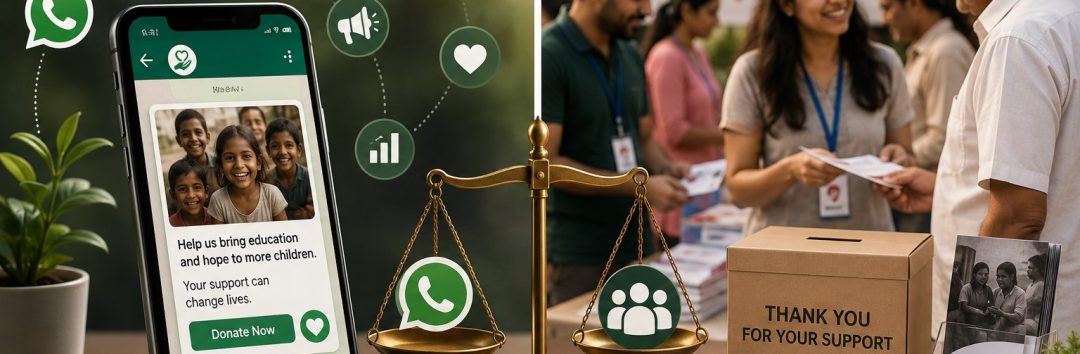
Introduction
Fundraising has always depended on relationships, trust, and clear communication. What has changed is the way charitable organisations can reach and stay connected with supporters.
Traditional charity fundraising methods such as donation events, fundraising drives, printed appeals, phone calls, community meetings, and face-to-face campaigns still play an important role. At the same time, WhatsApp has become a practical communication channel for many NGOs, charitable trusts, community organisations, and welfare initiatives.
For a fundraising team, the question is not simply whether WhatsApp fundraising is better than traditional charity fundraising. The more useful question is: Which approach is suitable for a particular donor group, campaign, and welfare objective?
A community organisation collecting emergency support may need to communicate with donors quickly. A charitable trust organising a large fundraising event may benefit more from personal invitations and offline engagement. In many cases, the strongest approach combines both traditional relationship-building and digital communication.
This article compares WhatsApp fundraising with traditional charity fundraising, explains the strengths and limitations of each approach, and offers practical guidance for organisations that want to build a more organised fundraising process.
What Is WhatsApp Fundraising?
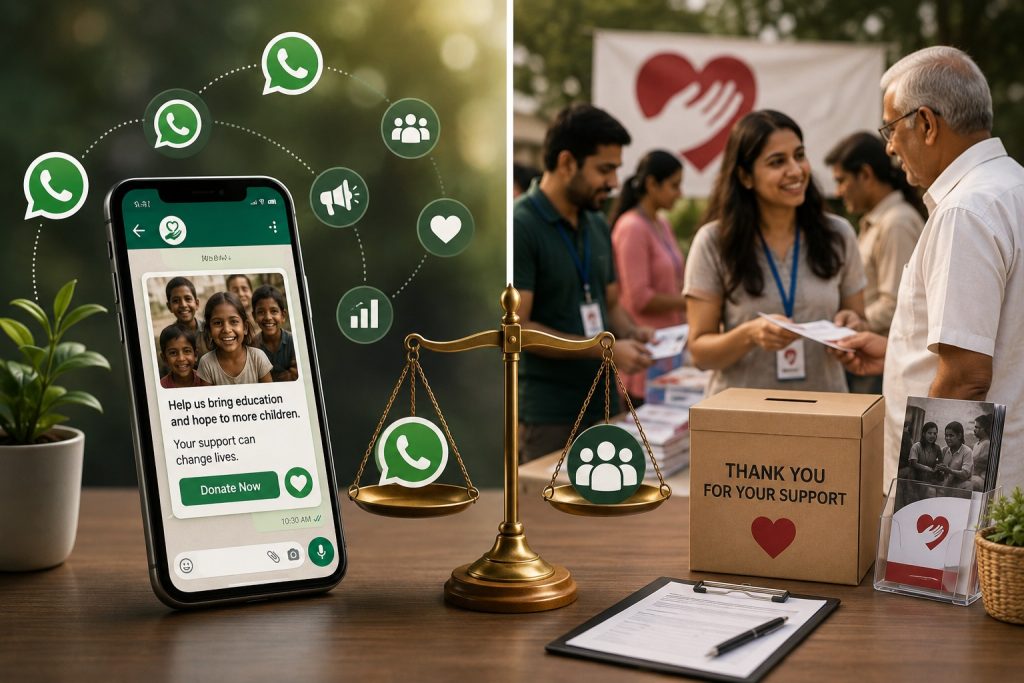
WhatsApp fundraising is the use of WhatsApp as a communication channel to engage supporters, share fundraising appeals, provide updates, answer questions, and guide people toward making contributions.
For charities and NGOs, WhatsApp can make communication feel more direct and personal because supporters can receive messages through a platform they may already use regularly.
A fundraising campaign may use WhatsApp to:
- Share information about a welfare need or project
- Send a fundraising appeal to existing supporters
- Provide donation instructions or a contribution link
- Share campaign updates
- Answer donor questions
- Send reminders when appropriate
- Thank contributors
- Share information about how funds are being used
- Keep supporters informed about project progress
However, WhatsApp itself should not be treated as the entire fundraising system. Messages and conversations are only one part of the process. An organisation still needs a structured way to manage donor information, contributions, funds, projects, communication, and reporting.
What Is Traditional Charity Fundraising?
Traditional charity fundraising refers to established methods of raising support through direct, offline, and relationship-based activities such as events, personal outreach, community campaigns, printed appeals, meetings, and telephone communication.
Examples include:
- Charity events
- Fundraising dinners
- Community collection drives
- Face-to-face donor meetings
- Telephone fundraising
- Printed donation appeals
- Collection boxes, where appropriate
- Local awareness campaigns
- Fundraising through community networks
- Personal introductions and referrals
Traditional fundraising often gives organisations more opportunities for personal interaction. A donor may meet the people behind a project, ask questions directly, and develop a deeper connection with the organisation’s work.
For some charities, particularly those with strong local or community relationships, this personal connection remains extremely valuable.
WhatsApp Fundraising vs Traditional Fundraising: The Main Difference
The biggest difference is usually how quickly and directly an organisation can communicate with supporters.
WhatsApp can support fast, ongoing, digital communication. Traditional fundraising often focuses more heavily on personal interaction and physical activities.
Area | WhatsApp Fundraising | Traditional Charity Fundraising |
Communication speed | Can be fast and immediate | May require more planning |
Personal interaction | Direct messaging, but digital | Strong face-to-face interaction |
Geographic reach | Can reach supporters across locations | Often stronger within physical networks |
Campaign updates | Easier to send regularly | May require calls, meetings, or printed communication |
Relationship building | Useful for ongoing engagement | Strong for deeper personal relationships |
Event dependence | Less dependent on physical events | Often linked to meetings or events |
Operational effort | Can reduce some communication effort | May require more physical coordination |
Record management | Still requires organised systems | Still requires organised systems |
Best use | Updates, follow-ups, appeals, engagement | Events, meetings, trust-building, community outreach |
The comparison is not about replacing one method completely with the other. Each method serves different purposes.
Why Are Charities Increasingly Using WhatsApp for Fundraising Communication?
Charities may use WhatsApp because it allows them to communicate quickly and maintain more regular contact with supporters without organising a physical meeting for every interaction.
Fundraising is often affected by communication gaps. A potential donor may want more information before contributing. An existing supporter may want an update on a project. A fundraising team may need to communicate an urgent need.
WhatsApp can help reduce the distance between the organisation and its supporter community.
1. Faster Campaign Communication
Imagine a community organisation responding to an urgent local need. The organisation may need to inform existing supporters about:
- What has happened
- What support is required
- Who the beneficiaries are
- What the immediate priorities are
- How people can contribute
- How future updates will be shared
A well-written message can communicate this information much faster than waiting for a physical fundraising event.
Speed, however, should not lead to poor communication. An urgent fundraising message should still be clear, accurate, and respectful.
2. Easier Follow-Up With Supporters
Fundraising often does not happen through a single message.
A person may:
- Learn about a welfare project
- Ask a question
- Consider contributing
- Make a contribution later
- Expect confirmation
- Want updates about the project
WhatsApp can support this continuing conversation. But the organisation should avoid excessive reminders or treating every contact as an opportunity to repeatedly request donations.
Good supporter communication should build trust rather than create pressure.
3. More Regular Project Updates
Supporters often want to understand what happens after they contribute.
For example, an education-support initiative could provide appropriate updates about:
- The project beginning
- Materials being distributed
- Activities taking place
- Progress against planned objectives
- Challenges affecting the project
- Next steps
Regular and meaningful communication can help supporters remain connected to the welfare work.
4. Useful for Existing Communities
Many charitable organisations already have networks of:
- Volunteers
- Previous donors
- Community members
- Trustees
- Supporters
- Families connected with welfare activities
Where communication is appropriate and permission has been considered, WhatsApp can help an organisation communicate with these existing communities.
What Are the Strengths of Traditional Charity Fundraising?
Traditional fundraising remains valuable because direct human interaction can create stronger relationships, improve understanding, and give supporters opportunities to engage personally with an organisation’s work.
Digital communication is useful, but it does not always replace trust developed through personal contact.
Face-to-Face Trust Building
Consider a charitable trust planning a long-term healthcare assistance programme.
A potential major donor may want to understand:
- The purpose of the programme
- How beneficiaries are identified
- How funds are allocated
- Who manages the project
- How progress will be reviewed
- How outcomes will be communicated
A detailed personal meeting may be more suitable than a short digital message.
Community Participation
Traditional campaigns can bring people together around a shared cause.
A local food distribution initiative, for example, may organise:
- Community meetings
- Volunteer activities
- Awareness drives
- Local fundraising events
These activities can create participation as well as raise funds.
Deeper Conversations
Complex welfare projects often require more explanation than a short message can provide.
A foundation raising support for a multi-year community development programme may need presentations, discussions, meetings, and detailed documentation. Traditional engagement can provide space for these deeper conversations.
What Are the Limitations of WhatsApp Fundraising?
WhatsApp can improve communication, but charities may face problems if fundraising messages are poorly targeted, poorly managed, overly frequent, or disconnected from proper donor and contribution records.
Simply sending a donation appeal to many people is not a fundraising strategy.
Message Fatigue
Supporters may stop engaging if they receive too many appeals.
Instead of sending repeated messages, organisations should plan communication around genuine needs and useful updates.
A balanced approach could include:
- A clear campaign introduction
- Important progress updates
- Relevant reminders
- A contribution confirmation or thank-you
- Outcome or impact communication
The goal should be meaningful engagement rather than message volume.
Information Can Become Scattered
A growing organisation may receive donor questions, contribution information, volunteer messages, and project discussions across multiple chats.
Without proper processes, important information can become difficult to find.
For example, a fundraising manager may later struggle to answer:
- Which supporters responded to the campaign?
- Which contributions were received?
- Which contributor should receive a follow-up?
- Which funds were associated with a particular welfare project?
- What updates have already been communicated?
This is why communication should connect with organised record management.
Privacy and Responsible Communication
Charities should communicate responsibly and handle supporter information carefully. Organisations should also avoid sharing sensitive information about beneficiaries simply to make a fundraising appeal more emotional or persuasive.
Fundraising communication should respect dignity.
What Are the Limitations of Traditional Fundraising?
Traditional fundraising can be highly effective for relationship-building, but it may require more time, coordination, travel, people, and physical resources to reach supporters and manage campaigns.
Higher Coordination Requirements
An event may involve:
- Venue planning
- Invitations
- Volunteers
- Registration
- Donor communication
- Payment or contribution processes
- Post-event follow-up
These activities can be valuable, but they require organisation.
Slower Communication
If an organisation needs to communicate an urgent requirement, waiting for the next meeting or physical event may not be practical.
Digital communication can help close this gap.
Limited Geographic Reach
A local fundraising campaign may have strong engagement within one community while finding it harder to stay connected with supporters living elsewhere.
This is where digital communication can extend the relationship beyond physical events.
Which Fundraising Method Is Better for an NGO?
Neither WhatsApp fundraising nor traditional fundraising is universally better. The right choice depends on the organisation’s donor relationships, campaign type, urgency, resources, and ability to manage communication and records responsibly.
A small community organisation may find WhatsApp useful for staying connected with existing supporters.
A charitable trust seeking long-term institutional relationships may rely more heavily on meetings and detailed discussions.
An organisation running regular fundraising campaigns may use both methods together.
WhatsApp May Be More Suitable When:
- The organisation needs to communicate quickly
- Supporters are already part of an active digital community
- Regular campaign updates are important
- The organisation wants to follow up efficiently
- Supporters are located in different places
- A campaign requires timely communication
Traditional Fundraising May Be More Suitable When:
- Personal meetings are essential
- The campaign depends on local community participation
- A donor requires detailed discussion
- An event can strengthen supporter relationships
- The welfare project is complex and requires in-depth explanation
A Combined Approach May Work Best When:
The organisation uses traditional methods to build trust and relationships, while using WhatsApp and other digital channels to maintain communication before and after those interactions.
For example:
Community meeting → Project presentation → Supporter questions → WhatsApp follow-up → Contributions → Project updates → Reporting → Continued engagement
This creates a more continuous relationship instead of treating fundraising as a one-time transaction.
How Can an NGO Use WhatsApp for Fundraising More Effectively?
An NGO can use WhatsApp more effectively by communicating with clear purpose, sending relevant information, managing follow-ups responsibly, and connecting fundraising conversations with organised donor and project records.
Here are practical steps.
1. Start With a Clear Fundraising Objective
Do not begin with, “Please donate.”
Explain:
- What welfare needs exist?
- What is the organisation trying to achieve?
- Who will benefit?
- What is the fundraising objective?
- What happens after funds are received?
The clearer the purpose, the easier it is for supporters to understand the appeal.
2. Write Messages Around the Supporter’s Questions
Before sending an appeal, consider what a potential donor may want to know.
For example:
- Why is this support needed?
- Who is managing the project?
- What will the contribution support?
- How will progress be communicated?
- How can the donor stay informed?
A good fundraising message anticipates reasonable questions.
3. Avoid Over-Messaging
Create a communication plan instead of sending messages whenever the organisation needs funds.
A campaign could have planned stages such as:
- Awareness
- Fundraising appeal
- Reminder, where appropriate
- Campaign update
- Thank-you communication
- Project progress update
- Outcome or reporting communication
This approach is more respectful and easier to manage.
4. Keep Communication and Records Connected
If a donor responds through WhatsApp, the organisation should have a reliable process for recording relevant information.
Depending on the organisation’s processes, this may include:
- Donor details
- Contribution information
- Date of communication
- Campaign or project association
- Follow-up status
- Communication history
The important principle is that critical organisational information should not depend only on someone remembering which chat contains it.
5. Share Meaningful Updates
A donation acknowledgement is important, but the relationship should not necessarily end there.
Where appropriate, share useful information about:
- Project progress
- Activities completed
- Challenges encountered
- Next steps
- Outcomes
This helps connect fundraising with the actual welfare work.
A Practical Example: Combining WhatsApp and Traditional Fundraising
Imagine a community organisation running an education-support programme for 100 children.
The organisation needs funds for planned educational assistance and wants to involve existing community supporters.
Traditional Fundraising Activities
The organisation may begin by:
- Holding a community meeting
- Explaining the programme
- Introducing the planned activities
- Answering supporter questions
- Encouraging people to become long-term supporters
This creates an opportunity for direct engagement.
WhatsApp Fundraising Communication
After the meeting, the organisation could use WhatsApp to:
- Share a summary of the programme
- Communicate important updates
- Answer follow-up questions
- Send information on how supporters can contribute
- Thank contributors
- Provide progress updates
The Management Challenge
As support grows, the organisation must manage more than messages.
It may need to connect:
Donors → Contributions → Funds → Education Project → Beneficiaries → Activities → Outcomes → Reporting
This is where fundraising becomes part of a wider management responsibility.
Why Fundraising Should Be Connected to Welfare Governance
Fundraising is only one part of a charity’s work. A contribution creates further responsibilities involving fund management, welfare activities, beneficiaries, accountability, communication, and reporting.
Collecting a contribution is not the end of the process.
A well-organised welfare ecosystem follows a broader journey:
Donors → Contributions → Funds → Welfare Projects → Beneficiaries → Outcomes → Reporting → Continued Support
Each stage affects the next.
For example, if contribution information is disconnected from project records, it may become harder to explain how support contributed to a particular welfare activity. If beneficiary and project information are scattered, outcome reporting may require significant manual effort.
This broader approach can be understood as Welfare Governance.
Welfare Governance means the structured management of an organisation’s welfare activities, resources, people, projects, beneficiaries, accountability, reporting, and impact.
From this perspective, WhatsApp is a communication channel. Traditional events are fundraising activities. But both should ideally fit into an organised system for managing the larger welfare journey.
What Should Charities Measure Beyond Donations Raised?
Charities should look beyond the total amount raised and consider whether fundraising is creating sustainable supporter relationships, supporting planned welfare activities, and enabling clear accountability.
Useful areas to review may include:
- Number of active supporters
- Repeat contributions
- Donor communication and follow-up
- Contribution records
- Campaign performance
- Funds associated with welfare activities
- Project progress
- Beneficiary reach
- Outcomes achieved
- Reporting completion
The exact measures will differ between organisations.
A small volunteer-led organisation may need a simple process. A larger welfare institution may require more detailed coordination. The important point is to measure information that helps the organisation make better decisions.
How Can Technology Improve Charity Fundraising Management?
Technology can help charities organise fundraising-related information, reduce scattered records, improve coordination, and create stronger connections between donors, contributions, projects, beneficiaries, and reporting.
The goal is not to add technology for its own sake.
A useful system should support the organisation’s actual workflow.
For example, a charity may need to understand:
- Who contributed to a campaign?
- What was the contribution associated with?
- What follow-up has been completed?
- Which welfare project received support?
- What activities have been carried out?
- What information is available for reporting?
When these areas are managed in disconnected tools, teams may spend significant time moving information between chats, spreadsheets, documents, and individual records.
An organised digital approach can help create better coordination across the welfare process.
Frequently Asked Questions
Can a charity raise funds using WhatsApp?
Yes. A charity can use WhatsApp as a communication channel to share fundraising appeals, engage existing supporters, answer questions, provide updates, and guide people toward contribution processes. It should be used responsibly and supported by organised fundraising and record-management processes.
Is WhatsApp fundraising better than traditional fundraising?
Not always. WhatsApp can be useful for fast communication and ongoing engagement, while traditional fundraising can be stronger for face-to-face relationship-building and community participation. Many organisations benefit from using both approaches.
How can an NGO ask for donations on WhatsApp?
An NGO should clearly explain the welfare need, the purpose of the campaign, how support will be used, and how people can contribute. Messages should be relevant, respectful, and not excessively repetitive.
What are the risks of using WhatsApp for fundraising?
Possible challenges include message fatigue, scattered donor information, inconsistent follow-up, poor communication practices, and inappropriate handling of personal or sensitive information. Clear processes can help reduce these risks.
How can charities avoid sending too many fundraising messages?
Create a communication plan that includes campaign information, relevant updates, carefully timed reminders, acknowledgements, and outcome communication. Focus on useful engagement rather than repeatedly sending donation requests.
Can WhatsApp help with donor engagement?
Yes. WhatsApp can help organisations communicate with supporters, answer questions, provide updates, acknowledge contributions, and maintain an ongoing connection. However, important donor information should still be managed through organised processes.
What is the best way to combine digital and traditional fundraising?
Use each method for its strengths. Traditional activities can help build deeper relationships, while digital channels can support faster communication and regular follow-up. Both should connect to a structured fundraising and welfare-management process.
Why is donor management important after fundraising?
Donor management helps an organisation maintain accurate records, communicate appropriately, track supporter engagement, and build a more organised relationship beyond a single contribution.
How NidhiMax Can Help Build a More Organised Welfare Governance System
Choosing between WhatsApp fundraising and traditional fundraising is only one part of the bigger challenge facing charitable organisations.
As an organisation grows, it may need to manage a connected journey involving donors, contributions, funds, welfare projects, beneficiaries, activities, outcomes, communication, and reporting.
That is where the idea of Welfare Governance becomes important.
NidhiMax — Welfare Governance Platform is designed around the broader need for charitable organisations, NGOs, trusts, community organisations, and welfare institutions to move toward a more organised digital welfare-management ecosystem.
The right technology approach should reflect an organisation’s actual welfare processes rather than force every organisation into the same workflow. Depending on its needs, an organisation may benefit from bringing important areas such as fundraising management, donor management, contribution tracking, welfare project coordination, beneficiary management, communication, reporting, transparency, and accountability into a more connected approach.
Whether an organisation uses WhatsApp, traditional fundraising, or a combination of both, the long-term goal should be more than collecting donations. It should be to build a clear and accountable system that connects support received with the welfare work carried out and the outcomes reported.
To explore how NidhiMax can support a more organised Welfare Governance system for your organisation.