
 Post by
Asking someone for a donation can feel difficult, especially when the request is being sent through a personal and direct channel like WhatsApp. Charity leaders and fundraising teams often wonder how to ask without sounding demanding, repetitive, or impersonal.
The answer is not simply to write “Please donate.” A good WhatsApp donation request should explain the need, provide enough context, make the next step clear, and respect the relationship between the organisation and the person receiving the message.
For NGOs, charitable trusts, community organisations, and welfare institutions, WhatsApp can be a useful communication channel for sharing fundraising campaigns, project needs, emergency appeals, and welfare updates. But collecting support effectively also requires organised donor communication, contribution tracking, transparency, and follow-up.
This guide explains how to ask someone for a donation on WhatsApp, what to include in the message, common mistakes to avoid, and how charities can connect WhatsApp fundraising with their wider welfare-management processes.
How Can I Ask Someone for a Donation on WhatsApp?
You can ask someone for a donation on WhatsApp by writing a short, respectful, and clear message that explains who you are, why support is needed, what the donation will help with, and how the person can contribute if they choose to support the cause.
A simple structure is:
Greeting → Brief context → Explain the need → Explain the purpose → Clear donation request → Simple next step → Thank the person
For example:
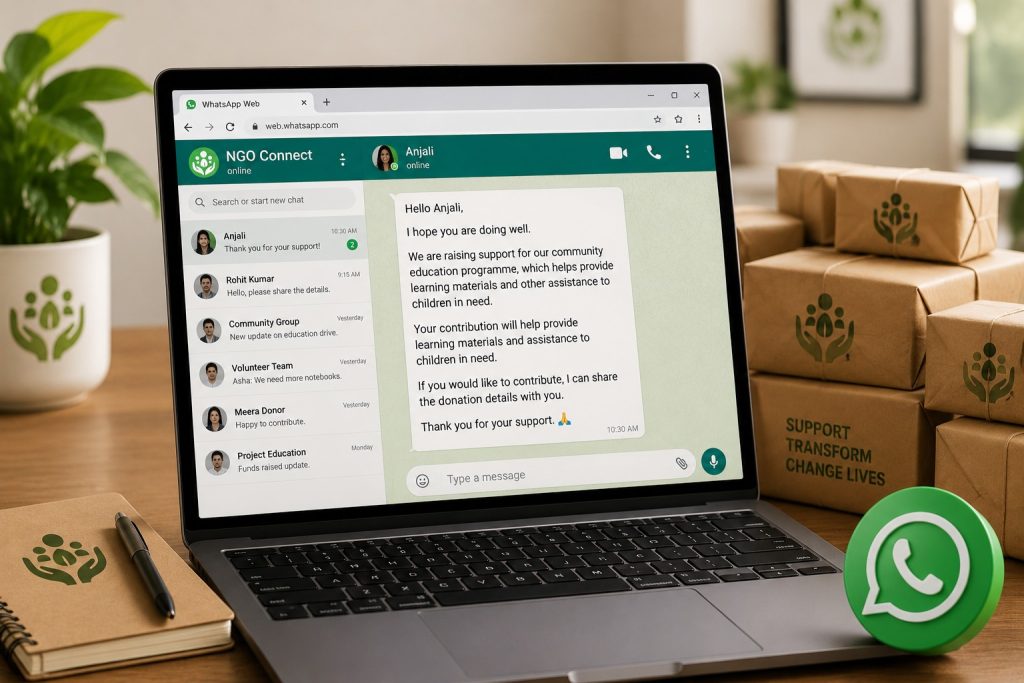
Hello [Name], I hope you are doing well. We are currently raising support for our community education programme, which helps provide learning materials and other assistance to children in need. We are reaching out to people who may be interested in supporting this initiative. If you would like to contribute, I can share the donation details with you. Thank you for taking the time to read this message.
The message does not pressure the recipient. It explains the purpose and gives them the freedom to decide whether they want to contribute.
Why Does the Way You Ask for a Donation Matter?
The way an NGO asks for a donation matters because WhatsApp is a direct communication channel. A vague, overly forceful, or poorly explained request may be ignored, while a clear and respectful message can help the recipient understand the purpose behind the appeal.
People are more likely to understand a fundraising request when they can answer basic questions such as:
- Who is asking for support?
- What is the organisation or initiative?
- What is the need?
- Why is support needed now?
- What will the contribution help with?
- How can they contribute?
- What happens after they contribute?
The goal is to provide enough information without overwhelming the recipient with a very long message.
A WhatsApp donation request should feel like a genuine communication about a real welfare need, not a mass-produced demand for money.
What Should You Include in a WhatsApp Donation Request?
A good WhatsApp donation request should include the essential information a potential supporter needs to understand the appeal and decide whether to contribute.
1. Start with a Personal and Respectful Greeting
Begin naturally.
If you know the person, use their name where appropriate:
Hello Anjali, I hope you are doing well.
For a broader supporter group:
Hello everyone, we would like to share an important update about one of our current welfare initiatives.
The tone should reflect your relationship with the recipient. A close supporter may receive a more personal message than someone who has only recently connected with the organisation.
2. Introduce the Organisation or Initiative
Do not assume everyone remembers what your organisation does.
Briefly explain:
- The name of the organisation or initiative
- The type of welfare work involved
- The purpose of the current appeal
For example:
Our community organisation is currently organising a food-support initiative for families who need assistance in our local area.
Keep the introduction relevant to the request.
3. Clearly Explain Why You Are Asking for Support
This is one of the most important parts of the message.
Instead of writing:
Please donate generously.
Explain the actual purpose:
We are currently raising funds to help purchase and distribute essential food supplies as part of our upcoming community support programme.
Specificity helps the reader understand the reason behind the appeal.
4. Explain What the Donation Will Support
A potential donor should have a clear idea of the intended welfare activity.
Depending on the campaign, you might explain that support will contribute toward:
- Educational materials
- Healthcare assistance
- Food and essential supplies
- Emergency relief
- Community development activities
- Support for a specific welfare project
Avoid making promises that the organisation cannot reasonably support or report.
5. Make the Request Direct but Respectful
It is acceptable to ask directly.
For example:
If you would like to support this initiative, we would be grateful for a contribution.
Or:
We are reaching out to our supporters to ask whether you would consider contributing to this campaign.
There is no need to make the request overly dramatic. Respectful language is often more effective than pressure.
6. Make the Next Step Easy
If someone decides to support the campaign, they should understand what to do next.
For example:
If you would like to contribute, please use the donation details below.
Or:
Reply to this message, and we will share the relevant contribution information.
Keep the action clear and avoid sending recipients through an unnecessarily complicated process.
7. End with Appreciation
Always acknowledge the person’s time, whether or not they contribute.
A simple closing could be:
Thank you for taking the time to read about this initiative. Your support and encouragement mean a great deal to our team.
A donation request should not imply that someone owes the organisation a contribution.
How Long Should a WhatsApp Donation Message Be?
A WhatsApp donation message should usually be long enough to explain the need but short enough that the recipient can quickly understand the purpose and next step.
A useful approach is to make the first message concise and provide additional information through a follow-up message, campaign page, document, image, or conversation when appropriate.
The recipient should be able to understand the main message quickly:
What is happening? Why is support needed? How can I help?
If a message contains several long paragraphs, multiple links, and too much background information, important details may get lost.
How Can You Ask for a Donation Without Sounding Pushy?
You can ask for a donation without sounding pushy by focusing on the welfare need, giving the person a genuine choice, and avoiding language that creates unnecessary guilt or pressure.
Consider the difference.
Too Pushy
You must donate today. We need everyone to contribute immediately. Please do not ignore this message.
More Respectful
We are currently seeking support for this welfare initiative. If you are in a position to contribute and would like to support the programme, we would be grateful for your help.
The second approach clearly asks for support while respecting the recipient’s decision.
Useful phrases include:
- If you would like to support this initiative…
- If you are able to contribute…
- We would be grateful for your support…
- Please consider supporting this welfare project…
- We are reaching out to people who may be interested in helping…
Avoid repeatedly messaging someone who has not responded. A lack of response should not automatically be treated as an invitation to continue sending donation requests.
What Is a Good WhatsApp Message for Asking for Donations?
A good WhatsApp donation message is clear, specific, respectful, and easy to act on. It should explain the welfare need and give the recipient a simple way to support the initiative.
Here are several practical examples.
Example 1: General Charity Donation Request
Hello [Name], I hope you are doing well. We are currently raising support for our ongoing welfare activities in the community. The contributions we receive help us plan and carry out initiatives based on the needs we are addressing. If you would like to support our work, we would be grateful for your contribution. Please let us know if you would like the donation details. Thank you for your time and support.
Example 2: Education Support Appeal
Hello [Name], we are currently organising an education-support initiative for children who need assistance with learning materials. We are reaching out to supporters who may be interested in contributing to this effort. If you would like to help, your contribution can support the planned programme activities. Please reply if you would like to know more. Thank you.
Example 3: Emergency Relief Appeal
Hello [Name], we are currently organising support for people affected by an urgent situation in our community. Our immediate focus is on providing essential assistance based on the needs identified by our team. If you would like to support the relief effort, we would be grateful for your contribution. We can share the relevant details and updates with you. Thank you for your consideration.
Example 4: Message to Existing Supporters
Hello [Name], thank you for your continued interest in our welfare activities. We wanted to share that we are beginning a new initiative focused on [brief purpose]. We are currently inviting supporters who may wish to contribute toward this project. If you would like to be part of the initiative, please let us know, and we will share the relevant details. Thank you once again for your support.
These examples should be adapted to the actual situation. A charity should never use generic wording to create the impression of a need that does not genuinely exist.
Should NGOs Personalise WhatsApp Donation Messages?
Yes, NGOs should personalise WhatsApp donation messages where practical, especially when communicating with existing supporters, previous donors, trustees, volunteers, or people who already know the organisation.
Personalisation does not mean adding a person’s name to the same message and sending it to everyone. It means making the communication relevant.
For example, if someone previously supported an education initiative, the organisation may share a relevant update about a future education project rather than sending an unrelated message without context.
Relevant communication can help the organisation build stronger supporter relationships.
However, personalisation should be managed responsibly. An NGO should have an organised approach to maintaining donor information and communication records rather than relying entirely on individual staff members’ personal message histories.
How Often Should You Ask for Donations on WhatsApp?
There is no single number that works for every organisation. NGOs should avoid sending repeated donation requests without considering the recipient’s relationship with the organisation, previous communication, and the relevance of the campaign.
Instead of contacting supporters only when money is needed, organisations can maintain a more balanced communication approach.
For example, communication may include:
- Updates about welfare projects
- Information about upcoming activities
- Relevant impact or progress updates
- Volunteer opportunities
- Messages of appreciation
- Fundraising appeals when support is genuinely needed
This creates a healthier communication relationship.
If every WhatsApp message is a request for money, supporters may begin to disengage.
How Can an NGO Use WhatsApp for Fundraising More Effectively?
An NGO can use WhatsApp more effectively for fundraising by treating it as part of a wider donor communication and engagement process rather than as a channel for repeatedly forwarding the same appeal.
A practical approach can involve five steps.
Step 1: Define the Fundraising Purpose
Before sending a message, clearly define:
- What is being funded?
- Why is the support needed?
- Who is expected to benefit?
- What activities are planned?
- What information can be shared with supporters?
A clear internal purpose leads to clearer communication.
Step 2: Identify the Appropriate Audience
Not every fundraising message is relevant to every contact.
An organisation may communicate differently with:
- Existing donors
- Previous supporters
- Volunteers
- Community members
- Trustees
- New contacts who have shown interest
Organising supporter information can help fundraising teams communicate more thoughtfully.
Step 3: Create a Clear Message
The message should answer the most important questions quickly.
Who?
Who is organising the initiative?
What?
What is the welfare activity or fundraising purpose?
Why?
Why is support needed?
How?
How can someone contribute or learn more?
Step 4: Record and Manage Responses
Once messages are sent, responses may include:
- A donation
- A request for more information
- A promise to contribute later
- A request to volunteer
- A decision not to participate
These interactions should be managed appropriately rather than forgotten inside individual WhatsApp chats.
Step 5: Follow Up with Relevant Communication
After a person contributes, the relationship should not end immediately.
Depending on the organisation’s processes, appropriate follow-up may include:
- Acknowledging the contribution
- Confirming receipt
- Sharing relevant project updates
- Communicating future opportunities
- Maintaining an organised donor relationship
What Common Mistakes Should Charities Avoid When Asking for Donations on WhatsApp?
Charities should avoid unclear messages, excessive pressure, repeated unsolicited requests, and poor follow-up. These mistakes can weaken the donor experience and make fundraising harder to manage.
Sending Only a Payment Request Without Context
A payment link or contribution instruction alone may not explain why support is being requested.
Always provide meaningful context.
Writing Extremely Long Messages
WhatsApp is often read quickly. A long message may be ignored or only partially read.
Put the most important information first.
Using Guilt or Emotional Pressure
Do not make people feel personally responsible for every welfare problem.
The message should invite support, not attempt to force it.
Repeatedly Forwarding the Same Message
A fundraising message should be relevant and purposeful. Repeated forwarding without new information can create message fatigue.
Failing to Respond to Questions
If a potential donor asks how funds will support a project or requests more information, the organisation should have a clear process for responding.
Forgetting to Acknowledge Contributions
Supporters should not be left wondering whether their contribution was received.
Keeping All Information in Individual Chats
When fundraising information remains only in personal phones and separate chat histories, organisations may struggle with continuity, donor management, and reporting.
How Can WhatsApp Fundraising Support Transparency and Accountability?
WhatsApp fundraising can support transparency and accountability when the organisation communicates clearly about its purpose, maintains organised records, and provides relevant information about the welfare activities connected to fundraising.
For example, imagine a community organisation collecting support for an education programme.
The organisation could manage the journey as follows:
Donors receive a clear explanation of the initiative through WhatsApp.
Interested supporters make contributions through the organisation’s chosen process.
The contributions are recorded and connected with the intended fundraising purpose.
Available funds support planned welfare project activities.
The project provides assistance to identified beneficiaries.
The organisation records relevant activities and outcomes.
Appropriate updates or reports can then help supporters understand the progress of the initiative.
This ongoing communication may encourage continued support.
The broader relationship is:
Donors → Contributions → Funds → Welfare Projects → Beneficiaries → Outcomes → Reporting → Continued Support
WhatsApp may be the starting point for a conversation or fundraising appeal, but responsible welfare management continues long after the message is sent.
Why Is WhatsApp Fundraising Only One Part of the Bigger Process?
WhatsApp can help an organisation communicate with supporters, but modern charitable organisations need to manage much more than messages and donation requests.
A welfare organisation may need to coordinate:
- Donors and supporter relationships
- Contributions
- Funds
- Welfare projects
- Beneficiaries
- Teams and activities
- Communication
- Reporting
- Accountability
- Outcomes
This broader approach can be understood as Welfare Governance.
Welfare Governance is the structured management of an organisation’s welfare activities, resources, people, projects, beneficiaries, accountability, reporting, and impact.
For example, sending a WhatsApp appeal may help generate contributions. But the organisation must also consider:
- Where is the donor information recorded?
- Which campaign received the contribution?
- What welfare project is being supported?
- How are activities managed?
- Who are the beneficiaries?
- What outcomes are being tracked?
- What information can be communicated back to supporters?
Thinking about these connections helps organisations move beyond isolated fundraising activity toward a more organised welfare-management ecosystem.
How Can Technology Help NGOs Manage WhatsApp Fundraising?
Technology can help NGOs create a more organised approach to donor information, contribution tracking, communication, welfare projects, beneficiaries, and reporting.
The right technology should support the organisation’s actual workflow.
Before introducing a digital system, an NGO can ask:
- How do we currently communicate with donors?
- Where do we record donor information?
- How do we track contributions received after WhatsApp campaigns?
- Can we identify which campaign or purpose a contribution relates to?
- How do we follow up with supporters?
- How do we connect fundraising with welfare projects?
- How do we prepare reports and updates?
- Where are our biggest administrative gaps?
For a small community organisation, the challenge may be moving away from scattered chats and spreadsheets. For a larger charitable institution, the challenge may be coordinating information across multiple teams, projects, and fundraising activities.
The most useful approach is one that helps create better organisation without adding unnecessary complexity.
Best Practices for Asking for Donations on WhatsApp
Before sending a fundraising request, use this practical checklist:
- Be clear about the purpose.
Know exactly why you are asking for support. - Introduce the context.
Do not assume every recipient understands the campaign. - Keep the message concise.
Share the essential information first. - Make a respectful and direct request.
Ask clearly without using pressure or guilt. - Explain the next step.
Make it easy for an interested supporter to contribute or ask for more information. - Use relevant communication.
Send appropriate messages to appropriate audiences where possible. - Respond to questions promptly.
Be prepared to provide genuine information about the initiative. - Acknowledge support.
Show appreciation when someone contributes. - Maintain organised records.
Do not rely solely on individual chat histories to manage donor relationships. - Connect fundraising with welfare activities.
Think beyond the donation request and consider projects, beneficiaries, outcomes, and reporting.
Conclusion
Asking someone for a donation on WhatsApp does not need to be uncomfortable or complicated. The most effective approach is usually to be clear, respectful, and honest about the welfare need.
Explain who you are, why support is needed, what the contribution is intended to support, and what the person can do if they choose to help. Avoid pressure, repeated unwanted messages, and vague requests that provide no context.
For charities and NGOs, WhatsApp can be a useful part of digital fundraising and donor communication. But a successful fundraising process should not end when a donation is received.
The larger journey connects:
Donors → Contributions → Funds → Welfare Projects → Beneficiaries → Outcomes → Reporting → Continued Support
When organisations manage these connections more effectively, fundraising becomes part of a broader and more accountable approach to welfare management.
To explore how NidhiMax can support a more organised Welfare Governance system for your organisation.
Frequently Asked Questions
Can I ask for donations on WhatsApp?
Yes. You can ask for donations on WhatsApp by sending a clear and respectful message explaining the welfare need, the purpose of the fundraising, and how someone can contribute if they choose to support the initiative.
What should I write when asking for a donation on WhatsApp?
Explain who you are, briefly describe the need, state what the donation will support, make a respectful request, and provide a clear next step for anyone who wants to contribute.
How do I ask for a donation without sounding pushy?
Focus on the welfare need, use respectful language, give the recipient a genuine choice, and avoid guilt, pressure, or repeated unwanted follow-ups.
How long should a WhatsApp donation request be?
Keep the initial message concise while including enough context to explain the purpose. Additional information can be shared with people who want to know more.
Can NGOs use WhatsApp for fundraising?
Yes. NGOs can use WhatsApp to communicate fundraising campaigns, share welfare updates, engage supporters, answer questions, and direct interested people toward an appropriate contribution process.
Should NGOs personalise WhatsApp donation messages?
Where practical, yes. Relevant and thoughtful communication can be more meaningful than sending the same generic appeal to every contact.
How should an NGO follow up after receiving a donation?
The organisation should acknowledge the contribution and maintain relevant communication according to its processes. This may include confirming receipt and sharing appropriate updates about the related welfare activity.
How can NGOs manage donors who respond through WhatsApp?
NGOs can create an organised process for recording relevant donor interactions, contributions, communication, and campaign information rather than relying only on individual chat histories.
How NidhiMax Can Help
WhatsApp can make it easier to start conversations with supporters and share fundraising appeals, but donation collection is only one part of a charitable organisation’s wider work.
NidhiMax is a Welfare Governance Platform designed to help charitable organisations, NGOs, trusts, community organisations, and welfare institutions move toward a more organised digital welfare-management ecosystem.
For organisations reviewing their processes, the bigger picture may include areas such as:
- Fundraising and donor management
- Contribution tracking
- Welfare project coordination
- Beneficiary management
- Communication
- Reporting
- Transparency and accountability
- Operational coordination
- Understanding activities and outcomes
Every organisation has different welfare processes. A small volunteer-led community initiative may have very different needs from an organisation managing multiple projects and beneficiary groups.
The important question is how information and activities connect across the complete welfare journey—from the first donor conversation to the reporting of welfare activities and outcomes.
To explore how NidhiMax can support a more organised Welfare Governance system for your organisation.