 Post by
For charities and NGOs, fundraising is rarely about choosing a single way to receive support. Some donors prefer to make a one-time contribution when a particular need catches their attention. Others prefer to support an organisation regularly through monthly donations.
This creates an important question for charity leaders: Is a one-time donation or a monthly donation better for the organisation?
There is no universal answer. Each model serves a different purpose, and the right approach depends on the charity’s projects, donor relationships, fundraising process, operational capacity, and communication practices.
A one-time donation can provide immediate support for a campaign or specific need. Monthly giving can create an ongoing relationship with supporters and provide a more regular fundraising pattern. Many organisations can benefit from understanding how both models work and using them appropriately.
What Is a One-Time Donation?
A one-time donation is a contribution made by a donor on a single occasion without an ongoing commitment to contribute regularly.
One-time donations are common during:
- Emergency relief campaigns
- Specific fundraising appeals
- Education-support initiatives
- Healthcare assistance
- Food distribution programs
- Community events
- Seasonal campaigns
- Project-specific fundraising
For example, an NGO may launch an appeal to support an urgent community need. A supporter may choose to contribute once based on that particular campaign.
The donor’s contribution can be valuable even if they do not become a recurring supporter.
What Is a Monthly Donation?
A monthly donation is a recurring contribution that a donor agrees to make regularly, typically once each month.
Monthly giving can be useful for charities that conduct ongoing welfare activities and want to develop longer-term relationships with supporters.
For example, an organisation supporting education may invite donors to contribute monthly toward its continuing education-support activities.
The important point is that a monthly donation is not simply a smaller version of a one-time donation. It represents an ongoing commitment and therefore requires an ongoing donor relationship.
What Is the Difference Between One-Time and Monthly Donations?
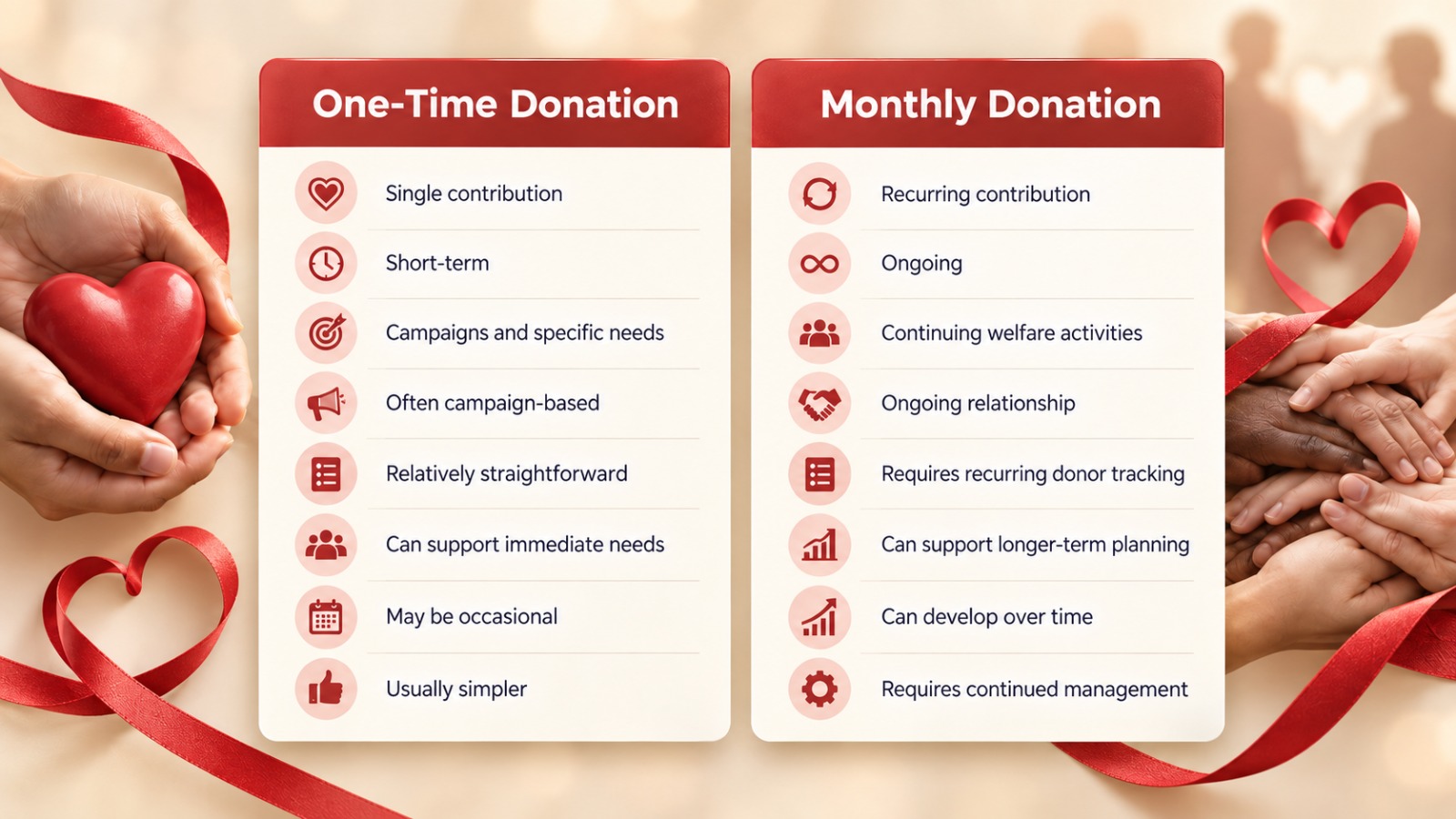
The main difference is the nature of the donor commitment: a one-time donation is made once, while a monthly donation establishes a recurring contribution pattern.
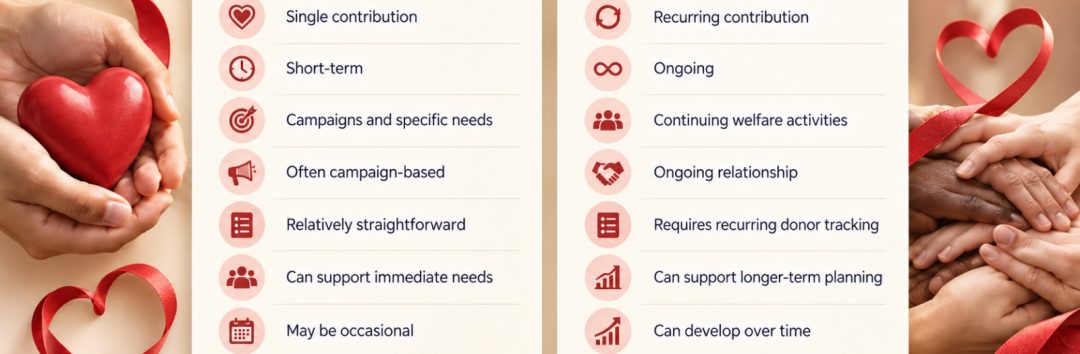
Factor | One-Time Donation | Monthly Donation |
Contribution pattern | Single contribution | Recurring contribution |
Donor commitment | Short-term | Ongoing |
Common use | Campaigns and specific needs | Continuing welfare activities |
Communication | Often campaign-based | Ongoing relationship |
Tracking requirement | Relatively straightforward | Requires recurring donor tracking |
Planning | Can support immediate needs | Can support longer-term planning |
Donor relationship | May be occasional | Can develop over time |
Administration | Usually simpler | Requires continued management |
Neither model should automatically be treated as better. The important question is how each model fits the charity’s objectives and the donor’s preferences.
Is a One-Time Donation Better for Charities?
A one-time donation can be particularly useful when a charity needs to raise funds for a specific campaign, project, or immediate requirement.
It can also provide an accessible way for first-time supporters to engage with an organisation without asking them to make a longer-term commitment.
Advantages of one-time donations
One-time giving can help charities:
- Respond to specific fundraising needs
- Reach supporters during campaigns
- Engage first-time donors
- Support emergency or time-sensitive activities
- Keep the contribution decision simple
- Generate support from people who prefer occasional giving
For example, a community organisation organising an emergency food-distribution activity may receive contributions from supporters who want to help with that particular initiative.
The donor may not be interested in a monthly commitment, and that is perfectly reasonable.
Is Monthly Giving Better for Charities?
Monthly giving can be useful for charities with ongoing welfare activities because it creates an opportunity to develop continuing donor relationships and more regular contribution patterns.
A monthly donor may continue supporting an organisation across multiple fundraising cycles rather than participating only when a particular campaign appears.
Potential benefits of monthly donations
Monthly giving can help charities:
- Build longer-term donor relationships
- Establish a recurring fundraising process
- Plan continuing welfare activities more systematically
- Communicate with supporters regularly
- Develop structured donor-management practices
- Connect ongoing contributions with continuing projects
However, monthly donations also require more careful management. Donor records, recurring contribution information, communication, acknowledgements, and payment interruptions need to be monitored.
Which Donation Model Is Better for a Charity?
Neither one-time nor monthly donations can be described as universally better for every charity. The appropriate model depends on the organisation’s fundraising objectives, welfare activities, donor preferences, and operational capacity.
A charity running emergency-relief campaigns may rely heavily on one-time contributions during specific appeals. An organisation operating a continuing education or community-support program may find monthly giving useful for building an ongoing supporter base.
In many cases, charities do not need to choose only one.
A practical fundraising strategy can accommodate both.
Should Charities Accept Both One-Time and Monthly Donations?
Yes. Offering both options can allow donors to choose the type of support that suits them.
A donation page could provide:
One-Time Donation
For supporters who want to contribute to a particular campaign or make an occasional donation.
Monthly Donation
For supporters who want to provide continuing support to the organisation.
This gives the donor control over the type and frequency of their contribution.
The organisation can then manage both donor groups through an appropriate donor-management process.
When Is a One-Time Donation More Appropriate?
A one-time donation may be more appropriate when the fundraising need is specific, short-term, or campaign-oriented.
Examples include:
Emergency relief
An NGO responding to an urgent situation may launch a focused appeal for immediate support.
Project-specific fundraising
A charity may seek contributions for a clearly defined activity or project.
First-time donors
A supporter who has never interacted with an organisation may prefer to make a one-time contribution before considering longer-term involvement.
Event-based fundraising
Community events, campaigns, or special appeals may naturally generate one-time contributions.
In these situations, the organisation should clearly communicate the purpose of the fundraising request and how contributions will support the relevant activity.
When Is Monthly Giving More Appropriate?
Monthly giving can be particularly relevant when an organisation has continuing welfare activities that require ongoing planning and support.
Examples include:
- Education-support programs
- Continuing community development
- Regular food-support activities
- Ongoing healthcare assistance
- Long-term social-support initiatives
- Continuing beneficiary-support programs
The organisation should be able to explain why continued support is relevant.
A donor should understand what makes the need ongoing rather than simply receiving a request to “donate every month.”
How Does Donor Preference Affect the Choice?
Donor preference is an important part of the decision because supporters have different financial circumstances, interests, and giving habits.
Some donors may prefer to contribute when a particular campaign aligns with their interests.
Others may prefer the convenience of setting up a regular contribution.
A charity should therefore avoid treating every donor in the same way.
Instead, organisations can provide clear choices and allow supporters to decide:
- Whether to donate
- How much to contribute
- How often to contribute
- Which fundraising initiative to support, where applicable
- What type of communication they want to receive
Respecting donor choice can contribute to a healthier supporter relationship.
How Can Charities Convert One-Time Donors Into Monthly Donors?
Charities can invite one-time donors to consider monthly giving by demonstrating the value of continued support rather than repeatedly asking for money.
A simple approach could be:
- Thank the donor for their contribution.
- Explain the ongoing nature of the organisation’s work.
- Share relevant project updates.
- Introduce monthly giving as an optional way to continue supporting the work.
- Provide a simple process for becoming a monthly donor.
For example:
“Thank you for supporting our education initiative. If you would like to continue supporting this work throughout the year, you can choose to become a monthly supporter.”
The invitation should remain optional and respectful.
How Can Charities Manage One-Time and Monthly Donors Together?
Charities can manage both groups effectively by maintaining organised donor records and distinguishing between different contribution patterns.
A donor-management process might record:
- Donor details
- Donation frequency
- Contribution history
- Campaign or project
- Communication history
- Donor preferences
- Acknowledgement status
- Follow-up activities
This allows the organisation to understand whether a supporter is:
- A first-time donor
- An occasional donor
- A recurring donor
- A previous donor who has not contributed recently
Such information can help fundraising teams communicate more appropriately without treating every supporter as an identical audience.
What Happens After a Donation Matters More Than the Donation Type?
Whether a donor contributes once or monthly, the relationship should not end when the payment is received.
A charity should consider what happens afterward.
A useful process is:
Donor → Contribution → Fund → Welfare Project → Beneficiaries → Outcomes → Reporting → Continued Support
For example, imagine a community organisation running an education-support program for 100 children.
The organisation may receive both one-time and monthly donations.
Instead of looking only at the amount collected, it can organise information around:
- Which fundraising activity generated support
- What resources were available
- Which welfare project received support
- Which beneficiaries were involved
- What activities were conducted
- What progress was made
- What needs remain
- What should be communicated to supporters
This connects fundraising with the actual welfare work.
How Important Are Transparency and Accountability?
Transparency and accountability are important for both one-time and monthly donors because supporters need confidence that the organisation is managing its responsibilities appropriately.
For one-time donors, appropriate communication may include information about the campaign they supported and its progress.
For monthly donors, ongoing communication can be particularly relevant because the relationship continues over time.
Useful reporting can include:
- Project progress
- Activities completed
- Beneficiary-related updates
- Resource use where appropriate
- Challenges
- Upcoming activities
- Relevant outcomes
Reports should be accurate and proportionate to the organisation’s activities. A charity should avoid presenting assumptions as measured outcomes.
How Can Technology Help Manage Both Donation Types?
Technology can help charities organise information about one-time and recurring donors in a structured way.
Depending on the organisation’s requirements, a digital system can support areas such as:
- Donor management
- Contribution tracking
- Fundraising management
- Donor communication
- Welfare project coordination
- Beneficiary information
- Reporting
- Internal operational coordination
For example, instead of maintaining separate records for donations, campaigns, projects, and communications, an organisation can work toward a connected view of its welfare activities.
The objective is not technology for its own sake. The purpose is to make charity management more organised and make relevant information easier for staff and leadership teams to understand.
What Is Welfare Governance and Why Does It Matter?
Welfare governance is the structured management of an organisation’s welfare activities, resources, people, projects, beneficiaries, accountability, reporting, and impact.
Fundraising is only one part of that system.
Whether a donation arrives once or every month, the organisation still needs to answer important questions:
- Where did the contribution come from?
- What fundraising activity generated it?
- Which funds are available?
- Which welfare project is involved?
- Who are the beneficiaries?
- What activities are being conducted?
- What outcomes are being observed?
- How should the organisation report progress?
- How should supporters be kept informed?
This broader view helps connect fundraising with the organisation’s actual social-impact work.
What Are the Common Challenges With One-Time and Monthly Donations?
Both models have operational challenges, although they are different.
Challenges with one-time donations
- Donors may contribute only during specific campaigns.
- The organisation may need to continually attract new supporters.
- Donor relationships can become inactive if there is no follow-up.
- Campaign-based fundraising can require repeated planning.
Challenges with monthly donations
- Recurring payments can be interrupted.
- Donor records need ongoing maintenance.
- Communication needs to continue over time.
- Donors may cancel or change their contributions.
- Administrative work can increase as the recurring donor base grows.
A strong donor-management process can help an organisation recognise and address these challenges.
How Should a Charity Decide Between One-Time and Monthly Giving?
A charity can evaluate several practical factors before deciding how much emphasis to place on each donation model.
Consider the nature of the welfare work
Is the organisation responding mainly to short-term campaigns, or does it operate continuing welfare projects?
Consider donor behaviour
Do supporters tend to respond to specific appeals, or are they interested in maintaining longer-term involvement?
Consider operational capacity
Can the organisation maintain recurring donor records, communication, contribution tracking, and follow-up?
Consider communication requirements
Can the charity provide meaningful updates to continuing supporters?
Consider fundraising objectives
Is the immediate goal to fund a particular activity, or to develop longer-term supporter relationships?
These questions can help an organisation develop a fundraising approach that reflects its actual circumstances.
What Is a Balanced Donation Strategy for an NGO?
A balanced strategy can give supporters multiple ways to participate while allowing the NGO to manage those relationships systematically.
For example:
One-time giving can support campaigns, specific needs, emergency activities, and occasional donors.
Monthly giving can support continuing donor relationships and ongoing welfare activities.
The two models can work together.
An NGO might attract a new supporter through a one-time campaign, maintain the relationship through useful communication, and later offer monthly giving as an optional way to continue supporting the organisation.
The transition should be based on donor interest rather than pressure.
FAQ
Is a monthly donation better than a one-time donation for charities?
Neither model is universally better. Monthly donations can support ongoing donor relationships and regular fundraising, while one-time donations can be useful for specific campaigns, projects, or immediate needs.
Why are monthly donations useful for NGOs?
Monthly donations can help NGOs develop ongoing relationships with supporters and create a more regular contribution pattern for continuing welfare activities.
Why are one-time donations important for charities?
One-time donations can help charities raise funds for specific campaigns, projects, emergencies, or other needs where supporters prefer to contribute occasionally.
Can a charity accept both one-time and monthly donations?
Yes. A charity can offer both options so donors can choose the contribution frequency that suits their preferences and circumstances.
How can charities convert one-time donors into monthly donors?
Charities can introduce monthly giving by thanking one-time donors, explaining ongoing needs, sharing relevant project updates, and offering recurring support as an optional next step.
How should NGOs manage one-time and recurring donors?
NGOs can use an organised donor-management process to track donor information, contribution history, donation frequency, communication, preferences, and relevant fundraising or project information.
What is the difference between recurring donations and one-time donations?
A one-time donation is made on a single occasion, while a recurring donation involves an ongoing contribution schedule, such as monthly giving.
How can technology support charity fundraising?
Technology can help charities organise donor records, contribution tracking, fundraising activities, communication, welfare projects, and reporting within a more structured digital workflow.
How NidhiMax Can Help
The choice between one-time and monthly donations is only one part of effective charity management. The larger challenge is connecting fundraising with the work that follows: managing contributions, coordinating welfare projects, supporting beneficiaries, communicating with donors, and reporting progress.
NidhiMax — Welfare Governance Platform is designed to help charitable organisations, NGOs, trusts, community organisations, and welfare institutions move toward a more organised digital welfare-management ecosystem.
For an organisation managing different types of donors, this broader approach can help bring relevant areas such as fundraising management, donor management, contribution tracking, welfare projects, communication, transparency, and reporting into a more structured workflow.
Every organisation has different welfare activities and operational requirements. The right technology approach should therefore reflect those real processes rather than forcing every organisation into the same model.