 Post by

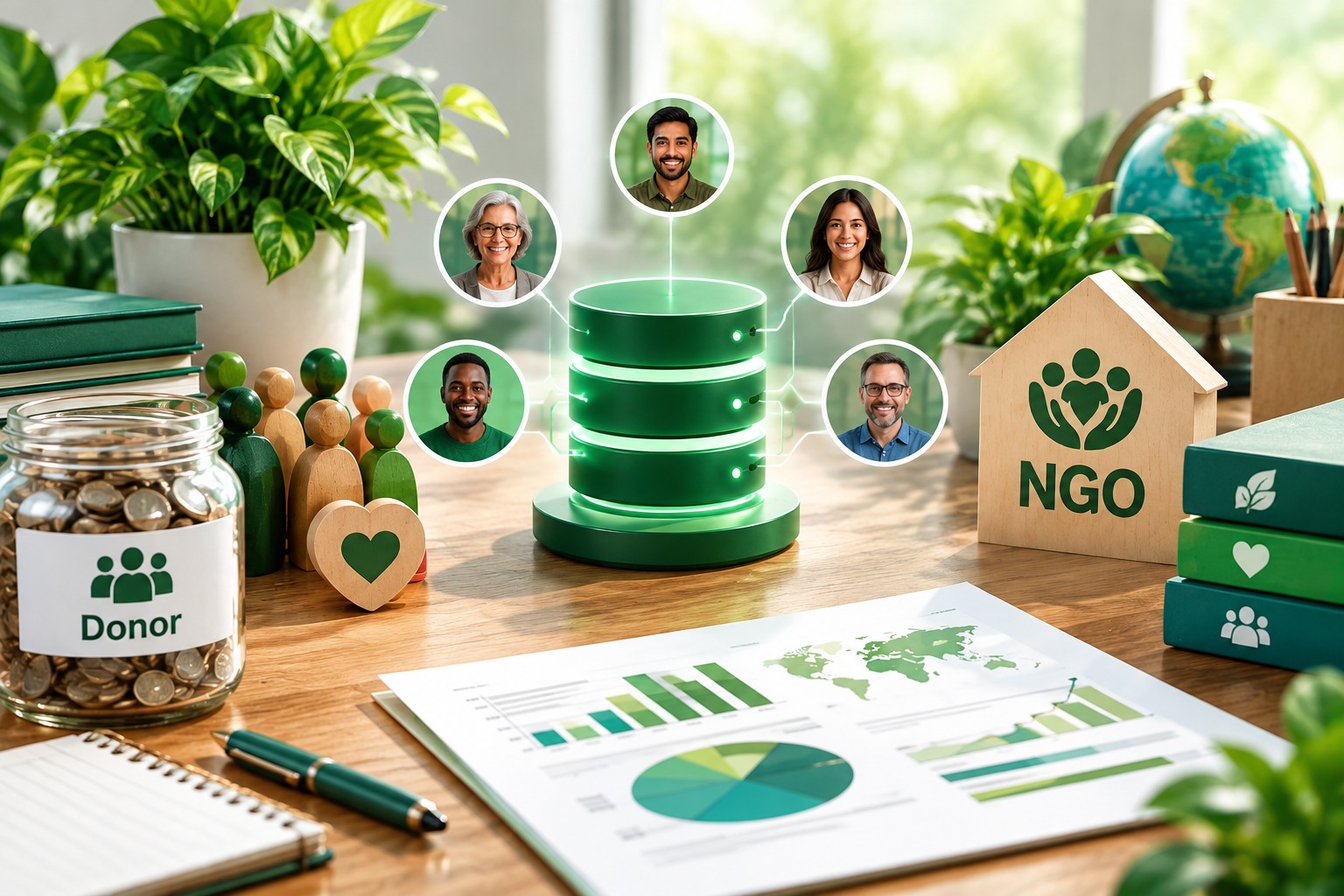
For an NGO, donors are more than names on a fundraising list. They are people, businesses, institutions, and supporters who choose to contribute to the organisation’s mission. As an NGO grows, keeping track of these relationships becomes increasingly important.
A few donors can often be managed with a simple spreadsheet. But when an organisation begins handling multiple fundraising campaigns, recurring contributions, welfare projects, and regular donor communication, scattered records can quickly become difficult to manage.
A well-structured donor database gives an NGO a central way to organise information about its supporters and their contributions. It can help the team understand donor history, coordinate communication, reduce duplicate records, and make fundraising activities more organised.
Building a donor database does not necessarily require complicated technology. What matters most is creating a clear structure, deciding what information is genuinely useful, keeping records accurate, and establishing processes that the team can follow consistently.
This guide explains how an NGO can build a donor database from the ground up and how that database can become part of a broader approach to donor management and welfare governance.
What Is a Donor Database for an NGO?
A donor database is an organised collection of information about an NGO’s donors, supporters, contributions, communication, and relevant engagement history.
Instead of keeping donor details across different notebooks, spreadsheets, emails, and messaging applications, an NGO can maintain a structured record that makes important information easier to find and manage.
A donor database may contain information such as:
- Donor names
- Contact information
- Contribution history
- Dates of contributions
- Campaigns supported
- Welfare projects supported
- Communication records
- Donor preferences
- Acknowledgement information
- Relevant engagement history
The exact structure should depend on the NGO’s activities.
A small community organisation may need only a straightforward donor list and contribution history. A larger organisation may need a more detailed system connecting donors with campaigns, welfare projects, communication, and reporting.
Why Does an NGO Need a Donor Database?
An NGO needs a donor database because donor information becomes difficult to manage when it is spread across disconnected records.
A centralised and organised database can help the organisation:
- Find donor information more easily
- Maintain contribution history
- Avoid duplicate records
- Improve donor communication
- Understand supporter interests
- Track fundraising participation
- Support donor retention
- Prepare useful reports
- Coordinate work between team members
- Build more consistent donor-management processes
The purpose is not simply to store information. The purpose is to make that information useful for the organisation’s fundraising and relationship-building activities.
How Do You Build a Donor Database for an NGO?
To build a donor database, first define the information the NGO needs, create a consistent donor-record structure, collect information responsibly, record contributions accurately, establish data-maintenance procedures, and choose technology that matches the organisation’s needs.
A practical process can be divided into the following steps:
Step 1: Define the purpose of the database
Before creating columns in a spreadsheet or choosing software, decide what the database needs to accomplish.
Ask:
- Do we mainly need donor contact information?
- Do we need to track contribution history?
- Do we run multiple fundraising campaigns?
- Do we need to know which projects donors support?
- Do multiple team members need access?
- Do we need communication history?
- What reports do we regularly need?
The answers will determine how simple or detailed the database should be.
What Information Should an NGO Include in a Donor Database?
An NGO should include information that helps it manage donor relationships, fundraising, and related operations effectively.
Basic donor information
Depending on the organisation’s needs, this can include:
- Full name
- Organisation name, where relevant
- Phone number
- Email address
- Preferred communication channel
- Location, where genuinely useful
Contribution information
Contribution records may include:
- Contribution date
- Amount
- Contribution type
- Relevant campaign
- Relevant welfare project
- Acknowledgement or receipt status
Relationship information
An NGO may also maintain useful relationship information such as:
- First contribution date
- Previous contribution history
- Recurring support
- Campaign participation
- Volunteer involvement
- Relevant communication history
- Areas of interest
The organisation should avoid collecting personal information simply because it can. Every field should have a clear operational purpose.
What Should a Simple NGO Donor Database Look Like?
A simple donor database can begin with a structure such as:
Donor Name | Contact | Contribution Date | Amount | Campaign | Project | Acknowledged |
Donor A | Contact details | Date | Amount | Education Support | Education Programme | Yes |
Donor B | Contact details | Date | Amount | Food Distribution | Community Food Programme | Yes |
Donor C | Contact details | Date | Amount | Healthcare Assistance | Healthcare Programme | Pending |
The names and information above are only examples of how a structure can be organised.
As the NGO grows, it may need additional records for communication, recurring contributions, campaigns, projects, and other relevant activities.
The key principle is consistency.
If different staff members enter information in completely different formats, the database will become harder to search and maintain.
Should an NGO Use Excel or a Dedicated Donor Management System?
An NGO can start with a spreadsheet when its donor records are relatively simple, but a dedicated donor management system may become useful as the number of donors, campaigns, contributions, and team members increases.
A spreadsheet can be suitable when:
- The donor base is small
- One or two people manage records
- There are few fundraising campaigns
- Contribution history is straightforward
- Reporting requirements are limited
A more structured digital system may be worth considering when:
- Several people manage donors
- Donor information is duplicated
- Multiple campaigns operate simultaneously
- Contribution history is difficult to maintain
- Communication records are scattered
- Reports take significant manual effort
- The NGO has multiple welfare projects
There is no universal point at which every organisation must move from a spreadsheet to software. The decision should be based on the complexity of the NGO’s actual operations.
How Should an NGO Collect Donor Information?
An NGO should collect donor information through clear and appropriate processes connected to its fundraising and supporter interactions.
Possible sources include:
- Donation forms
- Fundraising campaigns
- Events
- Direct contributions
- Organisational outreach
- Volunteer programmes
- Existing supporter records
When information is collected, the NGO should determine which fields are actually necessary.
For example, if an organisation only needs a donor’s name, contact details, contribution information, and communication preference for a particular process, there may be no reason to collect additional personal information.
Good data collection begins with a simple question:
“Will this information help us perform a legitimate organisational task?”
If the answer is no, the field may not be necessary.
How Can an NGO Keep Donor Data Accurate?
An NGO can keep donor data accurate by using standard formats, assigning responsibility for updates, reviewing records regularly, and correcting duplicate or outdated information.
Some practical measures include:
Use consistent names
Decide whether names will be entered using full names and follow the same convention throughout the database.
Standardise contact information
Use consistent formats for phone numbers and email addresses.
Record contributions promptly
Enter contribution information as part of the normal fundraising process rather than leaving it for later.
Review duplicates
The same supporter should not unnecessarily appear as several separate donor records.
Update outdated information
If a donor’s contact information changes, update the relevant record according to the organisation’s procedures.
Define who maintains the database
Someone should be responsible for ensuring that records remain accurate.
A database without ownership can quickly become outdated.
What Is Donor Segmentation in an NGO Database?
Donor segmentation means grouping donors according to useful characteristics so that an NGO can understand and communicate with different supporter groups more appropriately.
Possible groups include:
- First-time donors
- Recurring donors
- Previous donors
- Campaign-specific donors
- Corporate supporters
- Event participants
- Volunteers who also contribute
- Supporters interested in education
- Supporters interested in healthcare
- Supporters interested in community welfare
Segmentation can help an NGO avoid treating every donor exactly the same way.
For example, a supporter who previously contributed to an education programme may be interested in relevant updates about another education initiative.
Segmentation should remain practical. An NGO does not need dozens of categories if a few meaningful groups are sufficient.
How Can an NGO Track Donor Contributions?
An NGO can track contributions by maintaining a consistent record connecting each contribution with the relevant donor, date, amount, fundraising activity, and project where appropriate.
A contribution record might answer:
- Who contributed?
- When was the contribution received?
- What amount was contributed?
- Which campaign was involved?
- Which welfare project was supported?
- Has the contribution been acknowledged?
- Is any follow-up required?
This information becomes especially useful when a donor contributes more than once.
Instead of seeing five unrelated transactions, the NGO can understand the donor’s overall contribution history.
Why Is Contribution History Important?
Contribution history provides context about a donor’s relationship with an NGO.
For example, consider a supporter who contributed to:
- An education campaign in one year
- A healthcare initiative later
- An emergency relief campaign afterwards
Looking at these contributions together can provide a better understanding of the person’s relationship with the organisation than looking at each contribution separately.
Contribution history can support:
- Donor communication
- Fundraising planning
- Relationship management
- Campaign analysis
- Internal reporting
It should be used responsibly and only for legitimate organisational purposes.
How Can an NGO Use a Donor Database for Communication?
A donor database can help an NGO maintain more organised communication with supporters.
For example, the organisation may record whether a donor has received:
- A contribution acknowledgement
- A project update
- A campaign communication
- An event invitation
- A periodic organisational update
This can reduce the risk of repeatedly sending the same communication or overlooking important follow-up.
However, the objective should not be to contact donors as frequently as possible.
The objective should be to provide relevant, timely, and respectful communication.
How Can a Donor Database Improve Donor Relationships?
A donor database can improve donor relationships by helping the organisation remember important information about previous interactions and contributions.
Without an organised record, a staff member may have to search through old messages or files before speaking with a supporter.
With a well-maintained database, relevant information can be easier to find.
This can help the organisation:
- Acknowledge supporters appropriately
- Understand previous involvement
- Provide relevant updates
- Avoid unnecessary repetition
- Maintain continuity when team members change
The database itself does not create a relationship. It provides information that helps people in the organisation manage that relationship more effectively.
How Can Donor Databases Support Donor Retention?
A donor database can support donor retention by helping an NGO maintain consistent acknowledgement, communication, contribution history, and ongoing engagement with supporters.
A simple relationship cycle could be:
First Contribution → Thank You → Relevant Update → Programme Progress → Outcome Communication → Continued Engagement
For example, a supporter contributes to a food-distribution initiative.
The NGO can record the contribution, acknowledge it, share an appropriate programme update, and later communicate relevant progress.
The supporter therefore receives information about the work rather than being contacted only when another donation is needed.
How Can an NGO Use Its Donor Database for Fundraising?
An NGO can use donor information to understand previous supporter engagement and plan fundraising activities more thoughtfully.
For example, the organisation may review:
- Previous campaign supporters
- Recurring contributors
- Supporters of specific welfare programmes
- Donors who have supported emergency campaigns
- Donors who have participated in events
- Supporters who have not engaged recently
This does not mean every donor should receive a different message.
It means the organisation can make more informed decisions about who should receive relevant communication and why.
How Can a Donor Database Support Fundraising Campaigns?
A donor database can support a fundraising campaign before, during, and after the campaign.
Before the campaign
The NGO can:
- Identify relevant supporter groups
- Review previous campaign participation
- Prepare communication
- Check donor records
- Define how contributions will be recorded
During the campaign
The team can:
- Record contributions
- Track supporter engagement
- Acknowledge donations
- Maintain updated records
- Coordinate donor communication
After the campaign
The organisation can:
- Review contribution records
- Thank supporters
- Share appropriate project information
- Prepare internal reports
- Maintain relationships for future engagement
The post-campaign stage is especially important because fundraising should not end when the campaign closes.
How Can an NGO Connect Donor Data With Welfare Projects?
An NGO can connect donor information with welfare projects by recording which fundraising activities and projects are associated with contributions, while maintaining appropriate separation between donor information and beneficiary information.
For example, imagine a community organisation running an education-support programme for 100 children.
The organisation raises funds for educational materials.
Its records could connect:
Donors → Contributions → Fundraising Campaign → Education Project → Beneficiaries → Project Activities → Outcomes → Reporting
This does not mean every donor needs access to beneficiary information. It means the organisation internally understands how its fundraising activity relates to its welfare work.
This connection becomes increasingly important for organisations that want a broader view of their operations.
Should Donor and Beneficiary Data Be Kept Separately?
Donor and beneficiary information serve different purposes and should be handled according to the organisation’s operational and information-management requirements.
A donor database focuses on people or organisations that provide support.
A beneficiary record focuses on the individuals or communities receiving support through welfare activities.
They may be connected at the project or programme level, but that does not mean all donor and beneficiary information should be combined into one unrestricted record.
For example:
Donor: Supporter contributing to an education programme
Fundraising activity: Education campaign
Welfare project: School-support programme
Beneficiary group: Children receiving programme support
This structure allows the organisation to understand the overall welfare journey while maintaining appropriate information boundaries.
How Can Donor Databases Support Transparency and Accountability?
A well-maintained donor database can support transparency and accountability by helping an NGO maintain organised records of contributions, fundraising activities, and related project information.
A broader welfare-management process can follow:
Donors → Contributions → Funds → Welfare Projects → Beneficiaries → Outcomes → Reporting → Continued Support
Donor records are one part of this chain.
For an NGO, the ability to understand where contributions came from and which welfare activity they relate to can support internal review and reporting.
Transparency also depends on other factors, including the organisation’s financial controls, programme records, governance practices, and applicable requirements.
A donor database should therefore be viewed as one component of a broader accountability system.
What Are the Common Donor Database Mistakes NGOs Should Avoid?
Several common mistakes can reduce the usefulness of a donor database.
1. Collecting too much information
More fields do not automatically mean better records.
Collect information that has a clear purpose.
2. Keeping multiple donor lists
Separate lists can quickly become inconsistent.
Where practical, maintain one reliable source of donor information.
3. Ignoring duplicate records
Duplicate records can distort contribution histories and communication.
4. Failing to record communication
Without basic communication history, team members may not know what has already been discussed.
5. Updating records only occasionally
Information becomes less useful when it is consistently outdated.
6. Giving everyone unrestricted access
Donor information should be handled responsibly and access should be appropriate to people’s roles.
7. Treating the database as only a fundraising tool
Donor information can also support relationship management, communication, accountability, and broader welfare operations.
8. Choosing technology before understanding the process
Software cannot fix an unclear process. First understand how the organisation works, then select technology that supports it.
How Should an NGO Protect Donor Information?
An NGO should protect donor information by limiting access to authorised people, collecting only necessary information, maintaining appropriate security practices, and establishing clear internal procedures for handling donor data.
Practical measures include:
- Define who can access donor records
- Avoid sharing donor information unnecessarily
- Use appropriate access controls
- Keep records updated
- Establish procedures for correcting information
- Train relevant staff and volunteers
- Review how information is stored and shared
For organisations operating in India or elsewhere, specific privacy, data-protection, financial, or regulatory obligations may apply depending on their activities. Organisations should obtain appropriate professional advice where legal or regulatory interpretation is required.
How Often Should an NGO Clean Its Donor Database?
An NGO should review its donor database regularly rather than waiting until a major problem occurs.
A review can check for:
- Duplicate donors
- Missing contact information
- Incorrect entries
- Outdated information
- Unresolved acknowledgements
- Incomplete contribution records
- Unnecessary fields
- Records that no longer serve a legitimate purpose
The frequency can depend on the size and activity level of the organisation.
A small community organisation may review its records periodically, while a charity handling frequent fundraising activity may need more regular checks.
The important thing is to make database maintenance part of normal operations.
What Is the Difference Between a Donor Database and Donor Management?
A donor database is the organised collection of donor information, while donor management is the broader process of using that information to maintain relationships, track contributions, communicate with supporters, and support fundraising.
Think of the database as the information foundation.
Donor management includes what the organisation does with that information.
For example:
Database:
A donor contributed to an education campaign.
Donor management:
The organisation acknowledges the contribution, records the relationship, sends relevant updates, and considers the donor’s previous involvement when planning future communication.
Both are important, but they serve different purposes.
When Should an NGO Move From a Spreadsheet to a Digital Donor Management System?
There is no fixed donor count that automatically requires an NGO to adopt dedicated software.
A better indicator is operational complexity.
Consider moving to a more structured system when:
- The team spends too much time searching for records
- Several spreadsheets contain overlapping information
- Multiple staff members manage donors
- Contribution histories are difficult to reconstruct
- Donor communication is becoming difficult to coordinate
- The NGO manages several campaigns
- Reporting requires repeated manual work
- Donor information needs to connect with wider welfare activities
Technology should make the organisation’s work easier to manage, not introduce complexity for its own sake.
How Can Technology Make a Donor Database More Useful?
Technology can help an NGO move from static donor lists toward a more connected approach to donor management.
Depending on the organisation’s needs, a digital system can help bring together information relating to:
- Donors
- Contributions
- Fundraising campaigns
- Welfare projects
- Communication
- Reporting
- Supporter engagement
This can reduce the need to repeatedly move information between unrelated files.
For example, instead of maintaining one spreadsheet for donors and another for campaigns, a connected system can help the organisation understand the relationship between the donor, contribution, campaign, and relevant welfare activity.
The right technology depends on the organisation’s size, processes, resources, and goals.
How Can an NGO Build a Donor Database Without Making It Complicated?
The best donor database is not necessarily the one with the most fields or the most complicated technology.
An NGO can keep the initial system practical by following a few principles:
Start with essential information
Do not build dozens of fields before understanding what the team actually needs.
Design around real workflows
The database should reflect how donations and donor relationships are actually managed.
Make data entry consistent
A simple process that everyone follows is more useful than a sophisticated process that nobody maintains.
Review regularly
Small corrections made regularly are easier than large-scale data cleaning later.
Expand gradually
Add new information and functionality when the organisation has a genuine need.
What Does a Good NGO Donor Database Help You Understand?
A useful donor database should help an NGO answer practical questions quickly.
For example:
- Who are our current supporters?
- Who has contributed previously?
- What campaigns have they supported?
- Which donors contribute repeatedly?
- What communication has taken place?
- Which welfare projects are attracting support?
- Which records need updating?
- Which contributions still need acknowledgement?
- How is donor activity changing over time?
If the database cannot help answer questions that matter to the organisation, it may need to be redesigned.
How Does a Donor Database Fit Into Welfare Governance?
A donor database is useful, but it represents only one part of the organisation’s larger welfare ecosystem.
An NGO’s work can be viewed as a connected journey:
Donors → Contributions → Funds → Welfare Projects → Beneficiaries → Outcomes → Reporting → Continued Support
Donor management helps organise the first part of that journey.
But effective welfare governance requires the organisation to consider the wider system: how resources are raised, how projects are managed, how beneficiaries are supported, how activities are recorded, and how outcomes and accountability are communicated.
Welfare Governance can be understood as the structured management of an organisation’s welfare activities, resources, people, projects, beneficiaries, accountability, reporting, and impact.
This broader view helps prevent donor management from becoming an isolated administrative activity.
Frequently Asked Questions
What is a donor database for an NGO?
A donor database is an organised collection of information about an NGO’s donors, contributions, fundraising activities, communication, and relevant supporter history.
How do I create a donor database for a nonprofit?
Start by defining the information the organisation needs, create a consistent donor-record structure, enter existing information carefully, establish contribution-tracking procedures, and maintain the database regularly.
What information should be included in an NGO donor database?
Common information includes donor names, contact details, contribution history, dates and amounts, supported campaigns or projects, relevant communication history, and acknowledgement status.
Can an NGO use Excel as a donor database?
Yes. Excel or another spreadsheet can work for a small NGO with relatively simple donor records. A more structured donor management system may become useful as the organisation’s donor base and operations grow.
How can NGOs keep donor databases accurate?
NGOs can improve accuracy by using consistent data formats, assigning responsibility for updates, recording contributions promptly, checking for duplicate records, and reviewing the database regularly.
How can a donor database help fundraising?
A donor database can help fundraising teams understand previous contributions, campaign participation, supporter interests, and recurring relationships, allowing them to plan more relevant fundraising communication.
How does a donor database support donor management?
The database provides organised information that can support contribution tracking, donor communication, segmentation, relationship management, reporting, and future fundraising activities.
How does donor management connect with welfare governance?
Donor management is one part of welfare governance. It can connect donors and contributions with fundraising activities, welfare projects, beneficiaries, outcomes, reporting, and continued supporter engagement.
How NidhiMax Can Help
Building a donor database is an important step toward better donor management, but an NGO’s operational needs usually extend beyond maintaining a list of supporters.
Fundraising, donor relationships, contributions, welfare projects, beneficiaries, communication, and reporting are often interconnected. When these activities are managed through disconnected processes, teams may spend unnecessary time searching for information or manually transferring records.
NidhiMax — Welfare Governance Platform approaches this challenge from the broader perspective of welfare management.
For charitable organisations, NGOs, trusts, community organisations, and welfare institutions, the aim is to support a more organised digital welfare-management ecosystem in which relevant activities can be considered as connected parts of the organisation’s work.
Depending on the organisation’s actual needs, this broader approach may involve areas such as:
- Donor management
- Fundraising management
- Contribution tracking
- Welfare project management
- Beneficiary management
- Communication
- Reporting
- Transparency
- Accountability
- Operational coordination
- Impact tracking
The right approach will differ from one organisation to another. A volunteer-led community initiative may require a simple structure, while a larger NGO may need a more connected system across fundraising and welfare programmes.
The important principle is to begin with the organisation’s real processes and then use technology to support them.
For NGOs exploring a more organised approach to donor management and welfare governance, NidhiMax.com offers an opportunity to learn more about the NidhiMax approach.
A well-managed donor database is ultimately more than a collection of names. It can become part of a broader system that helps an organisation connect supporters, resources, welfare projects, beneficiaries, outcomes, and accountability in a more organised way.