 Post by
A charity may have hundreds or thousands of records covering donors, volunteers, beneficiaries, fundraising campaigns, projects, communications, and contributions. When this information is spread across spreadsheets, emails, notebooks, and separate systems, it becomes hard to maintain a clear picture of the organisation’s work.
This is where a CRM for charities can become useful.
A Customer Relationship Management (CRM) system helps organisations organise information about the people and relationships that matter to their work. For charities and NGOs, however, CRM is about more than sales or customers. It can support donor relationships, fundraising, volunteer engagement, communication, supporter records, and organisational coordination.
The right CRM can help a charity move from scattered information toward a more organised way of managing relationships and activities.
But what exactly should charities know before choosing one? What features matter? How does a charity CRM differ from a commercial CRM? And how can an organisation make sure the technology actually improves its work?
This complete guide explores these questions.
What Is a CRM for Charities?
A CRM for charities is a system designed to help a nonprofit or charitable organisation organise information about donors, supporters, volunteers, partners, and other important relationships.
Traditional business CRMs often focus on customers, sales opportunities, and commercial transactions. A charity CRM usually needs to support a broader relationship model.
Depending on the organisation’s needs, a charity CRM may help manage:
- Donor profiles
- Donation and contribution history
- Supporter communication
- Fundraising campaigns
- Volunteers
- Events
- Follow-ups
- Engagement history
- Notes and interactions
- Reports
- Supporter segmentation
The purpose is to give the organisation a more organised view of its relationships rather than keeping information in disconnected places.
Why Do Charities Need a CRM?
Charities need a CRM when managing relationships and information manually starts creating duplication, missed follow-ups, inconsistent records, or unnecessary administrative work.
A small community organisation may initially manage its contacts with a spreadsheet. This can work when the organisation has limited activities.
As it grows, however, it may have:
- More donors
- More fundraising campaigns
- More volunteers
- Multiple welfare projects
- Regular communication
- More reporting requirements
- Different staff or volunteers handling information
At that point, finding the right information can become difficult.
A CRM can provide a central place for authorised users to manage relevant relationship information.
How Is a Charity CRM Different From a Business CRM?
A charity CRM differs from a typical business CRM mainly in the relationships and outcomes it needs to support.
A commercial organisation may use CRM primarily to manage prospects, customers, sales pipelines, and revenue.
A charity may need to understand relationships such as:
Supporter → Contribution → Campaign → Welfare Project → Beneficiaries → Updates → Continued Engagement
The relationship does not end when a donation is received.
A donor may become a recurring supporter, volunteer, event participant, advocate, or long-term partner. A charity CRM should therefore help organisations understand relationships over time rather than treating every interaction as an isolated transaction.
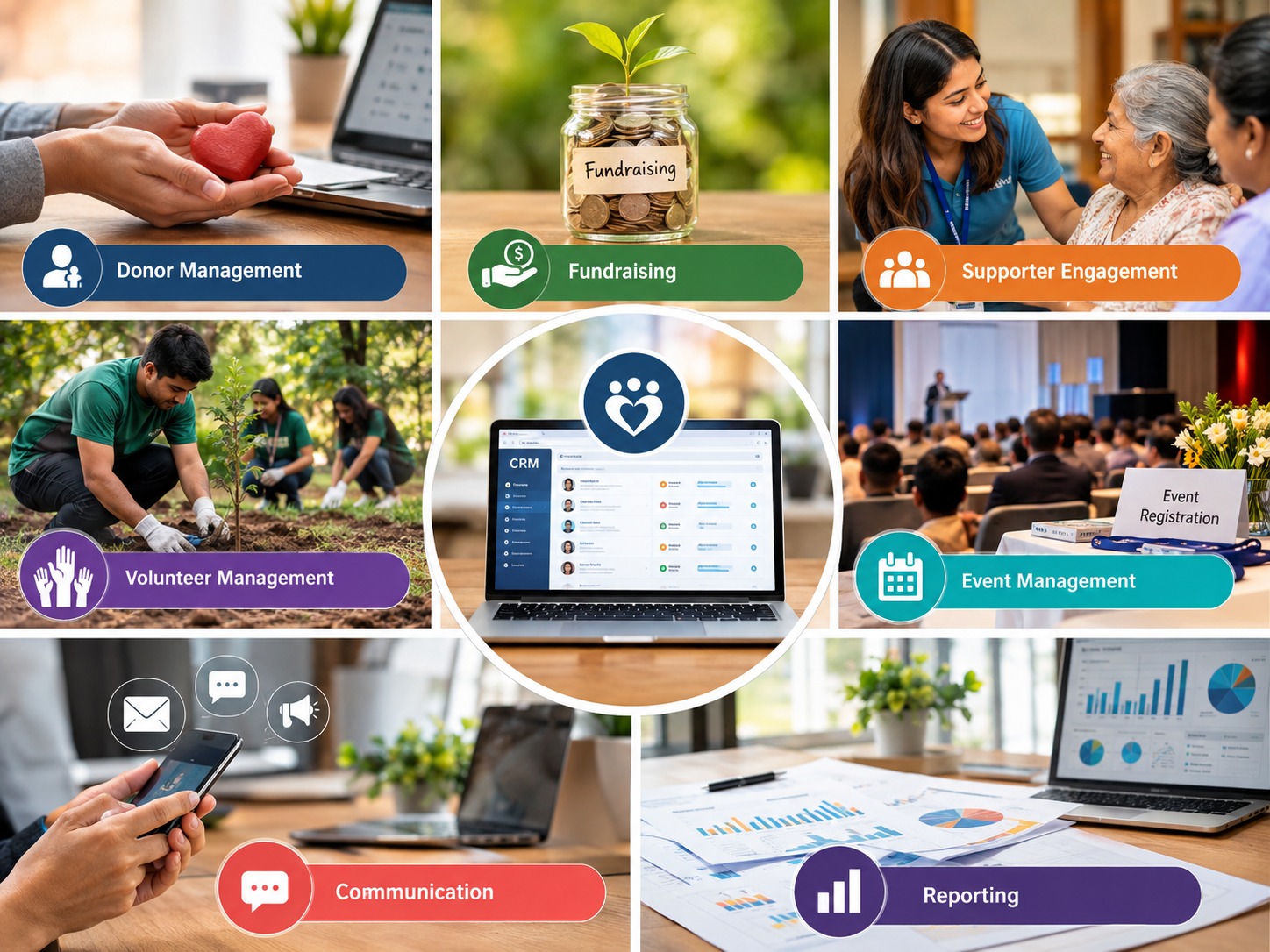
What Can a Charity CRM Help Manage?
A charity CRM can support several areas of nonprofit operations, although the exact capabilities vary between systems.
Donor Management
The CRM can help maintain donor profiles, contribution history, communication records, and engagement information.
Fundraising
It can help organisations organise fundraising campaigns, track supporter participation, and review fundraising information.
Supporter Engagement
A CRM can help charities understand how people interact with the organisation across different activities.
Volunteer Management
Where supported, a CRM can help maintain volunteer records, interests, participation, and communication.
Event Management
Organisations may use CRM information to manage event participants, invitations, attendance, and follow-ups.
Communication
A structured contact record can help staff understand previous communication and coordinate future engagement.
Reporting
A CRM can bring relevant information together for internal reports and management decisions.
The important point is that charities should select functions based on actual organisational needs rather than simply choosing the system with the longest feature list.
What Features Should a Charity CRM Have?
The most useful charity CRM features depend on the organisation, but several capabilities are commonly important.
1. Centralised Contact Management
A charity should be able to maintain organised records for relevant people and relationships.
A profile might contain:
- Name
- Contact information
- Relationship type
- Contribution history
- Communication history
- Engagement information
- Relevant notes
- Interests or preferences where appropriate
Centralising this information can reduce the need to search across multiple files.
2. Donor and Contribution Tracking
Donor management is an important part of many charity CRMs.
The system should make it possible to understand a donor’s contribution history and relevant engagement.
For example, an NGO might want to know:
- Has this person supported the organisation before?
- Which campaign did they support?
- When did they contribute?
- Have they supported multiple projects?
- Has the organisation communicated with them recently?
This information can support more thoughtful donor relationships.
3. Communication History
A charity CRM should ideally help staff understand previous interactions with supporters.
This might include:
- Thank-you messages
- Campaign communication
- Project updates
- Event invitations
- Follow-up activities
- Donor requests
- Important notes
This reduces the risk of different team members contacting the same person without knowing what has already been discussed.
4. Segmentation
Segmentation allows charities to organise contacts into meaningful groups.
For example:
- First-time donors
- Repeat donors
- Regular supporters
- Inactive supporters
- Volunteers
- Event participants
- Campaign-specific supporters
- Supporters interested in particular welfare areas
Segmentation can make communication more relevant.
A supporter interested in education initiatives may appreciate education-related updates more than messages about unrelated activities.
5. Fundraising Campaign Management
A CRM can help connect supporters with fundraising activities.
For example, a charity running an emergency relief campaign may want to understand:
- Who supported the campaign
- When contributions were received
- How supporters were engaged
- Which follow-ups were completed
- What reporting needs to be prepared
This provides a more complete picture of the campaign than a simple total amount.
6. Reporting and Dashboards
A charity CRM should provide useful information in a form that administrators and trustees can understand.
Depending on the system, reports may help answer questions such as:
- How many active supporters do we have?
- How many new donors joined during a period?
- Which fundraising campaigns received support?
- How many donors contributed more than once?
- Which supporters have become inactive?
- How are different engagement activities performing?
Reports should support decisions rather than simply display large amounts of data.
7. Search and Filtering
Search functionality may seem basic, but it is extremely important.
Staff should be able to quickly find a donor, volunteer, supporter, campaign, or relevant record.
Useful filters can make it easier to answer questions such as:
“Show me supporters who contributed to our education initiative and have not received an update recently.”
The exact filtering capabilities will vary by CRM, but the principle is simple: information should be easy to find when the team needs it.
8. User Access and Permissions
Different people in an organisation may need different levels of access.
For example, a volunteer may only need access to specific contact information, while an administrator may need broader access.
Charities should therefore consider whether the CRM provides appropriate user roles and permissions.
This is particularly important when a system contains personal or contribution-related information.
How Can a CRM Improve Donor Relationships?
A charity CRM can improve donor relationships by giving the organisation a more complete and organised view of each supporter.
Instead of seeing a donor as simply a name attached to a contribution, the organisation can understand the relationship over time.
For example:
First Contribution → Thank You → Project Update → Further Engagement → New Contribution → Continued Relationship
This can help charities communicate with greater context and avoid treating every donor interaction as a separate transaction.
Technology does not create trust by itself. Trust still depends on honest communication, responsible use of funds, appropriate reporting, and genuine engagement.
How Can a CRM Support Fundraising?
A CRM can support fundraising by helping organisations organise donor information, campaign participation, communication, and contribution history.
Consider a community organisation raising funds for an education-support programme.
The fundraising team may need to:
- Identify existing supporters.
- Share information about the project.
- Record contributions.
- Acknowledge supporters.
- Provide relevant updates.
- Track engagement.
- Review campaign results.
- Maintain relationships after the campaign.
A CRM can help organise these activities around a shared set of records.
Can a CRM Help With Donor Retention?
Yes. A CRM can support donor retention by helping charities maintain consistent records and follow-up processes.
Donor retention is influenced by many factors, including communication, trust, donor experience, appreciation, and how clearly organisations communicate about their work.
A CRM can support these activities by helping teams identify:
- Previous donors
- Recent contributors
- Inactive supporters
- Communication history
- Engagement patterns
- Relevant interests
This information can help staff plan more appropriate communication instead of sending identical messages to every supporter.
How Can a CRM Help Volunteers?
A charity CRM can help organisations maintain structured volunteer information where volunteer management is part of the system.
Relevant information may include:
- Volunteer contact details
- Areas of interest
- Availability
- Participation history
- Events or activities
- Communication records
For a community organisation running food distribution, education support, or local welfare activities, having an organised volunteer record can make coordination easier.
However, organisations should choose volunteer-management capabilities based on their actual needs. A CRM should not become unnecessarily complicated simply because it offers many possible functions.
Can a Charity CRM Manage Beneficiaries?
Not every CRM is designed to manage beneficiaries, and charities should distinguish between relationship management and beneficiary management.
A traditional CRM may focus primarily on donors and supporters. Organisations delivering welfare programmes may also need systems for beneficiary records, welfare projects, activities, outcomes, and service delivery.
If beneficiary management is important to the organisation, this should be evaluated separately during software selection.
The organisation should ask:
- What beneficiary information needs to be maintained?
- Who should have access?
- How does beneficiary information connect with projects?
- What reporting is required?
- How should sensitive information be handled?
This is one reason why a broader welfare-management approach can sometimes be more appropriate than a donor-focused CRM alone.
How Can a CRM Improve Transparency and Accountability?
A CRM can support transparency and accountability by helping an organisation maintain organised records of relationships, contributions, communications, and activities.
For internal management, this can make it easier to trace information and prepare reports.
For example, an organisation may be able to connect:
Donor → Contribution → Fundraising Activity → Welfare Project
The organisation can then maintain separate information about beneficiaries, activities, outcomes, and reporting where its systems support those processes.
A CRM does not automatically make an organisation transparent. Transparency also requires good internal procedures, responsible record-keeping, clear communication, and appropriate reporting.
What Are the Benefits of Using a CRM for Charities?
The benefits depend on how well the system fits the organisation’s needs and how consistently it is used.
Common benefits include:
Better Organisation
Information can be maintained in a structured system instead of scattered across multiple files.
Easier Donor Management
Staff can access relevant contribution and communication history more easily.
More Consistent Communication
Teams can understand previous interactions before contacting supporters.
Improved Fundraising Coordination
Campaign and supporter information can be organised together.
Better Reporting
Relevant information can be retrieved more easily for internal review.
Reduced Administrative Work
A well-designed system can reduce repetitive searching and manual record management.
Better Team Coordination
Authorised team members can work from a shared source of information.
Stronger Long-Term Relationships
Organised information can help charities maintain more informed relationships with donors and supporters.
What Challenges Should Charities Consider Before Using a CRM?
A CRM can introduce challenges if the organisation does not prepare properly.
Data Migration
Existing information may be spread across spreadsheets, documents, email accounts, or other systems.
Moving this information may require cleaning and standardising the data first.
Staff Adoption
People need to understand how and why the system should be used.
Data Quality
A CRM cannot compensate for inaccurate or outdated information.
Unnecessary Complexity
Choosing too many features can make the system difficult to manage.
Cost
Charities should consider the full cost of the system, including setup, training, support, and any additional services.
Process Changes
A CRM may require the organisation to establish clearer procedures for data entry, communication, and responsibility.
How Should a Charity Choose the Right CRM?
A charity should choose a CRM by first understanding its own processes and then comparing systems against those needs.
A practical selection process can follow these steps.
Step 1: Identify the Problem
Ask what is currently difficult.
Is the organisation struggling with:
- Donor records?
- Communication?
- Fundraising coordination?
- Reporting?
- Volunteer management?
- Duplicate information?
Start with the actual problem.
Step 2: Map the Current Workflow
Document what happens when:
A donor contributes → the contribution is recorded → the donor is thanked → project information is shared → follow-up happens → reporting is prepared.
This reveals where a CRM could help.
Step 3: Define Essential Features
Separate features into:
- Essential
- Useful
- Future requirements
This prevents the organisation from paying for complexity it does not need.
Step 4: Test With Real Scenarios
Instead of simply watching a software demonstration, test realistic workflows.
For example:
“Find a previous donor, review their contribution history, record a new contribution, identify their campaign interest, and prepare a follow-up.”
A practical test can reveal whether the system genuinely fits the organisation.
Step 5: Consider Data and Security
Review access controls, data handling, backup arrangements, export options, and provider policies.
Step 6: Consider Future Growth
A system should be able to support the organisation’s expected development without forcing unnecessary complexity today.
What Should a Small NGO Look for in a CRM?
A small NGO should prioritise simplicity, affordability, essential donor management, reliable records, and ease of adoption.
It may not need an extensive enterprise system.
A smaller organisation could begin by focusing on:
- Contact management
- Donor records
- Contribution tracking
- Communication history
- Basic segmentation
- Simple reporting
- User access controls
As its programmes and fundraising activities grow, its technology requirements can be reviewed.
How Should Charities Prepare Their Data Before Using a CRM?
Charities should clean and organise their existing data before moving it into a new CRM.
A practical preparation process includes:
- Collecting information from current sources.
- Identifying duplicate records.
- Correcting obvious errors.
- Standardising names and contact details.
- Identifying incomplete records.
- Reviewing old information.
- Deciding what information actually needs to be retained.
- Defining who should access different types of information.
- Establishing consistent data-entry practices.
- Creating a basic process for maintaining data quality.
Good data is the foundation of useful CRM reporting.
How Can a CRM Fit Into a Charity’s Wider Welfare System?
A CRM can be valuable, but donor and supporter management is only one part of a charity’s operations.
A welfare organisation may need to manage:
- Donors
- Contributions
- Funds
- Fundraising campaigns
- Welfare projects
- Beneficiaries
- Staff
- Volunteers
- Communication
- Reporting
- Outcomes
This can be viewed as a connected ecosystem:
Donors → Contributions → Funds → Welfare Projects → Beneficiaries → Outcomes → Reporting → Continued Support
This broader view is central to Welfare Governance.
Welfare Governance can be understood as the structured management of an organisation’s welfare activities, resources, people, projects, beneficiaries, accountability, reporting, and impact.
A CRM can help manage relationships within this ecosystem, particularly around donors and supporters. A broader welfare-management platform can address a wider set of organisational processes where those capabilities are required.
What Does a Practical Charity CRM Workflow Look Like?
A simple CRM-supported workflow might look like this:
- Add or identify the supporter
Create or locate the supporter record.
- Record the interaction
Capture relevant communication or engagement.
- Record the contribution
Maintain accurate contribution information.
- Connect the supporter to the relevant activity
Where appropriate, associate the supporter with a campaign, event, or welfare initiative.
- Follow up
Send an appropriate acknowledgement or update.
- Maintain the relationship
Review engagement over time.
- Report
Use organised information for internal decision-making.
- Connect with wider welfare operations
Where the organisation’s technology supports it, connect fundraising information with projects, beneficiaries, activities, and reporting.
This makes the CRM part of a process rather than just a database.
What Mistakes Should Charities Avoid When Implementing a CRM?
Charities should avoid treating CRM implementation as purely a technology project.
Common mistakes include:
Buying Before Defining Requirements
Software should follow the organisation’s needs, not the other way around.
Trying to Migrate Everything
Old or irrelevant information may not need to be transferred.
Ignoring Staff Training
People need clear guidance on how records should be created and maintained.
Allowing Inconsistent Data Entry
Different formats for names, contact details, or notes can make records difficult to use.
Measuring Success Only by Data Volume
A large database is not necessarily a useful database.
Forgetting the Donor Experience
The purpose of CRM is to support relationships, not simply collect information.
Focusing Only on Fundraising
A charity’s work extends beyond the fundraising transaction.
How Can Technology Support Better Charity Management?
Technology can support charity management by connecting information and reducing unnecessary administrative effort.
But technology should remain secondary to the organisation’s mission.
A useful system should help people answer practical questions:
- Who supports our work?
- What have they supported?
- How have we communicated with them?
- Which campaigns are active?
- Where are resources being directed?
- Which welfare projects are being managed?
- What information do we need for reporting?
- How can we improve coordination?
When technology makes these questions easier to answer, it becomes part of better organisational management.
Frequently Asked Questions
What is a CRM for charities?
A CRM for charities is a system that helps nonprofit organisations organise donor, supporter, volunteer, communication, fundraising, and relationship information.
Why do charities need a CRM?
Charities can use a CRM to organise information, reduce fragmented records, improve donor communication, support fundraising, and make relevant information easier to access.
What is the difference between a CRM and donor management software?
A CRM can cover a broader range of relationships and activities, while donor management software generally focuses more specifically on donors, contributions, and fundraising-related information.
Can small NGOs use a CRM?
Yes. Small NGOs can use a CRM when it addresses their actual needs. They can start with essential functions such as contact management, donor records, contribution tracking, communication, and reporting.
Can a CRM manage donations?
Many charity-focused CRMs can record or organise donation-related information, although the exact donation and payment capabilities vary by system.
Can a CRM manage beneficiaries?
Not every CRM is designed for beneficiary management. NGOs should check whether the system supports the beneficiary information, project activities, privacy controls, and reporting they actually require.
How does CRM help donor retention?
A CRM can help charities maintain donor history, communication records, engagement information, and follow-up processes, which can support more consistent donor relationships.
Is a CRM enough to manage an entire charity?
Not necessarily. A CRM can be an important part of charity management, but organisations may also need systems for welfare projects, beneficiaries, finance, volunteers, operations, reporting, and other activities.
How NidhiMax Can Help
A charity CRM can solve an important organisational challenge: keeping relationships and information organised. But many welfare organisations need to look beyond donor relationships alone.
Their work connects donors, contributions, funds, welfare projects, beneficiaries, outcomes, reporting, and continued support.
NidhiMax — Welfare Governance Platform is designed to help charitable organisations, NGOs, trusts, community organisations, and welfare institutions move toward a more organised digital welfare-management ecosystem.
The right technology should reflect the organisation’s actual welfare processes rather than forcing every organisation into the same structure. For charities exploring digital systems, this broader approach can help connect donor management with fundraising, welfare activities, reporting, transparency, accountability, and operational coordination where relevant.