 Post by
For a charity or NGO, donor data is much more than a list of names and donation amounts. It can help an organisation understand its supporters, maintain accurate contribution records, communicate appropriately, improve fundraising processes, and build stronger long-term relationships.
As a charitable organisation grows, donor information can end up scattered across spreadsheets, paper records, emails, payment platforms, messaging applications, and individual staff files. This makes even simple tasks difficult. Finding a donor’s previous contribution, checking whether an acknowledgement was sent, or understanding which welfare project they supported can require unnecessary manual work.
Good donor data management creates a more organised way to handle this information.
The objective is not to collect as much information as possible. It is to collect relevant information, keep it accurate, protect it appropriately, and make it useful for the organisation’s work.
What Is Charity Donor Data Management?
Charity donor data management is the process of collecting, organising, maintaining, protecting, and using information about donors and their contributions.
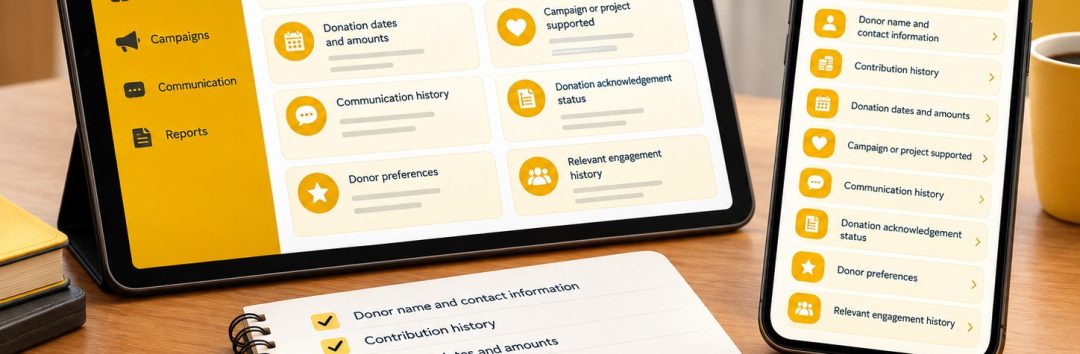
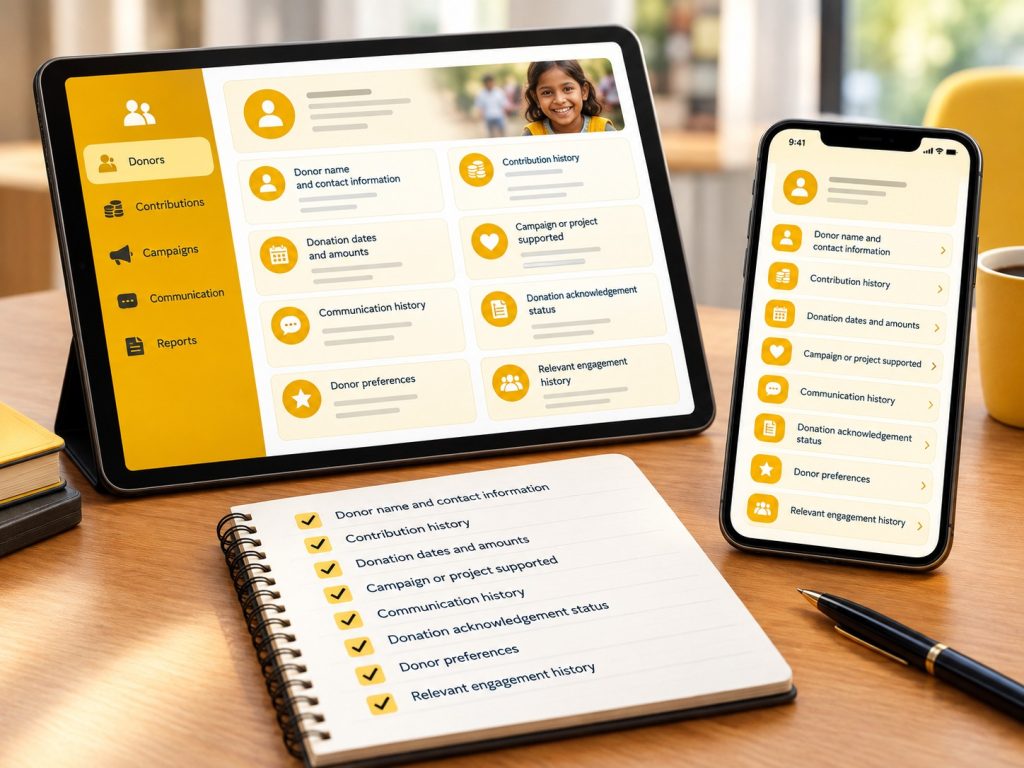
For an NGO or charitable organisation, donor data may include:
- Donor name and contact information
- Contribution history
- Donation dates and amounts
- Campaign or project supported
- Communication history
- Donation acknowledgement status
- Donor preferences
- Relevant engagement history
The exact information an organisation needs will depend on its activities and internal processes.
Good management means that authorised team members can find reliable information when they need it without maintaining several disconnected versions of the same donor record.
Why Is Managing Donor Data Important for Charities?
Managing donor data properly helps charities maintain accurate records, communicate with supporters, coordinate fundraising activities, and improve organisational accountability.
Imagine a community organisation receiving contributions for education support, healthcare assistance, and food distribution. If each campaign maintains its own donor spreadsheet, the organisation may not have a clear picture of its overall supporter relationships.
A structured donor-data process can help the organisation:
Understand donor history
The team can see relevant contribution and communication history without searching through multiple files.
Improve donor communication
Accurate information makes it easier to send appropriate acknowledgements, updates, and project communications.
Reduce administrative errors
Consistent records can reduce problems such as duplicate entries, missing information, and outdated contact details.
Support fundraising planning
Historical information can help fundraising teams understand existing relationships and organise future activities.
Strengthen accountability
Organised records can make it easier to connect contributions with campaigns, projects, activities, and reporting.
What Types of Donor Data Should a Charity Collect?
A charity should collect donor information that has a clear organisational purpose and is relevant to fundraising, communication, reporting, or donor relationship management.
A practical donor record can be divided into several categories.
1. Donor identification information
Depending on the organisation’s needs:
- Name
- Email address
- Phone number
- Organisation name, where relevant
- Preferred communication channel
2. Contribution information
This may include:
- Contribution date
- Amount
- Payment method
- Campaign or project
- One-time or recurring contribution
- Relevant transaction or receipt reference
3. Communication information
An organisation may record:
- Important donor conversations
- Acknowledgements
- Project updates
- Follow-up activities
- Communication preferences
4. Engagement information
Where relevant, this could include:
- Event participation
- Volunteer involvement
- Campaign engagement
- Other forms of supporter participation
The principle should be simple: collect useful information rather than collecting information simply because a system allows it.
What Are the Best Practices for Managing Charity Donor Data?
The best practices for managing charity donor data include standardising information, maintaining one reliable source of records, regularly updating data, protecting access, documenting communication, and reviewing the database for errors.
Here are the most practical practices an NGO can adopt.
1. Create a clear donor-data structure
Before choosing software, decide what information the organisation actually needs.
For example, a basic donor record could include:
Field | Example |
Donor Name | Anitha Menon |
Contribution Date | 18 September |
Amount | ₹5,000 |
Contribution Type | One-time |
Supported Project | Education Support |
Acknowledgement | Sent |
Communication Preference |
This is only an example. Each organisation should create fields according to its own requirements.
2. Maintain one reliable source of donor information
A charity should have a clearly defined primary source for donor records rather than allowing important information to remain scattered across multiple unofficial files.
For example, if the fundraising team maintains one spreadsheet while the accounts team maintains another and a programme manager keeps donor information in email, inconsistencies can quickly appear.
A centralised approach makes it easier to answer questions such as:
- How much has a particular donor contributed?
- When did they last contribute?
- Which project did they support?
- Has their contribution been acknowledged?
- What communication has already taken place?
3. Standardise data entry
Standardised data entry helps prevent inconsistent donor records and makes information easier to search, compare, and report.
For example, the same city should not be entered as:
- Kochi
- Cochin
- KOCHI
- Kochi, Kerala
unless the organisation deliberately uses different formats for a specific reason.
Similarly, donor names, phone numbers, dates, and campaign names should follow agreed internal conventions.
Create simple rules for:
- Names
- Dates
- Phone numbers
- Email addresses
- Campaign names
- Project names
- Contribution categories
The simpler the rules, the easier they are for staff and volunteers to follow.
How Can Charities Keep Donor Data Accurate?
Charities can improve donor-data accuracy by checking information at the point of entry, updating records regularly, identifying duplicates, and assigning responsibility for data maintenance.
Accuracy should be treated as an ongoing process rather than a one-time cleanup exercise.
Check information when it enters the system
If a donor provides a new email address, update it rather than creating a second record.
Review duplicate records
A donor may appear under slightly different names or contact details.
Update outdated information
Old phone numbers and email addresses can make future communication difficult.
Correct errors promptly
Small mistakes become more difficult to fix when they remain in the database for months.
Assign responsibility
Someone should be responsible for maintaining the quality of donor records, even if several people enter information.
How Can NGOs Prevent Duplicate Donor Records?
NGOs can reduce duplicate records by checking existing information before creating new profiles, using consistent data-entry rules, and periodically reviewing similar records.
For example, these entries could potentially refer to the same person:
- Joseph Thomas
- J. Thomas
- Joseph T.
- Joseph Thomas – Kochi
Duplicates can fragment a donor’s contribution history and make reporting less reliable.
A basic duplicate-management process can involve:
- Searching for an existing donor before creating a new record.
- Using consistent names and contact details.
- Checking similar email addresses and phone numbers.
- Reviewing possible duplicate records periodically.
- Carefully combining duplicate information when appropriate.
- Establishing clear rules to prevent the same issue from recurring.
How Should Charity Donor Data Be Protected?
Charities should protect donor data by limiting access to authorised people, using appropriate security controls, maintaining sensible data-handling procedures, and avoiding unnecessary sharing of personal information.
Donor information can include personal contact details and contribution history, so it should be treated responsibly.
Practical measures include:
- Give staff access based on their responsibilities.
- Avoid sharing complete donor databases unnecessarily.
- Use strong account credentials and appropriate security controls.
- Remove access when someone leaves the organisation.
- Maintain appropriate backup procedures.
- Be careful when exporting or sharing donor lists.
- Train staff and volunteers on responsible data handling.
- Review who can access sensitive donor information.
The exact security and privacy requirements applicable to an organisation can vary. Charities should follow relevant legal and professional requirements and obtain appropriate advice where necessary.
How Often Should Charity Donor Data Be Updated?
Donor data should be updated whenever meaningful information changes, with periodic reviews to identify outdated, duplicate, or incomplete records.
Waiting for an annual cleanup can allow small problems to accumulate.
A charity can establish simple routines:
After each contribution
Record the relevant contribution details.
After important communication
Update the donor’s interaction history where appropriate.
During campaign activities
Review contact and contribution information.
During periodic data reviews
Identify duplicates, outdated information, and incomplete records.
This creates a continuous process instead of a large data-cleaning exercise every few years.
How Can Donor Data Improve Communication?
Accurate donor data allows charities to make communication more relevant, timely, and consistent.
A donor who contributes to an education-support initiative may appreciate an update about that initiative. Another supporter may be more interested in healthcare assistance or community development.
A well-organised record can help an NGO understand:
- What the donor previously supported
- What communication has already been sent
- Which channel is appropriate
- Whether a contribution has been acknowledged
- What follow-up may be relevant
Good communication should still feel human. Donor data should help staff understand relationships, not turn every interaction into a generic automated message.
How Can Charities Use Donor Data for Better Fundraising?
Charities can use organised donor data to understand supporter history, monitor fundraising activities, identify communication opportunities, and plan future campaigns more systematically.
For example, an NGO could review:
- One-time versus recurring contributions
- Previous campaign participation
- Contribution history
- Donor engagement
- Communication history
This does not mean every donor should be approached in the same way.
Instead, organised information gives fundraising teams better context when planning their activities.
What Is the Difference Between Donor Data and Donor Management?
Donor data refers to the information an organisation maintains about its supporters, while donor management is the broader process of organising that information and using it to support communication, fundraising, relationships, and reporting.
Think of donor data as the information and donor management as the process around it.
For example:
Donor data:
A supporter contributed ₹5,000 to an education project.
Donor management:
The organisation records the contribution, sends an acknowledgement, maintains the interaction history, connects the contribution to the relevant project, and includes appropriate information in future communication.
Both need to work together.
How Can a Charity Connect Donor Data With Welfare Projects?
A charity can connect donor data with welfare projects by linking contributions to specific campaigns or activities and maintaining appropriate records of how those activities progress.
Consider a community organisation running an education-support programme.
The organisation may manage:
Donors → Contributions → Education Project → Activities → Beneficiaries → Outcomes → Reporting
This creates a more complete picture than simply recording the amount collected.
For example, fundraising staff can know which contributions were associated with the programme, while programme teams can maintain information about project activities and beneficiaries.
This connection can also support appropriate donor reporting.
Why Should Donor Data Be Connected to Welfare Governance?
Donor data becomes more valuable when it forms part of a wider welfare governance system that connects resources, projects, beneficiaries, activities, reporting, and accountability.
Fundraising is only one part of charitable work.
A broader welfare-management approach considers the complete journey:
Donors → Contributions → Funds → Welfare Projects → Beneficiaries → Outcomes → Reporting → Continued Support
This helps an organisation think beyond the donation transaction.
For example, if a donor contributes toward food distribution, the organisation’s work does not end when the contribution is received. The organisation may also need to coordinate the relevant welfare project, manage activities, maintain appropriate beneficiary information, document progress, and communicate meaningful updates.
That is where Welfare Governance becomes relevant.
Welfare governance can be understood as the structured management of an organisation’s welfare activities, resources, people, projects, beneficiaries, accountability, reporting, and impact.
What Are the Common Mistakes in Charity Donor Data Management?
Common mistakes include collecting unnecessary information, maintaining multiple disconnected databases, failing to update records, allowing unrestricted access, inconsistent data entry, and treating donor data only as a fundraising list.
Some common problems include:
Keeping too many spreadsheets
Multiple versions of donor lists make it difficult to determine which information is current.
Collecting unnecessary information
More data does not automatically mean better donor management.
Ignoring data quality
Incorrect email addresses and duplicate profiles reduce the value of the database.
Forgetting communication history
Without interaction records, staff may repeat messages or miss important follow-ups.
Giving everyone the same access
Donor information should be accessible according to legitimate organisational responsibilities.
Treating donations as isolated transactions
A contribution can be connected to campaigns, welfare projects, activities, and reporting.
How Can Small NGOs Start Managing Donor Data Better?
Small NGOs can start with a simple donor-data process and improve it gradually as their fundraising and welfare activities grow.
A practical starting point is:
- List the donor information you actually need.
- Create a standard donor-record format.
- Choose one primary location for the records.
- Clean existing donor information.
- Establish simple data-entry rules.
- Assign responsibility for maintaining records.
- Create a basic communication process.
- Review the system periodically.
- Introduce dedicated technology when manual processes become difficult to manage.
The goal is not to build a complicated system from day one.
A simple process that staff consistently follow is often more useful than a sophisticated system that nobody maintains properly.
When Should a Charity Consider Donor Management Software?
A charity should consider dedicated donor management technology when the volume or complexity of its donor information makes manual processes difficult to maintain accurately and efficiently.
Signs that an organisation may need a more structured system include:
- Multiple people maintaining donor records
- Growing numbers of contributions
- Several fundraising campaigns
- Frequent duplicate records
- Difficulty finding donor history
- Increasing communication requirements
- More complex reporting needs
- Donor information spread across different systems
- Difficulty connecting fundraising with welfare projects
Technology should solve a genuine operational problem.
Before choosing a platform, an organisation should understand its workflows and identify which problems the technology needs to address.
How Can Technology Improve Charity Donor Data Management?
Technology can help charities centralise donor information, organise contribution records, support communication, improve reporting, and connect donor management with wider welfare-management processes.
A useful digital system can help reduce dependence on scattered spreadsheets and individual staff knowledge.
The more important question, however, is not simply whether an organisation has software. It is whether the software supports the way the organisation actually works.
A charity should consider:
- What information needs to be connected?
- Who needs access?
- Which processes are currently manual?
- Where do errors occur?
- What reports does the organisation need?
- How does fundraising connect with welfare projects?
- How can donor communication remain personal and relevant?
Technology works best when it follows a clear organisational process.
Frequently Asked Questions
What is donor data management for charities?
Donor data management is the process of collecting, organising, updating, protecting, and using information about donors and their contributions.
What information should a charity collect from donors?
A charity should collect information that is relevant to its fundraising, communication, reporting, and operational needs, such as contact details and contribution history.
How can NGOs keep donor data accurate?
NGOs can maintain accuracy by standardising data entry, updating records regularly, checking for duplicates, correcting errors, and assigning responsibility for data quality.
How can charities protect donor information?
Charities can protect donor information by limiting access, using appropriate security measures, training staff, maintaining sensible data-handling procedures, and avoiding unnecessary sharing.
Can a small NGO use a spreadsheet for donor management?
Yes. A spreadsheet can be practical for a small organisation with straightforward donor-management needs. As operations become more complex, dedicated software may become more useful.
How does donor data support fundraising?
Organised donor data can help fundraising teams understand contribution history, campaign engagement, communication history, and supporter relationships when planning fundraising activities.
Why should donor data be connected to welfare projects?
Connecting donor information with relevant welfare projects can help an organisation understand the relationship between contributions, activities, beneficiaries, outcomes, and reporting.
How can technology help manage charity donor data?
Technology can provide a more organised way to manage donor records, contributions, communications, reporting, and related welfare-management processes.
How NidhiMax Can Help
Building a Better Welfare Governance System
Good donor data management is ultimately about more than maintaining a database. It is about creating a reliable information flow that supports the organisation’s wider welfare work.
NidhiMax — Welfare Governance Platform is designed to help charitable organisations, NGOs, trusts, community organisations, and welfare institutions move toward a more organised digital welfare-management ecosystem.
For organisations working across fundraising, donor management, contribution tracking, welfare projects, beneficiaries, communication, reporting, transparency, and accountability, a connected approach can make it easier to understand how different parts of the organisation relate to one another.
Every organisation has different processes and requirements. Technology should therefore support the organisation’s actual welfare activities rather than force teams into unnecessary complexity.
To explore the broader approach to organised welfare management, visit NidhiMax.com.