
 Post by
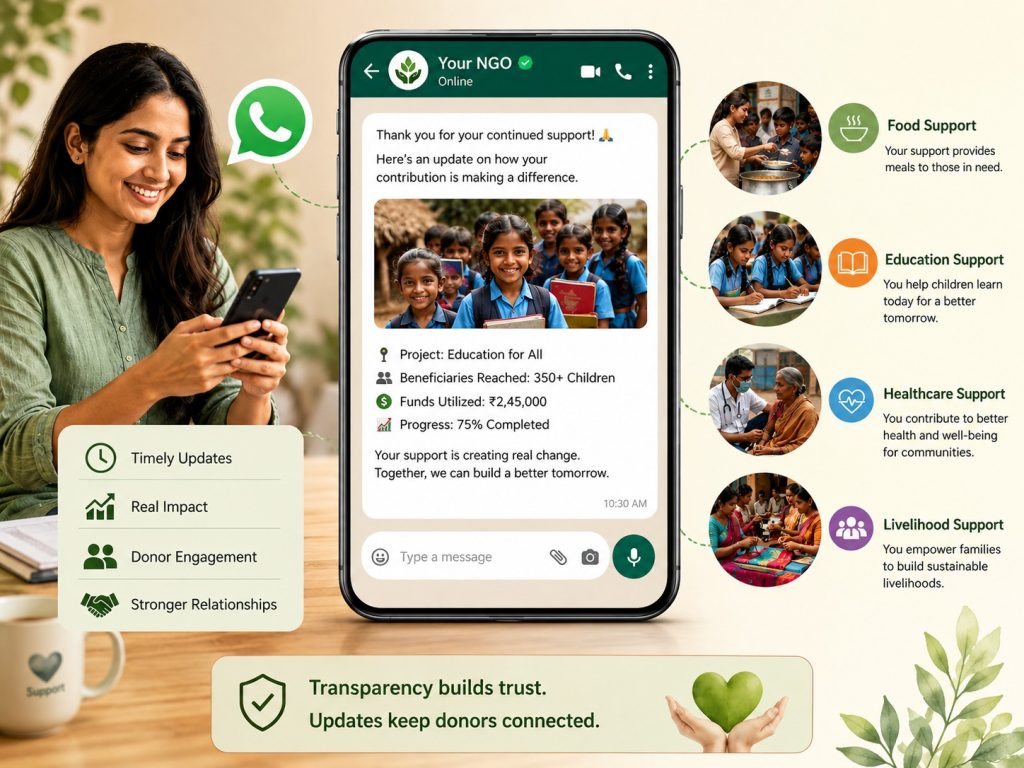
Fundraising does not end when a donor contributes. For charities, NGOs, trusts, and welfare organisations, keeping donors informed about how their support is being used is an important part of building trust and maintaining long-term relationships.
WhatsApp can be a practical communication channel for sharing fundraising updates because many donors already use it in their daily lives. A short message about a campaign milestone, a project update, or the progress of a welfare initiative can help supporters feel connected to the work they have chosen to support.
However, sending updates to donors on WhatsApp requires more than forwarding the same message to everyone. Organisations need to decide what to communicate, when to send it, how often to follow up, and how to connect communication with accurate information about contributions, funds, welfare projects, beneficiaries, and outcomes.
This guide explains how NGOs and charitable organisations can send useful fundraising updates to donors on WhatsApp while improving transparency, donor experience, and accountability.
Why Should Charities Send Fundraising Updates to Donors on WhatsApp?
Charities should send fundraising updates on WhatsApp to keep donors informed, demonstrate progress, and maintain an ongoing relationship beyond the original donation. Clear and relevant updates can help supporters understand what is happening with a fundraising campaign and the welfare work connected to their contributions.
A donor may contribute to an education-support initiative, emergency relief effort, healthcare assistance programme, food distribution project, or community development campaign. After contributing, they may naturally want to know:
- Did the organisation reach its fundraising goal?
- Is the campaign still active?
- What happened after the funds were collected?
- What activities were carried out?
- Who or what did the project support?
- What progress has been made?
- Will the organisation share future updates?
Regular communication can answer these questions before donors have to ask them.
WhatsApp can make updates easier to notice
Unlike a long newsletter that may remain unread in an inbox, WhatsApp messages are often seen quickly. This can make the platform useful for short, timely communication.
For example, a charity could send:
Thank you for supporting our education campaign. We are pleased to share that the first phase of the programme has now begun. We will continue to update supporters as the project progresses.
The message does not need to be complicated. Its value comes from being relevant, accurate, and connected to the donor’s support.
What Types of Fundraising Updates Should an NGO Send on WhatsApp?
An NGO should send updates that help donors understand the journey from fundraising to welfare activity and outcomes. Useful updates may include campaign progress, project milestones, fund utilisation summaries, activity updates, impact stories, and appropriate opportunities for continued support.
A good communication plan can include several types of updates rather than sending only donation appeals.
1. Fundraising campaign progress updates
Let donors know how a campaign is progressing.
For example:
Our community healthcare fundraising campaign is continuing, and the first phase of support activities is now being planned. Thank you for being part of this effort.
Where accurate campaign information is available, the organisation may also share clear progress details.
The important point is to avoid exaggerating progress or presenting estimates as confirmed results.
2. Milestone updates
Share meaningful moments during a campaign or project.
Examples include:
- A fundraising phase being completed
- A welfare project beginning
- Essential materials being distributed
- A new programme phase starting
- A project reaching an important operational milestone
Milestones give donors a sense that the work is moving forward.
3. Project activity updates
Donors may appreciate knowing what their support has helped make possible.
Imagine a community organisation raising funds for an education-support programme for 100 children. After fundraising, the organisation could share periodic updates about activities such as:
- Learning materials being prepared
- Educational support sessions beginning
- Programme activities being conducted
- Progress toward the next phase of the project
The organisation should communicate respectfully and protect the privacy and dignity of beneficiaries.
4. Fund utilisation and accountability updates
Donors should not have to guess how a fundraising effort connects with actual welfare work.
An organisation can provide appropriately prepared updates explaining, at a high level, how funds are being directed toward planned project activities. Communication should be based on accurate organisational records.
For example:
The first phase of the funds raised is now being allocated to the planned programme activities. Our team is tracking project progress and will share further updates as the initiative develops.
The exact level of financial detail will depend on the organisation, the campaign, and the information it is prepared to report accurately.
5. Impact and outcome updates
Fundraising updates become more meaningful when they explain what happened after the money was collected.
Where information is available and properly verified, an organisation can share:
- Activities completed
- Services delivered
- Project outcomes
- Progress toward programme objectives
- Lessons from the initiative
- Next steps
This shifts communication from “we raised funds” to “this is how the welfare initiative progressed.”
6. Thank-you messages
A simple thank-you message remains important.
However, gratitude should not be the only communication a donor receives.
A stronger donor communication journey might look like this:
Thank You → Campaign Progress → Project Update → Outcome Update → Continued Relationship
How Can a Charity Create a WhatsApp Fundraising Update Plan?
A charity can create a WhatsApp fundraising update plan by defining its donor groups, deciding what information each group should receive, setting a reasonable communication schedule, and ensuring every update is based on accurate records.
Without a plan, communication can become inconsistent. Some donors may receive repeated fundraising requests, while others receive no information after contributing.
Step 1: Organise donor information
Before sending updates, the organisation should know who its donors are and what information is relevant to communication.
Depending on the organisation’s processes and permissions, useful information may include:
- Donor name
- Contact details
- Donation or contribution history
- Campaign supported
- Date of contribution
- Communication preferences
- Previous communication
- Relevant supporter category
Keeping this information organised helps reduce confusion and duplication.
Step 2: Segment donors where appropriate
Not every donor needs exactly the same message.
For example, a charity may have supporters connected to:
- Education initiatives
- Healthcare assistance
- Food distribution
- Emergency relief
- Community development
- General welfare activities
A donor who supported an emergency relief campaign may be more interested in an update about that specific initiative than a general fundraising message.
Segmentation can make communication more relevant.
Step 3: Decide what updates donors will receive
Create a simple communication structure.
For example:
Immediately after contribution
- Thank the donor
- Confirm the organisation has recorded the contribution, where appropriate
- Explain what type of updates they can expect
During fundraising
- Share relevant campaign progress
After fundraising
- Explain the next stage of the initiative
During project implementation
- Share meaningful activity or milestone updates
After an important project phase
- Share outcomes or a clear progress summary
Step 4: Set a reasonable frequency
Sending too few updates can make donors feel disconnected. Sending too many can become intrusive.
The right frequency depends on the campaign and the nature of the welfare work.
An emergency relief initiative may require more frequent updates during an active response. A long-term community development programme may be better suited to periodic milestone-based communication.
The goal is to communicate when there is something useful to say.
Step 5: Assign responsibility for communication
Someone should be responsible for preparing, reviewing, and sending updates.
For a small volunteer-led organisation, this may be one administrator. A larger NGO may involve fundraising, programme, finance, and communication teams.
Clear responsibility can help ensure that messages are:
- Accurate
- Timely
- Consistent
- Appropriate for the audience
- Connected to actual organisational records
What Should a Fundraising Update on WhatsApp Include?
A good fundraising update should clearly explain what is happening, why the update matters, and what the donor should understand from it. Most messages should be short enough to read easily while providing enough context to be meaningful.
A useful structure is:
1. Start with context
Remind the donor what the update relates to.
For example:
You supported our recent community food assistance fundraising initiative.
2. Share the actual update
Explain the progress, activity, milestone, or outcome.
We have now begun the next stage of the programme and are coordinating the planned distribution activities.
3. Connect it to the larger purpose
Help the donor understand why the update matters.
This is an important step in moving the initiative from fundraising into direct welfare support.
4. Thank the donor
Keep the relationship human.
Thank you for being part of this effort.
5. Provide an appropriate next step
Depending on the purpose of the message, this could be:
- Waiting for the next update
- Reading a detailed report
- Responding with a question
- Sharing the campaign with others
- Supporting a future phase
Do not force every update to become another donation request.
Example WhatsApp Fundraising Updates for NGOs and Charities
The following examples can be adapted to suit an organisation’s own welfare activities and communication style.
Example 1: Campaign progress update
Hello [Name], thank you for supporting our [Campaign Name]. We wanted to share a quick update: the fundraising effort is continuing, and our team is preparing for the next stage of the planned welfare activities. Thank you for being part of this initiative.
Example 2: Project update after fundraising
Hello [Name], because of the support received for our [Project Name], we have now moved into the implementation phase. Our team has begun the planned activities, and we will continue to share meaningful updates on the project’s progress. Thank you for your support.
Example 3: Milestone update
We are happy to share an update from our [Project Name]. An important project milestone has now been completed, and the team is preparing for the next phase of activities. Thank you for helping make this work possible.
Example 4: Impact-focused update
Hello [Name], we would like to share a progress update from the [Project Name] you supported. The programme activities are continuing, and we are documenting the progress and outcomes of the initiative. We appreciate your continued trust and support.
Example 5: Thank-you and future communication update
Thank you for your contribution to [Organisation/Campaign Name]. We value your support and will share relevant updates about the progress of the fundraising and welfare activities connected to this initiative.
These templates should be adapted to match the facts of each campaign. Generic wording should never replace accurate reporting.
How Can NGOs Make WhatsApp Updates More Meaningful for Donors?
NGOs can make WhatsApp updates more meaningful by focusing on relevance, clarity, progress, and real connection to the work being carried out. A donor should be able to understand why they received the message and what it tells them about the initiative they supported.
Use specific updates when possible
Compare these two messages:
Generic:
We are doing great work because of your support.
More useful:
We have now completed the first planned phase of our education-support programme and are preparing for the next stage.
Specific communication usually provides more value because it tells the donor what has actually happened.
Share the journey, not just the final result
Welfare work often develops over time.
A useful update journey may show:
Fundraising → Planning → Project Activity → Progress → Outcomes
This helps supporters understand that a contribution is part of a larger process.
Use simple language
Donors do not need internal organisational terminology.
Avoid messages filled with complex administrative language. Explain the update as you would explain it directly to a supporter who wants to understand the work.
Use visuals carefully
Where appropriate, organisations may use:
- Relevant photographs
- Short videos
- Project graphics
- Simple progress summaries
However, charities should be thoughtful about privacy, consent, dignity, and the representation of beneficiaries. A photograph should not turn a beneficiary into a marketing object.
Give donors useful ways to respond
Communication should not always be one-directional.
Where appropriate, provide a way for donors to ask questions or learn more. Donor feedback can also help an organisation understand what supporters want to know.
What Are the Common Challenges of Sending Fundraising Updates on WhatsApp?
The most common challenges include keeping donor information organised, avoiding duplicate or irrelevant messages, maintaining accurate communication, managing communication volume, and connecting fundraising updates with reliable project information.
Challenge 1: Donor records are scattered
A small organisation may have donor information spread across:
- Individual phones
- Spreadsheets
- Payment records
- Paper notes
- Multiple communication groups
This can make it difficult to identify who should receive which update.
A more organised donor management process can reduce the risk of missed or duplicated communication.
Challenge 2: Fundraising and project information are disconnected
The fundraising team may know how much was collected, while programme staff know what activities are happening.
If these records are disconnected, donor updates can become vague.
Better coordination helps connect:
Donors → Contributions → Funds → Welfare Projects → Beneficiaries → Outcomes
This creates a clearer basis for reporting and communication.
Challenge 3: Every donor receives the same message
Mass communication is convenient, but relevance matters.
A donor who supported a healthcare initiative may not want every message about an unrelated campaign. Organising donors and communication around relevant interests or campaigns can improve the supporter experience.
Challenge 4: Updates are sent only when more money is needed
If the only message a donor receives is another appeal, the relationship can become purely transactional.
Regular progress and outcome communication can help build a more informed and engaged donor relationship.
Challenge 5: Information is shared without proper internal verification
An update should reflect information the organisation can stand behind.
Before sending messages about funds, activities, beneficiaries, or outcomes, organisations should have an appropriate process for checking the information.
Accuracy is essential for accountability.
What Are the Best Practices for Donor Communication on WhatsApp?
The best donor communication practices on WhatsApp are to communicate with appropriate consent and respect, send relevant messages, protect personal information, keep records organised, and ensure updates are accurate before they are shared.
Key practices include:
- Communicate with donors in a manner consistent with their preferences and applicable requirements.
- Keep donor contact information secure.
- Avoid unnecessary sharing of personal information.
- Send relevant rather than excessive messages.
- Keep fundraising and project records organised.
- Verify important information before communicating it.
- Maintain a consistent communication process.
- Respect beneficiary dignity and privacy when sharing stories or images.
- Keep a record of significant donor communications where useful for organisational coordination.
- Avoid making promises about outcomes that cannot be supported.
Each organisation should establish communication practices appropriate to its size, operations, and responsibilities.
How Can Technology Help Manage WhatsApp Fundraising Updates?
Technology can help charities manage fundraising updates by organising donor information, contributions, campaigns, project activities, and reporting data so communication is based on a clearer view of the organisation’s work.
The challenge is often not writing a WhatsApp message. The bigger challenge is knowing:
- Which donor should receive it?
- What campaign did they support?
- What contribution is connected to the campaign?
- What has happened since the funds were collected?
- Which welfare project is being implemented?
- What information has already been communicated?
- What outcome information is available for reporting?
A connected digital system can make these questions easier to manage.
For example, imagine a charitable organisation raising funds for healthcare assistance. If donor records, contributions, funds, welfare projects, and beneficiary-related activities are managed in disconnected systems, preparing a reliable donor update can take significant manual effort.
A more organised digital process can support better coordination between fundraising, welfare operations, communication, and reporting.
Why Is Welfare Governance Important for Donor Updates?
Welfare Governance is important because a donor update is most useful when it is connected to the wider journey of how an organisation manages resources, welfare activities, accountability, and impact.
Fundraising is only one part of the overall welfare ecosystem.
The broader journey can be understood as:
Donors → Contributions → Funds → Welfare Projects → Beneficiaries → Outcomes → Reporting → Continued Support
When these areas are managed separately and without coordination, it can be difficult to produce meaningful updates.
Welfare Governance can be understood as the structured management of an organisation’s welfare activities, resources, people, projects, beneficiaries, accountability, reporting, and impact.
From this perspective, sending a WhatsApp update is not simply a communication task. It is part of a wider responsibility to maintain visibility over the journey from donor support to welfare activity and reported outcomes.
A well-organised system can help an organisation answer important operational questions:
- What funds were raised for a particular initiative?
- How are those funds connected to planned welfare activities?
- What stage has the project reached?
- What information is available about progress and outcomes?
- What has already been communicated to donors?
- What should be reported next?
This broader approach can support both donor communication and organisational accountability.
Frequently Asked Questions
Can a charity send fundraising updates to donors on WhatsApp?
Yes. WhatsApp can be used as a communication channel for fundraising and project updates where the organisation communicates appropriately with donors and manages their contact information responsibly.
What should an NGO include in a donor update?
A donor update should usually include context, the relevant progress or activity, why the update matters, and a clear thank-you. Important information should be accurate and based on the organisation’s records.
How often should charities send WhatsApp updates to donors?
There is no single ideal frequency. Charities should send updates when there is meaningful and relevant information to share, while avoiding excessive or unnecessary messaging.
Should every donor receive the same fundraising update?
Not always. Where practical, charities can make communication more relevant by considering the campaign, project, or type of welfare activity a donor supported.
How can an NGO make fundraising updates more transparent?
An NGO can improve transparency by sharing clear and accurate information about campaign progress, project activities, milestones, and available outcomes. Communication should be connected to reliable organisational records.
Can WhatsApp help charities build better donor relationships?
Yes. Thoughtful, relevant communication can help donors remain informed and connected to the welfare initiatives they support. WhatsApp should be used as part of an overall donor communication approach rather than only for repeated fundraising appeals.
What is Welfare Governance in a charitable organisation?
Welfare Governance is the structured management of welfare activities, resources, people, projects, beneficiaries, accountability, reporting, and impact. It helps connect different parts of an organisation’s welfare ecosystem.
How can NGOs manage donor communication more effectively?
NGOs can manage donor communication more effectively by keeping donor information organised, recording contributions accurately, connecting fundraising with project information, planning communications, and maintaining a clear history of important updates.
How NidhiMax Can Help Build a More Organised Welfare Governance System
Sending fundraising updates on WhatsApp is easier when an organisation has a clear view of the wider journey behind each update.
A donor may contribute to a campaign, but the organisation’s responsibility continues through fund management, welfare project activities, beneficiary coordination, progress tracking, reporting, and continued communication. Managing these areas in isolation can make it harder to provide donors with clear and meaningful updates.
NidhiMax — Welfare Governance Platform is designed to support charitable organisations, NGOs, trusts, community organisations, and welfare institutions as they move toward a more organised digital welfare-management ecosystem.
Depending on an organisation’s actual processes and requirements, a welfare governance approach can bring greater structure to areas such as donor management, contribution tracking, welfare project coordination, communication, reporting, transparency, accountability, and operational coordination.
Every charitable organisation works differently. Technology should support the organisation’s real welfare processes rather than force teams into unnecessary complexity.