 Post by
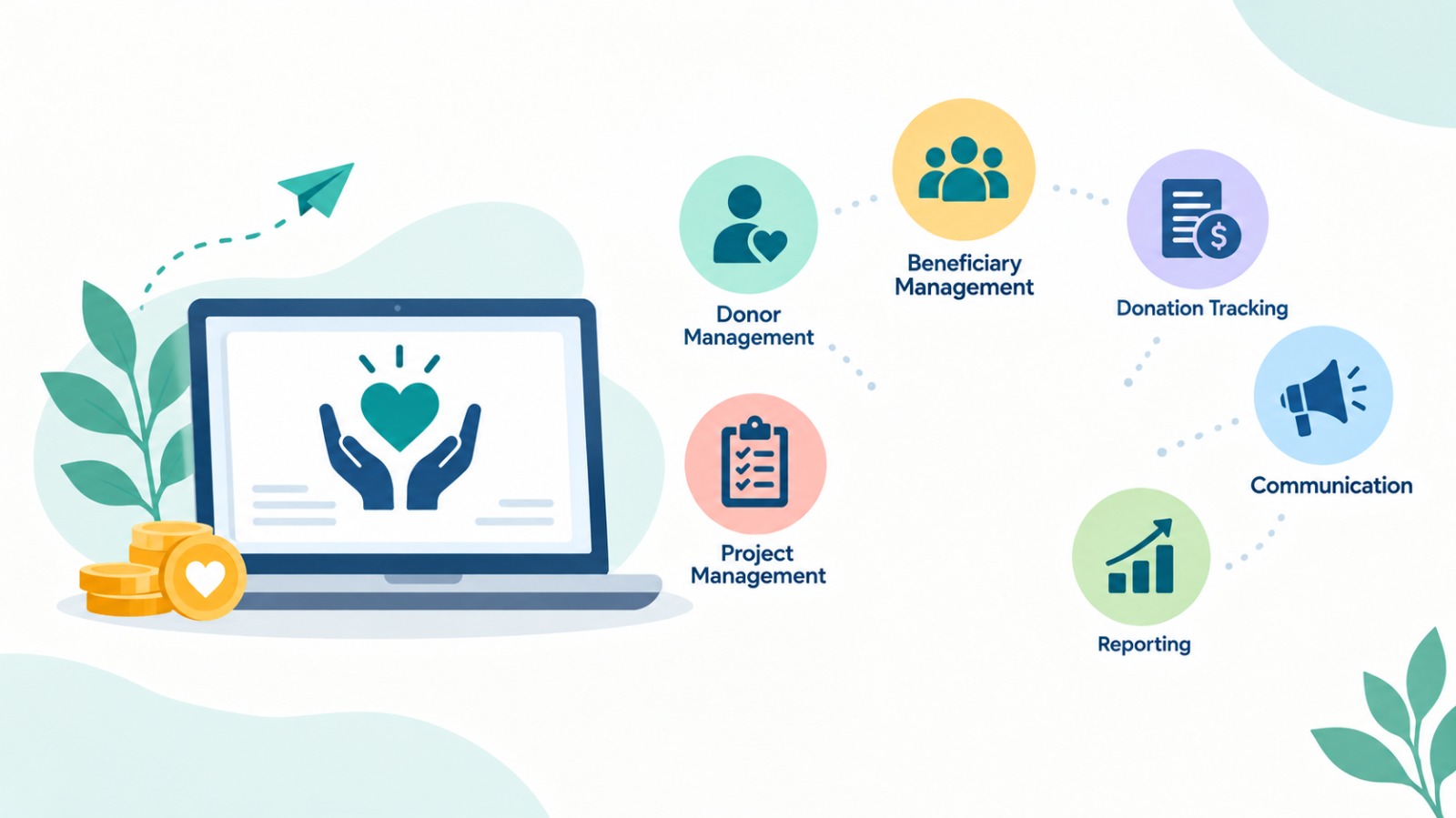
Running a charity organisation involves much more than collecting donations. An NGO or charitable organisation may need to manage donors, beneficiaries, welfare projects, volunteers, fundraising activities, financial records, communications, and impact reports at the same time. When these activities depend heavily on spreadsheets, paper files, messaging apps, and scattered records, it becomes difficult to maintain a clear view of what is happening across the organisation.
Digitising a charity organisation means moving important processes from disconnected manual systems into organised digital workflows. The goal is not simply to use more software. It is to create a reliable way to manage information, coordinate activities, communicate with supporters, monitor welfare projects, and understand the organisation’s overall impact.
For a small community organisation, digitisation might begin with replacing paper-based beneficiary records. For a growing NGO, it could involve connecting fundraising, donor management, project tracking, reporting, and communication into a more structured system.
The right approach depends on the organisation’s size, activities, people, existing processes, and priorities.
What Does It Mean to Digitise a Charity Organisation?
Digitising a charity organisation means using digital tools and structured processes to manage the organisation’s key activities, information, communication, fundraising, beneficiaries, welfare projects, and reporting more efficiently.
Digitisation is broader than simply creating a website or accepting online donations. A charity can have an online donation page while still relying on paper registers and disconnected spreadsheets for its day-to-day welfare activities.
A more complete digital approach considers the organisation as an interconnected system.
For example:
Donors → Contributions → Funds → Welfare Projects → Beneficiaries → Outcomes → Reporting → Continued Support
When these stages are properly organised, an NGO can build a clearer connection between the resources it receives and the welfare activities it delivers.
Digitisation vs. Digital Transformation
These terms are often used interchangeably, but they are not exactly the same.
Digitisation usually refers to converting information or processes into digital form.
For example:
- Moving paper beneficiary records into digital records
- Maintaining donor information in a database
- Recording donations electronically
- Creating digital project reports
- Storing documents digitally
Digital transformation goes a step further. It involves redesigning how the organisation works using technology.
For example:
- Connecting fundraising with donor management
- Linking welfare projects with beneficiaries
- Automating appropriate communication
- Creating structured reporting workflows
- Using data to understand project performance
- Building a consistent donor-to-impact journey
A charity does not need to transform everything at once. A well-planned digitisation journey can gradually lead to broader digital transformation.
Why Should a Charity Organisation Go Digital?
A charity should consider digitisation when manual processes make it difficult to manage information, coordinate activities, communicate with supporters, or demonstrate impact.
Many welfare organisations begin with simple systems because they are inexpensive and familiar. A spreadsheet may work perfectly well when there are only a few donors and beneficiaries. But as activities grow, the same approach can become difficult to maintain.
Common signs that an organisation is ready for greater digitisation include:
- Donor information is stored across multiple spreadsheets.
- Beneficiary records are maintained in notebooks or separate files.
- Staff members cannot easily find the latest project information.
- Donation records require repeated manual entry.
- Reports take considerable time to prepare.
- Donor communication is inconsistent.
- Welfare project information is difficult to track.
- Different teams maintain separate versions of the same information.
- Trustees or managers do not have a clear overview of ongoing activities.
- Important records depend on individual staff members.
Digitisation can help create a more organised operating environment.
However, technology should solve a real organisational problem. Buying software simply because it is popular does not automatically improve charity management.
What Charity Processes Should Be Digitised First?
The best processes to digitise first are usually those that are repetitive, information-heavy, difficult to track manually, or important for accountability.
A charity can begin by reviewing its activities across several areas.
1. Donor Management
Donor information is one of the most valuable relationship records for a nonprofit organisation.
A structured donor management system can help an organisation maintain information such as:
- Donor name and contact details
- Contribution history
- Communication history
- Campaign participation
- Donor preferences
- Follow-up activities
- Thank-you and acknowledgement records
The purpose is not simply to store names. It is to understand and manage relationships responsibly.
2. Donation and Contribution Tracking
Donation records should be organised in a way that allows the organisation to understand what contributions have been received and how they relate to fundraising activities.
Digital contribution tracking can reduce the need to manually reconcile information from different sources.
It can also make it easier to answer questions such as:
- How much was collected for a particular campaign?
- Which contributions have been recorded?
- Which donors participated in a campaign?
- What communication has been sent?
- What reporting needs to be completed?
3. Beneficiary Management
For welfare organisations, beneficiary information is just as important as donor information.
A digital beneficiary system can help organise records related to:
- Individuals or families receiving support
- Eligibility or programme-related information
- Assistance provided
- Project participation
- Follow-up activities
- Support history
- Outcomes or progress
Access to beneficiary information should be carefully controlled, particularly when records contain sensitive personal information.
4. Welfare Project Management
A charity may operate several programmes simultaneously.
For example:
- Education support
- Food distribution
- Healthcare assistance
- Community development
- Emergency relief
- Skill development
- Housing support
Digital project management can help the organisation track activities, responsibilities, beneficiaries, resources, milestones, and reports in a more structured manner.
5. Communication
Charities communicate with many groups:
- Donors
- Beneficiaries
- Volunteers
- Staff
- Trustees
- Community members
- Supporters
Digital communication tools can help create more consistent communication while allowing the organisation to maintain appropriate records of important interactions.
6. Reporting
Reporting is often one of the most time-consuming administrative activities.
A digital system can help bring together information required for internal updates, project reviews, donor communication, and organisational reporting.
The quality of reporting depends heavily on the quality of information captured throughout the project.
How Can a Charity Start Its Digital Transformation?
A charity should start with its existing processes rather than starting with software.
Before selecting a technology platform, document how the organisation currently works.
A practical starting process is:
Step 1: Map Existing Processes
Write down how information currently moves through the organisation.
For example:
Donation received → Donation recorded → Donor thanked → Funds allocated → Project conducted → Beneficiaries supported → Results recorded → Report prepared
Do the same for beneficiary management, volunteer coordination, fundraising campaigns, and project activities.
This exercise often reveals where information is being duplicated or lost.
Step 2: Identify the Biggest Problems
Do not attempt to digitise everything simultaneously.
Ask:
- Which process takes the most administrative time?
- Where are errors most likely to happen?
- Which information is difficult to retrieve?
- Where are records duplicated?
- Which reports are difficult to prepare?
- Where do staff depend on manual follow-ups?
- Which donor or beneficiary interactions need better tracking?
Start with the areas that create the greatest operational difficulty.
Step 3: Organise Existing Data
Before moving information into a new system, review what already exists.
You may find:
- Duplicate donor records
- Incomplete contact information
- Different spellings of the same names
- Outdated beneficiary records
- Multiple versions of project documents
- Inconsistent categories
- Missing dates or transaction details
Digitisation is a good opportunity to clean and standardise information.
Step 4: Define Basic Data Standards
Decide how information should be recorded.
For example, establish consistent approaches for:
- Names
- Dates
- Contact details
- Project names
- Donation categories
- Beneficiary categories
- Campaign names
- Status fields
- Reporting periods
Simple standards can make digital records much more useful.
Step 5: Choose Technology Based on Actual Needs
Only after understanding the processes should the organisation evaluate technology.
The right solution should be:
- Easy for staff to understand
- Appropriate for the organisation’s size
- Scalable as activities grow
- Secure
- Accessible to authorised users
- Capable of producing useful reports
- Suitable for the organisation’s actual workflows
A small organisation does not necessarily need a complicated technology stack.
What Technology Does a Charity Organisation Need?
There is no single technology package that is suitable for every charity. The right combination depends on the organisation’s activities and maturity.
A digital charity ecosystem may include:
Charity Website
A website can serve as a public information point where supporters can understand:
- Who the organisation is
- What it does
- Which welfare programmes it runs
- How people can support it
- How to contact the organisation
Online Fundraising
Digital fundraising can make it easier for supporters to discover campaigns and contribute through suitable online channels.
But fundraising technology should connect with the organisation’s broader donor and contribution management processes rather than operate as an isolated activity.
Donor Management Software
A donor management system helps an organisation maintain structured supporter records and understand relationships over time.
Beneficiary Management
Beneficiary management technology can help welfare organisations organise information about the people or communities receiving support.
Project Management
Welfare projects need structured planning and monitoring just like other organisational activities.
Communication Tools
Email, messaging platforms, websites, social media, and other digital channels can support communication, provided they are used responsibly and consistently.
Reporting and Analytics
Reports can help managers understand fundraising activity, project progress, beneficiary support, and organisational performance.
The key principle is integration where it creates practical value.
How Can Digital Tools Improve Donor Management?
Digital donor management can help charities move from simply recording donations to building structured supporter relationships.
For example, instead of maintaining a spreadsheet with only a donor’s name and contribution amount, an organisation may maintain a broader relationship record.
This can help answer:
- When did the person first support the organisation?
- Which campaign did they support?
- What communication have they received?
- Has the organisation thanked them?
- Have they participated in previous campaigns?
- What type of updates might be relevant to them?
This does not mean every communication should be automated.
Human communication remains important in charitable work. Technology should help staff understand relationships and follow up appropriately, rather than replace genuine engagement.
How Can Technology Improve Beneficiary Management?
Technology can help a charity maintain more structured beneficiary records and connect those records to the welfare programmes delivering support.
Consider a community organisation providing educational assistance.
Instead of maintaining separate paper files for each child, the organisation could maintain structured digital records covering:
- Beneficiary profile
- Programme participation
- Assistance provided
- Relevant project
- Support history
- Follow-up information
- Outcome records
The organisation can then better understand which beneficiaries are connected to which programmes and what support has been delivered.
This is particularly useful when an organisation runs multiple welfare projects simultaneously.
At the same time, beneficiary information should be handled responsibly. Access should be limited to people who genuinely need the information for their role, and organisations should establish appropriate internal policies for data protection and retention.
How Can Technology Make Charity Fundraising More Organised?
Technology can support fundraising by bringing campaign planning, donor information, contribution tracking, communication, and reporting into a more structured workflow.
A digital fundraising process might look like:
Campaign Planning → Supporter Outreach → Contributions → Contribution Recording → Donor Communication → Fund Allocation → Project Delivery → Impact Reporting
This creates a stronger connection between fundraising and welfare delivery.
For example, if an NGO raises funds for an education-support project, it should be possible internally to understand:
- Why the campaign was created
- Who supported it
- What contributions were received
- Which project received the funds
- Which beneficiaries were supported
- What activities were completed
- What outcomes were observed
- What information can be shared with supporters
This is much more meaningful than simply knowing the total amount raised.
How Can a Charity Use Digital Reporting to Improve Transparency?
Digital reporting can improve transparency by making relevant organisational information easier to collect, organise, review, and communicate.
A useful report should answer practical questions.
For donors:
- What did my contribution support?
- What activity was carried out?
- Who benefited?
- What progress was made?
For managers:
- Which projects are active?
- What resources have been allocated?
- Which activities are completed?
- What needs attention?
For trustees:
- Are welfare activities progressing as planned?
- Are records organised?
- What areas require oversight?
- What outcomes are being observed?
Technology does not create transparency by itself. Transparent governance depends on accurate data, clear processes, responsible reporting, and organisational discipline.
Digital systems simply make those practices easier to structure and maintain.
What Are the Biggest Challenges When Digitising a Charity?
Digitisation can create significant improvements, but charities should expect challenges during implementation.
Resistance to Change
People who have worked with paper files or spreadsheets for years may initially be uncomfortable with new systems.
The solution is practical training and gradual adoption rather than forcing a complicated system on everyone at once.
Poor Data Quality
Moving inaccurate information into a new system does not solve the underlying problem.
Data should be cleaned before migration wherever possible.
Choosing Too Many Tools
Using separate applications for fundraising, donor records, projects, beneficiaries, communication, and reporting can create another form of fragmentation.
The organisation should evaluate whether systems can work together or whether a more integrated approach would be useful.
Limited Digital Skills
Not every employee or volunteer will have the same level of technical experience.
Interfaces should therefore be simple, and training should focus on actual tasks rather than technical terminology.
Cost Considerations
Technology involves more than subscription fees.
Organisations should consider:
- Implementation
- Training
- Data migration
- Maintenance
- User access
- Support
- Future scalability
A lower-cost tool may become expensive if it creates significant manual work.
Data Security
Charities may handle donor details, beneficiary information, financial information, and other organisational records.
Security should therefore be considered from the beginning.
Basic practices include:
- Strong passwords
- Appropriate user permissions
- Regular backups
- Controlled access
- Secure data handling
- Clear internal policies
How Can a Small NGO Digitise Without a Large IT Team?
A small NGO does not need a large technical department to begin digitisation. It can start with a focused project that solves one or two major operational problems.
A practical approach is to:
- List current manual processes.
- Identify the biggest administrative bottleneck.
- Clean the relevant information.
- Choose a simple digital solution.
- Train the people who will use it.
- Run the process consistently.
- Review what works and what does not.
- Gradually digitise additional activities.
For example, an organisation might first digitise donor and contribution records. Once that process is stable, it could introduce beneficiary management and then connect those records to welfare projects.
This incremental approach can be easier to manage than attempting a complete digital overhaul in a single step.
A Practical Example: Digitising an Education-Support Charity
Imagine a community organisation running an education-support programme for 100 children.
Before digitisation, the organisation may have:
- Donor information in spreadsheets
- Beneficiary records in paper files
- Donation details in accounting records
- Project updates in messaging groups
- Photographs stored on personal devices
- Reports prepared manually at the end of each period
The organisation may still be doing valuable work, but connecting all this information can take considerable effort.
A structured digital system could organise the process as follows.
Fundraising
The organisation creates a campaign explaining the education-support programme and its objectives.
Donor Management
Supporters are recorded in an organised donor database along with relevant contribution and communication information.
Contribution Tracking
Contributions are recorded against the appropriate campaign or fundraising activity.
Fund Allocation
The organisation records how available resources are assigned to the education programme.
Beneficiary Management
The 100 children are maintained as structured beneficiary records rather than scattered paper entries.
Project Management
Activities such as educational materials, learning support, or programme sessions can be recorded against the relevant welfare project.
Communication
Supporters receive appropriate updates about project activities and progress.
Reporting
At the end of a reporting period, the organisation can bring together relevant information about contributions, activities, beneficiaries, and outcomes.
The important change is not simply that the organisation has moved from paper to software.
The larger improvement is that the organisation can see the relationship between support received and welfare delivered.
What Should a Charity Look for in Digital Management Software?
Before choosing a platform, charity leaders should ask practical questions rather than focusing only on the number of features.
Does it fit our workflow?
A system should support the way the organisation actually operates.
Can different activities be connected?
If donor information, fundraising, beneficiaries, and welfare projects are completely isolated, staff may still have to manually connect information.
Is it easy to use?
A powerful system that staff avoid using is not an effective system.
Can information be retrieved easily?
Staff should be able to find important records without searching through multiple files.
Can it support reporting?
The organisation should consider what reports managers, trustees, donors, and project teams actually need.
Does it support accountability?
A good system should make responsibilities, records, activities, and outcomes easier to monitor.
Can it grow with the organisation?
The solution should be suitable for the organisation’s current needs while leaving room for future growth.
Are access controls available?
Different users may need different levels of access to organisational information.
What Are the Best Practices for Charity Digitisation?
A successful digitisation programme is as much about organisational discipline as technology.
Start Small
Begin with a clearly defined problem rather than attempting to digitise everything.
Standardise Data
Use consistent categories, naming conventions, and processes.
Assign Responsibility
Someone should be responsible for maintaining data quality and ensuring that agreed processes are followed.
Train Users
Training should focus on real organisational tasks.
Review Regularly
After implementation, ask:
- Are staff actually using the system?
- Are records complete?
- Are reports easier to prepare?
- Has duplicate work decreased?
- Can managers access the information they need?
Keep Human Relationships at the Centre
Technology should support relationships with donors, beneficiaries, volunteers, and communities. It should not make the organisation feel impersonal.
Protect Important Information
Data security, access control, backups, and responsible information handling should be treated as part of good charity management.
How Does Digitisation Support Welfare Governance?
Digitisation becomes particularly valuable when it connects the different parts of welfare management.
Donors → Contributions → Funds → Welfare Projects → Beneficiaries → Outcomes → Reporting → Continued Support
This chain represents more than fundraising.
A donor contributes resources. Those resources become available to the organisation. The organisation allocates them to welfare projects. Projects deliver support to beneficiaries. Activities create outcomes. The organisation records and communicates relevant results. Clear reporting can then help maintain trust and encourage continued engagement.
This broader approach can be understood as Welfare Governance.
Welfare Governance is the structured management of an organisation’s welfare activities, resources, people, projects, beneficiaries, accountability, reporting, and impact.
From this perspective, technology is not simply an administrative convenience. It can become part of the organisational infrastructure that helps a charity coordinate its welfare work.
What Does a Digitally Organised Charity Look Like?
A digitally organised charity does not necessarily have the most sophisticated technology.
Instead, it has clear and connected processes.
A well-organised digital environment may allow the organisation to answer questions such as:
- Who supports us?
- What contributions have been received?
- Which campaigns are active?
- Where are resources being allocated?
- Which beneficiaries are receiving support?
- What welfare projects are underway?
- What activities have been completed?
- What outcomes have been recorded?
- What reports need to be prepared?
- What information can responsibly be shared with supporters?
The ability to answer these questions quickly can make a significant difference to day-to-day charity management.
Frequently Asked Questions
What does it mean to digitise a charity organisation?
Digitising a charity organisation means using digital systems to organise activities such as donor management, fundraising, contribution tracking, beneficiary management, welfare projects, communication, and reporting.
How can a small NGO start digitisation?
A small NGO can start by identifying one major manual process, such as donor records or beneficiary management, and moving it into a structured digital system before expanding to other activities.
Why should charities digitise donor management?
Digital donor management helps charities maintain organised supporter records, track contribution history, manage communication, and build more consistent donor relationships.
How can technology help with beneficiary management?
Technology can help charities maintain structured beneficiary records, connect beneficiaries with welfare programmes, record support provided, and organise follow-up and outcome information.
Can digital technology improve charity transparency?
Yes. Digital systems can make it easier to maintain accurate records, connect resources with projects, prepare reports, and communicate relevant information. However, transparency also depends on responsible governance and accurate data.
What should an NGO consider before choosing charity management software?
An NGO should consider ease of use, workflow fit, data security, reporting capabilities, integration between activities, user permissions, scalability, implementation requirements, and overall cost.
Is digitisation useful for volunteer-led charities?
Yes. Even a volunteer-led organisation can benefit from organised digital records and workflows. The system should remain simple enough for volunteers and staff to use consistently.
Is digitisation the same as digital transformation?
Not exactly. Digitisation generally involves converting manual information and processes into digital form, while digital transformation involves broader changes to how an organisation operates using technology.
Building a Better Welfare Governance System with NidhiMax
Digitising a charity organisation is ultimately about creating better ways to manage welfare work.
Technology should not be introduced simply because an organisation feels it needs to “go digital.” The more important question is whether technology can help the organisation manage its donors, contributions, welfare projects, beneficiaries, communication, reporting, and impact in a more organised way.
This is where the broader idea of Welfare Governance becomes important.
NidhiMax is positioned as a Welfare Governance Platform designed for charitable organisations, NGOs, trusts, community organisations, and welfare institutions that want to move toward a more organised digital welfare-management ecosystem.
Depending on an organisation’s needs, a welfare governance approach can bring areas such as fundraising management, donor management, contribution tracking, beneficiary management, welfare project management, communication, reporting, transparency, accountability, and impact tracking into a more structured operational framework.
The right digital journey will look different for every organisation. A small community initiative may begin with basic record management, while a larger NGO may need a more connected approach across fundraising, donors, beneficiaries, projects, and reporting.
The objective is the same: make welfare work easier to organise, understand, monitor, and communicate responsibly.