
 Post by
For many charities, NGOs, trusts, and community organisations, donor communication becomes harder as fundraising activity grows. A small team may be answering the same questions repeatedly, sending individual thank-you messages, following up on donations, sharing project updates, and trying to remember which supporters need a response.
WhatsApp can make communication more immediate, but manually managing every conversation can quickly become difficult. This is where thoughtful automation can help.
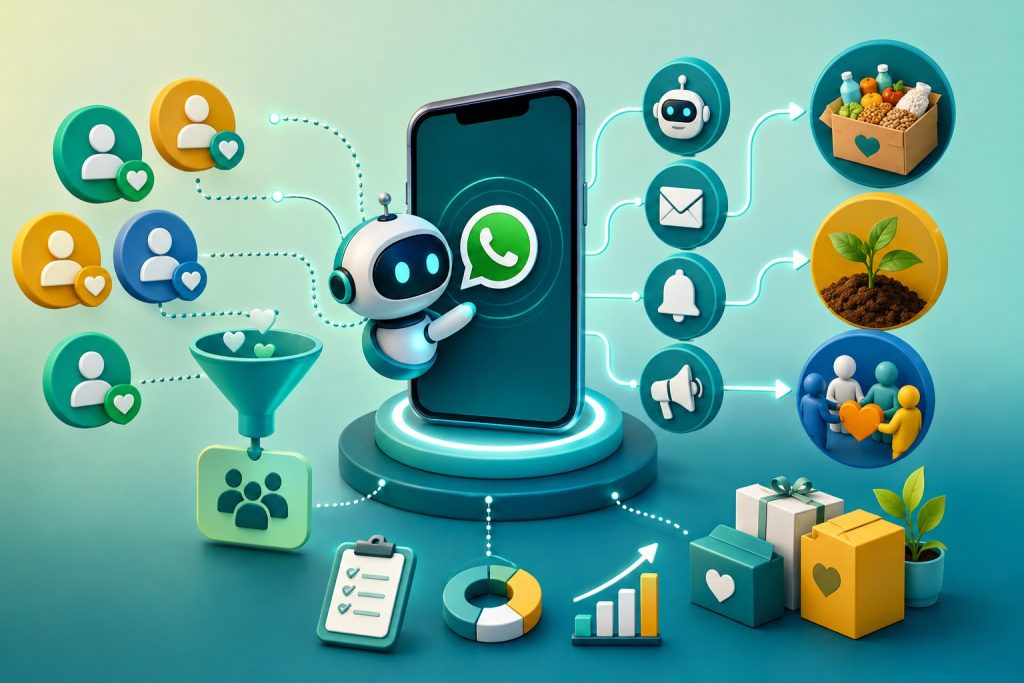
Automating charity donor communication on WhatsApp means setting up structured, timely, and relevant communication for routine interactions while keeping human involvement where personal attention is needed. The goal is not to replace relationships with automated messages. It is to reduce repetitive administrative work so the organisation can communicate more consistently and focus its people on meaningful donor relationships and welfare activities.
A well-planned approach can help an organisation acknowledge contributions, answer common questions, send appropriate updates, manage follow-ups, and keep communication connected to donor and welfare records.
This article explains how charities can approach WhatsApp communication automation, what to automate, what should remain personal, and how donor communication fits into the wider idea of Welfare Governance.
What Does Automating Donor Communication on WhatsApp Mean?
Automating donor communication on WhatsApp means using defined communication workflows and approved messaging tools to trigger or schedule routine messages based on relevant events, actions, or stages in the donor journey.
For example, a charity may create a process in which a supporter receives an acknowledgement after a contribution is recorded. Later, the supporter may receive a relevant project update according to the organisation’s communication plan.
Automation can potentially support communication such as:
- Donation acknowledgements
- Thank-you messages
- Welcome messages for new supporters
- Responses to common questions
- Fundraising campaign updates
- Event reminders
- Project progress updates
- Follow-up messages
- Information requests
- Supporter communication based on defined preferences or engagement
The exact approach depends on the organisation’s systems and the WhatsApp communication solution it uses.
The key principle is simple: automate routine processes, not the entire donor relationship.
Why Should Charities Automate Donor Communication?
Charities may automate routine donor communication to improve consistency, reduce repetitive manual work, respond more quickly, and create a more organised supporter experience.
Consider a small NGO running several welfare projects. Its team may be responsible for collecting contributions, speaking with donors, coordinating volunteers, managing beneficiaries, and reporting on project activities.
If every acknowledgement and routine follow-up has to be written and sent manually, important communication can be delayed or missed.
Automation can help create more predictable processes.
A More Consistent Donor Experience
A donor should not have to wonder whether their contribution was received or whether the organisation has forgotten to respond.
A defined workflow can help ensure that appropriate routine communication happens consistently.
For example:
Contribution recorded → Acknowledgement triggered → Donor record updated → Follow-up status maintained
The organisation can still add personal communication when needed.
Less Repetitive Work for Staff and Volunteers
Fundraising teams often spend time sending similar messages repeatedly.
For instance:
Thank you for your support. We have received your contribution and appreciate your help with our welfare work.
Automation may reduce the need to manually repeat such routine communication for every individual interaction, provided the process is designed carefully.
This can give staff and volunteers more time for:
- Donor conversations requiring personal attention
- Complex supporter questions
- Welfare project coordination
- Beneficiary support
- Fundraising planning
- Reporting and accountability
Faster Responses to Common Questions
Supporters may frequently ask similar questions, such as:
- How can I contribute?
- What project is currently seeking support?
- How can I learn more about the organisation’s work?
- When will I receive an update?
- Who should I contact for further information?
A structured response process can help the organisation provide useful information without requiring a team member to manually answer every routine question from the beginning.
What Donor Communication Should a Charity Automate?
The best communication to automate is usually repetitive, predictable, and based on a clear trigger. Messages requiring judgement, sensitivity, or a personal relationship should generally remain under human control.
A charity does not need to automate everything.
Good Candidates for Automation
1. Donation Acknowledgements
When a contribution is appropriately recorded in the organisation’s process, an acknowledgement can be sent promptly.
The message should be clear and respectful.
For example:
Thank you for supporting our community welfare work. We appreciate your contribution and will continue to share relevant updates about our activities.
The organisation should ensure that the communication reflects its actual processes and does not make unsupported promises.
2. Welcome Messages
When someone begins engaging with the organisation through an approved communication journey, a welcome message can introduce:
- The organisation’s purpose
- The type of welfare work it carries out
- How supporters can stay informed
- How to find relevant information
- How to contact the organisation when needed
3. Frequently Asked Questions
Automated responses can be useful for straightforward questions.
For example:
Supporter: How can I help?
Automated response: Thank you for your interest in supporting our welfare activities. You can choose from the available ways to contribute or contact our team for more information about current projects.
A human team member should still be available when the question is more complex.
4. Campaign Updates
A charity may plan communication around important campaign stages.
For example:
- Campaign launched
- Fundraising objective explained
- Important project update
- Relevant reminder
- Campaign progress communication
- Next steps
Messages should provide genuine value rather than simply repeating donation requests.
5. Event Reminders
If a charity is organising a community event, volunteer activity, or fundraising programme, reminders can be scheduled around relevant dates.
This can reduce manual follow-up work.
6. Project Updates
Supporters may appreciate relevant updates about the welfare work they have helped support.
For example, an organisation running an education-support programme may communicate progress such as:
- Activities beginning
- Educational materials being distributed
- Programme milestones
- Upcoming activities
The organisation should avoid sharing sensitive beneficiary information unnecessarily.
What Should Not Be Fully Automated?
Sensitive, complex, high-value, or emotionally significant donor interactions should not be treated as routine automated conversations. Human judgement remains important.
Some situations require a person to understand context and respond appropriately.
These may include:
- Complex donor questions
- Complaints
- Requests for detailed financial or project information
- Sensitive beneficiary matters
- Major donor conversations
- Disputes or misunderstandings
- Personal bereavement or emergency situations
- Requests that require verification or management approval
Automation should make it easier for the right person to step in, not create a barrier between the organisation and its supporters.
How Can an NGO Set Up a WhatsApp Donor Communication Workflow?
An NGO can set up a WhatsApp communication workflow by mapping the donor journey, identifying routine communication points, defining triggers, preparing useful messages, and connecting communication records with the organisation’s wider management process.
A practical approach can begin with the following steps.
Step 1: Map the Donor Journey
Start by understanding how a supporter currently interacts with the organisation.
A simple journey may look like this:
Learns about the organisation → Makes an enquiry → Receives information → Contributes → Receives acknowledgement → Gets project updates → Continues engagement
For a more complex organisation, there may be several donor journeys.
For example:
- First-time supporter
- Recurring supporter
- Event participant
- Volunteer who later becomes a donor
- Supporter interested in a specific welfare project
Mapping these journeys helps the organisation decide where automation is genuinely useful.
Step 2: Identify Communication Triggers
A trigger is an event that starts a defined communication process.
Examples may include:
- A new supporter enquiry
- A contribution being recorded
- Registration for an event
- A request for information
- A scheduled project update
- A supporter not completing a defined action
- A change in campaign status
Not every trigger needs an automated message.
The organisation should ask:
Does this event require a standard response, or does it require human judgement?
Step 3: Create a Small Set of Useful Message Templates
Avoid creating dozens of messages before the process is tested.
Start with essential communication.
For example:
- Welcome message
- Donation acknowledgement
- Frequently asked question response
- Campaign information message
- Project update
- Event reminder
- Human support handover message
Each message should have a clear purpose.
Avoid vague messages such as:
Please support our cause.
A better message gives context and explains why the communication matters.
Step 4: Define When a Human Should Take Over
Every automated communication process should have a clear handover point.
For example:
Thank you for your message. Our team will review your request and respond with further information.
This is especially important when a supporter asks a question that automation cannot answer reliably.
A good workflow recognises the difference between routine communication and relationship management.
Step 5: Keep Records Connected
One of the biggest operational problems is communication happening in one place while donor and contribution records exist elsewhere.
Imagine a supporter makes a contribution after a WhatsApp conversation. If the fundraising team has no structured process for connecting that interaction with the donor record, future communication may become inconsistent.
The organisation may need to know:
- Who the supporter is
- What communication has taken place
- Whether a contribution has been recorded
- Which campaign or project the support relates to
- Whether follow-up is needed
- What updates have already been shared
The exact system will vary, but important information should not depend entirely on searching through old chat messages.
How Can Charities Personalise Automated WhatsApp Messages?
Charities can personalise automated communication by making messages relevant to the donor’s relationship with the organisation, rather than simply inserting a person’s name into a generic message.
True personalisation is about relevance.
For example, a first-time supporter and a long-term donor may not need the same communication.
A charity may structure communication according to relevant categories such as:
- New supporter
- Existing donor
- Supporter of a particular welfare project
- Event participant
- Volunteer
- Person requesting more information
However, organisations should only use information appropriately and avoid making assumptions about a donor’s preferences or circumstances.
Example
A generic message might say:
Hello, thank you for supporting us.
A more relevant message might say:
Thank you for supporting our education programme. We will share relevant updates as the planned activities progress.
The second message connects the communication to the donor’s actual relationship with the welfare activity.
How Often Should a Charity Send Automated WhatsApp Messages?
There is no single ideal frequency. Charities should send messages when they are relevant and useful, rather than communicating simply because an automated schedule allows them to do so.
Too many messages can weaken engagement.
A supporter may appreciate:
- A prompt acknowledgement
- A useful campaign update
- Important project information
- Relevant event reminders
- Meaningful outcome communication
They may not appreciate repeated appeals with little new information.
Before adding an automated message, ask:
Would this communication be useful to the recipient?
If the answer is unclear, the message may not be necessary.
Common Mistakes When Automating Charity Donor Communication
The most common mistake is treating automation as a substitute for good donor relationships. Effective automation supports communication; it does not remove the need for trust, accountability, and human judgement.
Mistake 1: Automating Every Conversation
Not every interaction is predictable.
Over-automation can make communication feel impersonal and may frustrate supporters who need a real response.
Better approach: Automate routine interactions and provide a clear path to human support.
Mistake 2: Sending Too Many Fundraising Appeals
A large number of messages does not necessarily create stronger donor relationships.
Repeated requests without meaningful updates can lead to message fatigue.
Better approach: Balance fundraising communication with useful project information, acknowledgements, and updates.
Mistake 3: Using the Same Message for Everyone
Different supporters may have different relationships with the organisation.
Better approach: Where practical, make communication relevant to the person’s actual interaction with the organisation.
Mistake 4: Keeping Important Information Only in Chats
If a team member has to search through old messages to understand a donor’s history, the process may not scale well.
Better approach: Create an organised process for connecting important communication with donor and contribution records.
Mistake 5: Ignoring the Human Handover
An automated system that cannot direct a supporter to a real person can create frustration.
Better approach: Define clear situations where staff or volunteers should take over.
Mistake 6: Sharing More Beneficiary Information Than Necessary
Charities should not compromise beneficiary dignity or privacy simply to create compelling fundraising messages.
Better approach: Share welfare stories responsibly and use appropriate information for the purpose of communication.
A Practical Example: Automating Communication for an Education Support Programme
Imagine a community organisation running an education-support programme for 100 children.
The organisation raises funds to support planned educational activities. Its small team also manages donors, volunteers, beneficiary records, project activities, and communication.
Without a structured process, the team may manually handle every interaction.
A More Organised Communication Journey
A supporter learns about the programme and sends a WhatsApp enquiry.
Step 1: Initial Response
The supporter receives relevant introductory information and options for learning more.
Step 2: Human Assistance When Needed
If the supporter has a detailed question, a team member takes over.
Step 3: Contribution Process
When a contribution is appropriately recorded through the organisation’s process, an acknowledgement workflow is initiated.
Step 4: Donor Record
Relevant supporter and contribution information is maintained in the organisation’s records.
Step 5: Project Communication
The organisation shares planned and relevant updates about programme activities.
Step 6: Outcome and Reporting
As information becomes available through the organisation’s welfare processes, it can support appropriate reporting and continued communication.
The bigger journey is:
Donors → Contributions → Funds → Welfare Projects → Beneficiaries → Outcomes → Reporting → Continued Support
WhatsApp communication is one part of this journey. It becomes more useful when it is connected to the wider welfare-management process.
Why Donor Communication Should Be Part of Welfare Governance
Donor communication should connect with the wider management of contributions, welfare projects, beneficiaries, activities, outcomes, and reporting rather than operate as an isolated messaging activity.
Fundraising creates a relationship between support received and welfare work carried out.
If these areas are disconnected, an organisation may face questions such as:
- Which campaign did this donor support?
- What communication has already been sent?
- What project information is available for an update?
- Who is responsible for the follow-up?
- What outcomes can be reported?
- How can the organisation demonstrate accountability?
This is where Welfare Governance provides a broader perspective.
Welfare Governance can be understood as the structured management of an organisation’s welfare activities, resources, people, projects, beneficiaries, accountability, reporting, and impact.
From this perspective, automated WhatsApp communication is not simply a marketing activity. It can be part of a structured communication and accountability process.
A well-organised organisation aims to create clear connections between:
Donors → Contributions → Funds → Welfare Projects → Beneficiaries → Outcomes → Reporting → Continued Support
When the wider journey is managed more effectively, communication can become more relevant because it is based on actual organisational activity rather than disconnected messages.
What Should a Charity Consider Before Choosing Technology for WhatsApp Automation?
Before choosing a technology approach, a charity should first understand its communication workflows, donor-management needs, team responsibilities, and the information that needs to stay connected across the welfare process.
Technology should support a process, not create another disconnected system.
Important questions include:
- What donor communication is currently repetitive?
- Which messages require human approval or personal attention?
- What events should trigger communication?
- Where are donor and contribution records maintained?
- How are welfare projects managed?
- How will communication history be recorded?
- Who is responsible for responding when automation cannot help?
- How will the organisation review whether messages remain useful?
- How will supporter information be handled responsibly?
Starting with these questions can prevent an organisation from automating a poorly designed process.
A Simple WhatsApp Donor Communication Automation Checklist
Before introducing automation, review the following:
- Map the main donor journeys
- Identify repetitive communication tasks
- Define clear communication triggers
- Prepare useful and respectful message templates
- Decide which interactions require human involvement
- Avoid unnecessary or excessive messages
- Keep important donor information organised
- Connect communication with contribution and project processes where relevant
- Review messages regularly for accuracy and relevance
- Maintain appropriate accountability for communication
Automation should be introduced gradually. It is usually better to start with a few high-value communication workflows and improve them than to automate everything at once.
Frequently Asked Questions
Can a charity automate WhatsApp messages to donors?
Yes. A charity can automate routine WhatsApp communication such as acknowledgements, welcome messages, common responses, reminders, and relevant updates using an appropriate communication workflow and approved tools.
What donor messages should be automated?
Good candidates include repetitive and predictable messages such as contribution acknowledgements, welcome messages, common information requests, event reminders, and planned project updates.
Should charities automate all donor communication?
No. Complex, sensitive, personal, or high-value interactions should involve human judgement. Automation works best when it handles routine communication and provides a clear handover to staff when needed.
How can an NGO send personalised WhatsApp messages automatically?
An NGO can make messages more relevant by connecting communication to meaningful information about the supporter’s relationship with the organisation, such as their enquiry, campaign interest, or welfare project engagement.
How often should an NGO send WhatsApp messages to donors?
Messages should be sent when they are relevant and useful. A charity should avoid excessive fundraising appeals and balance requests with acknowledgements, meaningful updates, and appropriate reporting.
Can WhatsApp automation improve donor management?
It can support donor management by making communication more consistent and helping teams follow defined workflows. Important donor, contribution, and communication information should also be maintained through organised management processes.
What is the biggest mistake in automated charity communication?
One of the biggest mistakes is treating automation as a replacement for genuine donor relationships. Charities should automate repetitive tasks while keeping human support available for situations that require attention and judgement.
How does automated donor communication support transparency?
When communication is connected to organised records and actual welfare activities, charities can more consistently acknowledge support, provide relevant updates, and support clearer communication about projects and outcomes.
To explore how NidhiMax can support a more organised Welfare Governance system for your organisation.
How NidhiMax Can Help Build a More Organised Welfare Governance System
Automating WhatsApp donor communication is most effective when it forms part of a wider, organised approach to managing welfare activities.
A charitable organisation may begin with a simple question: How can we send donor messages more efficiently? But as fundraising grows, the wider questions often become more important:
- How are donor records managed?
- How are contributions connected to funds?
- How is support linked to welfare projects?
- How are beneficiaries and activities managed?
- How can teams coordinate follow-ups?
- How can outcomes and reporting support accountability?
This is the broader purpose of Welfare Governance.
NidhiMax — Welfare Governance Platform is designed to help charitable organisations, NGOs, trusts, community organisations, and welfare institutions move toward a more organised digital welfare-management ecosystem.
Every organisation has different processes, communication needs, and welfare responsibilities. Technology should support those real-world processes and help create better connections between areas such as fundraising management, donor management, contribution tracking, welfare project coordination, beneficiary management, communication, reporting, transparency, accountability, and operational coordination where relevant.
For organisations exploring how to build a more structured welfare-management approach, NidhiMax offers a starting point for thinking beyond individual tools and toward a connected Welfare Governance system.
To explore how NidhiMax can support a more organised Welfare Governance system for your organisation.