 Post by
Donors want to know that their contributions are being handled responsibly. For a charity or NGO, building that confidence requires more than simply acknowledging a donation. Supporters increasingly want to understand what is happening after they contribute: Which project is their donation supporting? What progress has been made? What challenges has the organisation faced? What has changed for the people being supported?
This is where real-time reporting can become useful.
Real-time reporting gives charitable organisations a more current view of fundraising activity, project progress, contributions, and other relevant information. When appropriate information can be shared with donors without long delays, communication becomes more timely and transparent.
Real-time reporting does not mean publishing every internal transaction or sending constant notifications. It means having organised, up-to-date information that helps an organisation communicate accurately and responsibly.
For NGOs, charitable trusts, foundations, and community organisations, this can strengthen the connection between donations, welfare projects, beneficiaries, outcomes, and donor communication.
What Is Real-Time Reporting for a Charity?
Real-time reporting for a charity means maintaining and accessing current information about fundraising, contributions, welfare projects, activities, and outcomes so that relevant updates can be communicated without unnecessary delays.
The exact meaning of “real-time” can vary depending on the organisation. For one NGO, it might mean a live fundraising dashboard. For another, it may mean regularly updated project records that allow staff to prepare accurate donor updates quickly.
A useful reporting system can bring together information such as:
- Donations received
- Fundraising campaign progress
- Project activities
- Funds allocated to projects
- Beneficiary-related information
- Milestones achieved
- Pending activities
- Communication history
- Reports prepared for supporters
The objective is not simply to produce more data. The objective is to make useful information available when it is needed.
Why Does Real-Time Reporting Matter for Donor Confidence?
Real-time reporting can improve donor confidence by making communication more timely, evidence-based, and easier to understand.
When donors receive information only after a long period, they may find it difficult to understand what happened to their contribution. Even when an organisation is doing good work, a communication gap can create uncertainty.
Consider two different experiences.
In the first, a donor contributes to an education-support campaign and hears nothing for several months.
In the second, the donor receives an acknowledgement, a meaningful project update, information about progress, and a report when an important milestone is reached.
The underlying work could be identical. The difference is the quality and timing of communication.
Real-time reporting can help organisations close that information gap.
How Does Reporting Influence Donor Trust?
Reporting influences donor trust by helping supporters see a clearer connection between their contribution and the organisation’s work.
Trust develops through repeated experiences. A donor needs to feel that the organisation communicates honestly, handles information responsibly, and follows through on the purpose of its fundraising.
Useful reporting can answer questions such as:
- What was the fundraising campaign for?
- How much support has been received?
- What stage is the project at?
- What activities have been completed?
- What remains to be done?
- What challenges affected progress?
- What outcomes can currently be reported?
The organisation does not need to present every operational detail. Instead, it should provide the information that is meaningful to supporters while protecting confidential information.
Transparency Is More Than Publishing Numbers
A donation amount by itself does not tell the full story.
For example:
“₹5 lakh was raised.”
This is useful, but donors may still want to understand what happened next.
A stronger update might explain:
- the purpose of the fundraising campaign,
- the welfare project supported,
- the activities completed,
- the current stage of implementation,
- the remaining requirements, and
- what the organisation plans to do next.
This provides context around the numbers.
What Information Should Charities Include in Real-Time Reports?
A charity should include information that helps donors understand fundraising progress, project activity, resource use, and outcomes without exposing confidential or unnecessary personal information.
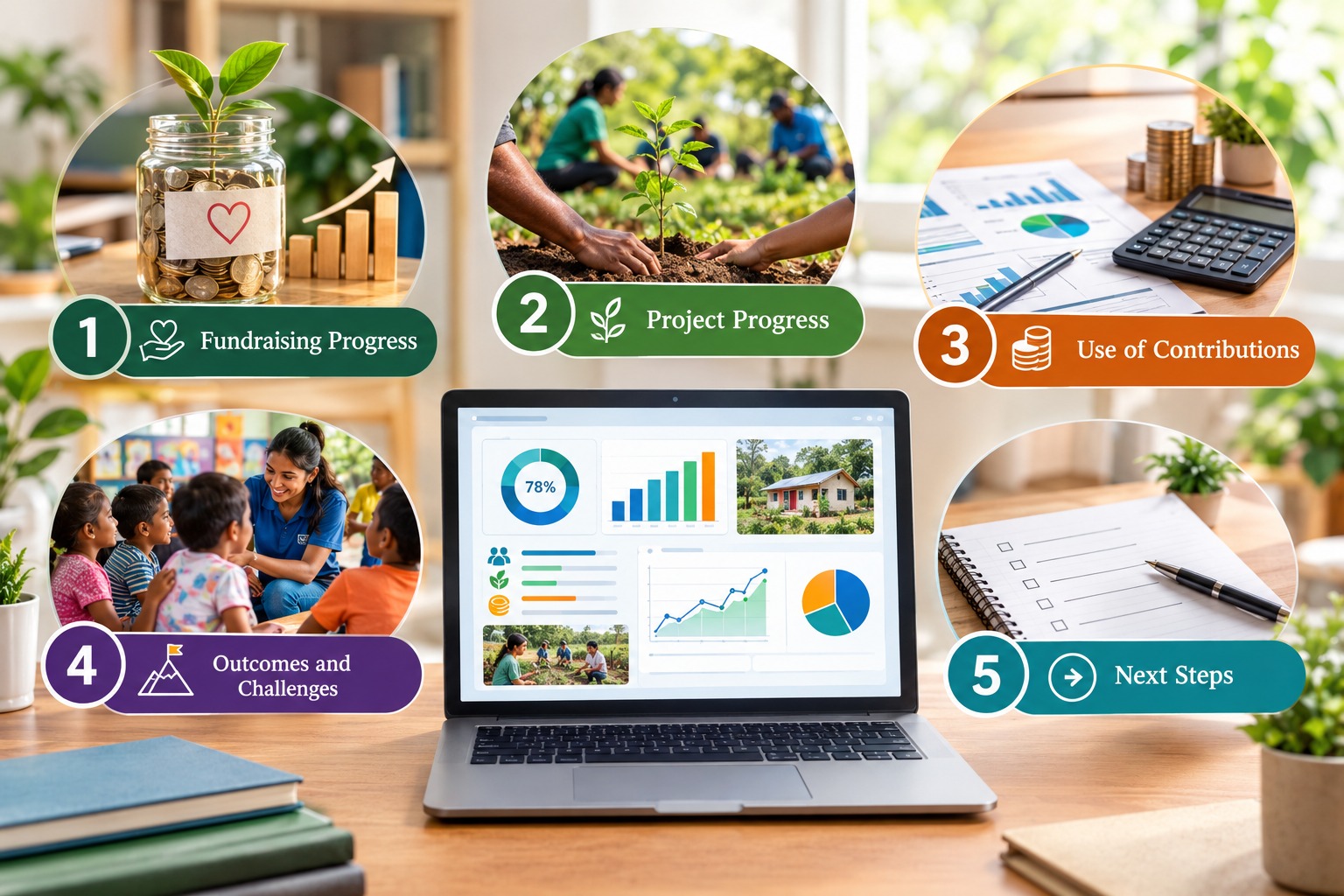
Depending on the organisation and project, useful information may include:
1. Fundraising Progress
Show relevant campaign information such as:
- fundraising target, where applicable,
- amount received,
- campaign status,
- funds required for the next stage,
- number or type of activities supported.
2. Project Progress
Explain what is happening on the ground.
For example:
- classes conducted,
- food distribution completed,
- medical assistance provided,
- community facilities supported,
- relief materials distributed,
- project milestones reached.
The information should be specific enough to be meaningful without exaggeration.
3. Use of Contributions
Where appropriate, explain how funds are being directed toward the intended welfare activities.
This does not necessarily mean publishing every internal expense. A clear summary can often provide useful context.
4. Outcomes and Challenges
Good reporting should include both progress and relevant challenges.
If a project is delayed because of operational circumstances, communicating the delay honestly can be more useful than presenting an unrealistically positive picture.
5. Next Steps
Donors should understand what happens next.
A simple “next step” section can make a report much more useful:
Completed: Initial education materials distributed
Current: Learning support sessions underway
Next: Additional sessions and progress assessment planned
How Can Real-Time Reporting Improve Donor Communication?
Real-time reporting improves donor communication by giving fundraising and communication teams access to current information when preparing updates.
Without organised reporting, staff may have to search through spreadsheets, messages, receipts, emails, and project notes before answering a donor’s question.
That creates several problems:
- information may be outdated,
- different teams may have different figures,
- reporting takes longer,
- staff spend more time checking records,
- donors may receive inconsistent answers.
An organised reporting process reduces this friction.
Instead of asking, “Where is the latest information?”, staff can work from a structured source of records.
Can Real-Time Reporting Help Donors See Where Their Money Goes?
Yes. Real-time reporting can help charities explain how fundraising connects to welfare activities, provided the information is accurate and appropriate to share.
Consider a community organisation raising funds for education support.
The organisation might structure its information around:
Donors → Contributions → Funds → Education Project → Beneficiaries → Activities → Outcomes → Reporting
This creates a clearer story around the fundraising effort.
For example, rather than simply telling donors that a campaign raised money, the organisation can explain:
- why the campaign was created,
- what activities it supports,
- what stage the project has reached,
- what resources have been allocated,
- what remains pending,
- and what outcomes can currently be reported.
This connection is particularly valuable when donors want to understand the practical effect of their support.
What Is the Difference Between Real-Time Reporting and Traditional Reporting?
Traditional reporting often provides information at scheduled intervals, while real-time reporting aims to make current information available as activities and records are updated.
Neither approach is automatically better for every situation.
A charity may still need:
- monthly reports,
- quarterly reports,
- annual reports,
- project completion reports,
- financial statements,
- donor-specific updates.
Real-time information can support these reporting processes rather than replace them.
For example, if project records are maintained throughout the year, preparing a quarterly report can become easier because staff are working from current information instead of reconstructing activities months later.
Real-Time Reporting vs Periodic Reporting
Real-Time Reporting | Periodic Reporting |
Information is updated frequently | Information is compiled at scheduled intervals |
Useful for current project visibility | Useful for formal review periods |
Can support timely donor updates | Can provide consolidated summaries |
Helps teams monitor ongoing activities | Useful for structured reporting |
Requires consistent record updates | May involve more work at reporting time |
A practical charity management system can use both.
How Can NGOs Build a Reliable Real-Time Reporting System?
NGOs can build a reliable real-time reporting system by standardising records, assigning responsibility, updating information consistently, and connecting fundraising and project data.
A practical approach involves several steps.
Step 1: Decide What Needs to Be Reported
Start with the questions your donors and internal teams actually need answered.
For example:
- How much has been raised?
- Which campaign generated the contribution?
- Which project is receiving support?
- What activities have been completed?
- What remains pending?
- What outcomes can currently be reported?
Avoid collecting information simply because a system allows it.
Step 2: Create Consistent Records
Use standard fields and formats for important information.
For example, donation records might include:
- donor reference,
- contribution date,
- contribution amount,
- campaign,
- project,
- communication status.
Project records could include:
- project name,
- objective,
- current status,
- activities,
- responsible team,
- milestones,
- updates.
Step 3: Assign Responsibility
Someone should be responsible for keeping each category of information current.
For example:
- fundraising team → contribution records,
- project team → activity updates,
- administration → supporting documentation,
- communication team → donor updates.
Clear ownership reduces the chance that important information remains outdated.
Step 4: Establish an Update Routine
“Real-time” does not mean everyone must update records every minute.
Instead, define practical expectations.
A project team might update information after a significant activity or milestone. Fundraising records may be updated as contributions are confirmed. Communication teams can then use the latest approved information.
Step 5: Review Before Sharing
Current information is useful only when it is accurate.
Before a donor-facing report is published, check:
- figures,
- dates,
- project status,
- wording,
- beneficiary information,
- privacy considerations.
Speed should not come at the expense of accuracy.
How Can Technology Help With Real-Time Charity Reporting?
Technology can help charities organise information in one place, reduce manual reporting work, connect records across teams, and make current information easier to access.
A digital system can provide a structured view of information that might otherwise be spread across multiple files and communication channels.
Depending on the organisation’s needs, technology can support:
- fundraising management,
- donor management,
- contribution tracking,
- welfare project records,
- beneficiary information,
- communication records,
- reporting,
- project monitoring,
- operational coordination.
The value comes from connecting these areas.
If a donation record exists in one place while the corresponding project information exists somewhere else, staff may still struggle to create a complete donor update.
What Role Does Donor Management Play in Real-Time Reporting?
Donor management helps organisations connect supporter information and contribution history with communication and reporting activities.
A well-organised donor record can help a charity understand:
- when someone contributed,
- which campaign they supported,
- previous interactions,
- whether an acknowledgement was sent,
- which updates were communicated,
- what future communication may be relevant.
This can make donor communication more consistent.
It also reduces the risk of repeatedly asking a supporter for information the organisation already has.
Personalisation Without Overcomplication
A donor who supports education projects may appreciate updates about education initiatives.
Another donor may be more interested in emergency relief or community healthcare assistance.
Organised records can help organisations communicate more relevant information while avoiding unnecessary messages.
The objective should be better communication, not excessive targeting.
How Can Real-Time Reporting Support Transparency and Accountability?
Real-time reporting supports transparency and accountability by helping an organisation maintain a clearer record of what it planned, what it received, what it did, and what it achieved.
These concepts are related but different.
Transparency is about making relevant information understandable and accessible.
Accountability is about taking responsibility for decisions, resources, actions, and outcomes.
A reporting system can support both by creating a more reliable information trail.
For example, a welfare project could maintain records showing:
- Project purpose
- Fundraising activity
- Contributions received
- Resources allocated
- Activities completed
- Beneficiary-related information
- Project progress
- Outcomes
- Pending work
- Reports shared
This creates a stronger foundation for internal review as well as donor communication.
Can Real-Time Reporting Improve Donor Retention?
Real-time reporting can support donor retention by helping organisations maintain an ongoing relationship with supporters instead of communicating only when another donation is needed.
Donor relationships often weaken when communication becomes one-sided.
If every message asks for another contribution, donors may feel that their previous support has been forgotten.
A better communication journey can look like this:
Contribution → Acknowledgement → Project Update → Milestone → Outcome → Continued Engagement
The donor remains connected to the work.
This does not guarantee that every donor will continue giving, but it creates a stronger basis for an informed relationship.
What Should Charities Avoid When Using Real-Time Reporting?
Charities should avoid overwhelming donors with raw data, publishing unverified information, exposing beneficiary privacy, or using reporting mainly as a fundraising pressure tool.
Common mistakes include:
Publishing Too Much Information
More information does not always mean more transparency.
Donors usually need relevant information presented clearly, not an unfiltered database.
Reporting Before Information Is Verified
A fast report containing incorrect figures can damage confidence more than a carefully checked report delivered slightly later.
Exposing Beneficiary Information
Organisations should consider privacy and dignity when reporting on beneficiaries.
Names, photographs, medical details, financial circumstances, children’s information, or other personal details should not be shared casually simply to make a report appear more convincing.
Turning Every Update Into an Appeal
A project update should be allowed to remain an update.
If every report immediately asks for more money, the communication can feel transactional.
Showing Only Positive Results
Responsible reporting can acknowledge challenges, delays, limitations, and changes in plans when relevant.
Honesty can make reporting more credible.
How Can a Small NGO Use Real-Time Reporting Without a Large Technology Team?
A small NGO can begin with a simple reporting structure focused on a few essential records rather than trying to digitise everything at once.
A practical starting point could include:
- one organised donor record,
- one contribution record,
- one record for each welfare project,
- clear project milestones,
- a simple communication history,
- standard donor-update templates,
- a regular data-review routine.
For a small volunteer-led organisation, this may be enough to create a significant improvement in visibility.
As the organisation grows, its reporting system can grow with it.
The important principle is consistency.
A simple system that is regularly maintained is often more useful than a sophisticated system filled with outdated information.
What Does a Real-Time Reporting Workflow Look Like?
A useful real-time reporting workflow connects fundraising activity with project activity and donor communication in a continuous information cycle.
A simplified workflow could look like this:
Fundraising Campaign
↓
Contribution Recorded
↓
Funds Linked to Welfare Activity
↓
Project Activity Updated
↓
Progress Reviewed
↓
Donor Update Prepared
↓
Report Shared
↓
Feedback and Continued Engagement
This structure helps organisations move away from treating fundraising and welfare implementation as separate activities.
It also supports the broader idea of Welfare Governance.
What Is Welfare Governance and How Does Reporting Fit Into It?
Welfare Governance is the structured management of an organisation’s welfare activities, resources, people, projects, beneficiaries, accountability, reporting, and impact.
Fundraising is one part of this larger system.
A charitable organisation may successfully collect donations but still struggle if it cannot organise what happens after the money is received.
A stronger welfare-management approach connects:
Donors → Contributions → Funds → Welfare Projects → Beneficiaries → Outcomes → Reporting → Continued Support
Real-time reporting sits particularly close to the final stages of this chain because it helps an organisation communicate what has happened and what comes next.
This makes reporting more than an administrative task. It becomes part of the relationship between the organisation, its supporters, and the communities it serves.
How Can a Charity Start Improving Its Reporting Today?
A charity does not have to begin with a large digital transformation project.
Start with these practical actions:
- List the questions donors commonly ask.
- Identify where the answers currently exist.
- Create one reliable source for important records.
- Connect contributions with relevant campaigns or projects.
- Keep project progress updated.
- Create a simple donor communication schedule.
- Review figures before publishing reports.
- Protect beneficiary privacy.
- Share challenges honestly when relevant.
- Use technology when it reduces manual work and improves visibility.
The goal is not to report everything.
The goal is to make the right information available, accurate, understandable, and timely.
Why Real-Time Reporting Is Becoming Part of Better Charity Management
Donor confidence is built through experience.
A donor who receives clear acknowledgement, meaningful updates, understandable reporting, and honest communication can develop a stronger understanding of the organisation’s work.
For the charity, this requires more than a fundraising tool. It requires connected information across donors, contributions, projects, beneficiaries, activities, and reporting.
Real-time reporting can help create that connection.
It can make internal decision-making easier, reduce information gaps, support accountability, and give fundraising teams better information for donor communication.
Most importantly, it helps organisations tell a more complete story:
What was supported → What was done → What changed → What remains → What happens next.
That is the kind of reporting that can contribute to lasting donor confidence.
Frequently Asked Questions
What is real-time reporting in a charity?
Real-time reporting means keeping important fundraising, contribution, project, and activity information current so the organisation can access and communicate relevant information without unnecessary delays.
How does real-time reporting improve donor confidence?
It can give donors clearer and more timely information about fundraising progress, welfare activities, resource use, and project outcomes, helping them better understand how the organisation is using support.
Can real-time reporting help NGOs retain donors?
Yes. Timely project updates and meaningful reporting can help maintain an ongoing relationship with supporters rather than communicating only when another donation is needed.
What should a charity include in a donor report?
Depending on the project, a report can include fundraising progress, activities completed, project milestones, relevant resource information, outcomes, challenges, and next steps.
Is real-time reporting the same as financial reporting?
No. Real-time reporting can include financial information, but it can also cover project activities, fundraising progress, beneficiaries, milestones, outcomes, and communication.
How can small NGOs implement real-time reporting?
Small NGOs can start with organised donor and contribution records, clear project documentation, defined responsibilities, regular updates, and simple reporting templates before expanding into more advanced digital systems.
Can technology automate charity reporting?
Technology can reduce manual work by organising records and making current information easier to access. However, reports still need appropriate review, interpretation, and human oversight.
Does transparency mean a charity should publish everything?
No. Transparency should provide relevant and understandable information while respecting beneficiary privacy, confidentiality, security, and responsible data handling.
How NidhiMax Can Help
Real-time reporting works best when the information behind the report is organised from the beginning.
For charitable organisations, NGOs, trusts, community organisations, and welfare institutions, that means creating stronger connections between fundraising, donor management, contributions, welfare projects, beneficiaries, activities, communication, and reporting.
NidhiMax — Welfare Governance Platform is designed around this broader approach to welfare management.
Rather than treating fundraising and reporting as isolated activities, a welfare governance approach looks at the complete relationship:
Donors → Contributions → Funds → Welfare Projects → Beneficiaries → Outcomes → Reporting → Continued Support
For an organisation considering digitalisation, the first step should be understanding its actual workflow. Every charity operates differently, so technology should support the organisation’s existing welfare processes rather than adding unnecessary complexity.
A more organised digital welfare-management ecosystem can help organisations work toward better visibility, coordination, transparency, accountability, and reporting.
If your organisation is looking at ways to bring fundraising, welfare activities, donor relationships, and reporting into a more organised system, explore NidhiMax.com to learn more about the Welfare Governance approach.