
 Post by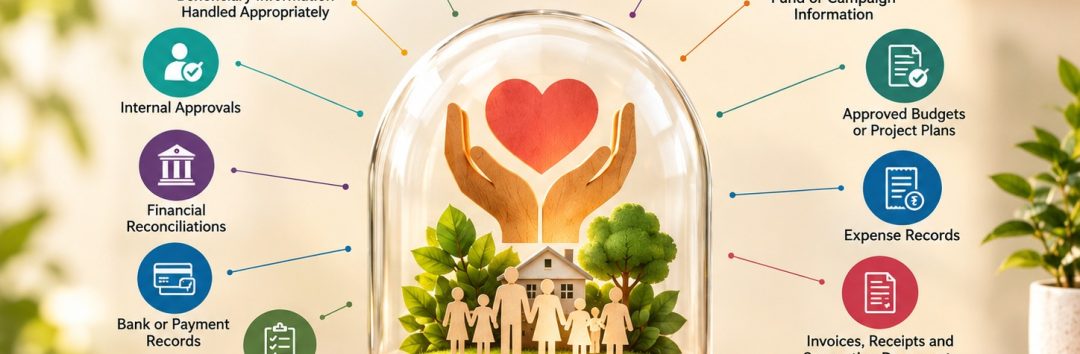

When people donate to a charity, they want to know that their contribution is being handled responsibly and used for a meaningful purpose. For a charity or NGO, answering that expectation requires more than saying that funds are being used properly. The organisation needs reliable records, clear processes, appropriate documentation, and understandable reporting that can demonstrate what happened to the money.
Proving responsible use of donations does not necessarily mean publishing every internal transaction. It means creating a clear chain of information connecting the contribution to its intended purpose, the welfare activity it supports, and the results or progress that follow.
For charitable organisations managing education programmes, healthcare assistance, food distribution, emergency relief, community development, or other welfare activities, this connection can become increasingly important as the number of donors and projects grows.
A useful way to think about it is:
Donors → Contributions → Funds → Welfare Projects → Beneficiaries → Outcomes → Reporting → Continued Support
When each stage is properly documented and connected, an organisation can provide stronger evidence of accountability.
What Does It Mean for a Charity to Prove That Donations Are Being Used Properly?
A charity can demonstrate responsible use of donations by maintaining accurate financial and programme records, documenting how funds are allocated, linking spending to legitimate organisational activities, and communicating relevant information to donors and stakeholders.
The evidence may include:
- Donation and contribution records
- Fund or campaign information
- Approved budgets or project plans
- Expense records
- Invoices, receipts, and supporting documents
- Bank or payment records
- Project activity records
- Beneficiary information handled appropriately
- Internal approvals
- Financial reconciliations
- Project and donor reports
- Outcome or impact information
The exact records required will vary depending on the organisation and the nature of its activities. The central principle is that the organisation should be able to explain and support the journey of its funds from receipt to use.
Why Is It Important for Charities to Demonstrate How Donations Are Used?
Demonstrating responsible use of donations helps strengthen transparency and accountability. It also gives trustees, administrators, donors, programme teams, and other stakeholders a clearer understanding of how organisational resources are being managed.
For donors, the question is often simple:
“What happened after I contributed?”
A strong charity should be able to provide a reasonable answer.
For the organisation itself, good documentation can also make it easier to:
- Monitor projects
- Review spending
- Identify discrepancies
- Prepare reports
- Answer donor questions
- Coordinate teams
- Assess progress
- Improve future fundraising and welfare planning
Transparency is therefore not only an external communication activity. It is also part of sound internal management.
What Records Should a Charity Maintain to Track Donations?
A charity should maintain organised records that connect contributions with the appropriate fundraising activity, fund, project, and financial information.
Depending on the organisation’s structure, useful records may include:
Donor records
- Donor name or preferred identification
- Contact information where appropriate
- Communication preferences
- Contribution history
Contribution records
- Date of contribution
- Amount
- Payment or transaction reference
- Relevant campaign or fund
- Purpose, where applicable
- Acknowledgement or receipt status
Project records
- Project name
- Purpose
- Planned activities
- Relevant budget information
- Project timeline
- Responsible team
Expense records
- Date
- Amount
- Expense category
- Related project or activity
- Supporting documentation
- Appropriate approval
These records create the foundation for meaningful donation reporting.
How Can a Charity Track Donations From Receipt to Impact?
A charity can track donations effectively by establishing a clear relationship between the contribution, the relevant fund or campaign, the welfare project, the activities undertaken, and the outcomes being pursued.
For example:
Contribution received
↓
Assigned to relevant campaign or fund
↓
Allocated to welfare project
↓
Project activities carried out
↓
Beneficiaries supported
↓
Progress and outcomes recorded
↓
Report prepared
This does not mean that every individual donation must always be linked to one specific beneficiary or expense. The appropriate level of tracking depends on how the organisation structures its fundraising and programmes.
What matters is that the organisation can explain the relationship between its resources and its welfare work.
Should Charities Provide Financial Reports to Donors?
Charities can provide appropriate financial summaries or reports to help donors understand how funds are being managed. The level of detail should depend on the type of donor, project, contribution, and reporting purpose.
A donor-facing financial report might explain:
- Amount raised
- Fundraising objective
- Broad categories of fund use
- Amount allocated to relevant activities
- Remaining funds, where relevant
- Significant changes to the original plan
The report does not necessarily need to expose confidential information or provide every internal accounting record.
A useful approach is to distinguish between internal financial documentation and donor-facing financial communication.
Internal records may contain detailed transactions and supporting documents. Donor reports can present the relevant information in a clearer, more accessible format.
What Evidence Can Show That Donations Were Used Responsibly?
Different types of evidence can support a charity’s explanation of how donations were used.
Financial evidence
Examples include:
- Receipts
- Invoices
- Payment records
- Bank records
- Expense documentation
- Accounting records
- Reconciliation records
Programme evidence
Examples include:
- Project activity records
- Procurement or distribution records
- Programme photographs where appropriate
- Attendance or participation records
- Completion documentation
- Progress reports
Governance evidence
Examples include:
- Budget approvals
- Authorisation records
- Internal review procedures
- Financial policies
- Responsibility assignments
- Reporting processes
Outcome evidence
Examples include:
- Project completion information
- Beneficiary-level information where appropriate
- Programme outcomes
- Progress against objectives
- Follow-up information
No single document proves everything. A stronger accountability system uses multiple types of evidence that support one another.
How Can Charities Make Their Donation Tracking More Transparent?
Charities can improve transparency by creating a consistent process for recording donations, allocating funds, documenting expenditure, and reporting project progress.
A practical approach is to:
- Give each fundraising campaign a clear purpose.
- Record every contribution consistently.
- Identify whether funds are restricted to a particular purpose or available more generally.
- Connect relevant funds to welfare projects.
- Record project-related expenditure.
- Keep supporting financial documents organised.
- Review and reconcile records regularly.
- Document significant changes or reallocations.
- Prepare understandable reports.
- Maintain an audit trail for important financial and programme information.
The objective is to make it possible to answer reasonable questions without reconstructing the entire history of a project manually.
What Is an Audit Trail in Charity Fund Management?
An audit trail is a sequence of records that helps show how a financial transaction or decision moved through an organisation’s processes.
For a donation, an audit trail might connect:
Donor contribution → Transaction record → Fund or campaign → Allocation → Project expense → Supporting document → Report
An audit trail can help the organisation identify who recorded information, what happened, when it happened, and what supporting documentation exists.
This can be particularly valuable when several people or teams are involved in fundraising, finance, programme delivery, and reporting.
The exact audit and accounting requirements applicable to a charity depend on its structure and jurisdiction, so organisations should obtain appropriate professional advice where required.
How Should Charities Handle Restricted and General Donations?
Charities should clearly understand the purpose associated with each type of contribution and maintain records that reflect those distinctions.
A contribution may be associated with:
- A specific welfare project
- A particular fundraising campaign
- A broader organisational purpose
- A recurring programme
- Emergency or general support
The organisation should avoid communicating that funds were used for a particular purpose if its records do not support that statement.
Clear internal classification makes donor communication easier because staff can explain the intended purpose and actual allocation of funds consistently.
Where restrictions, formal conditions, or regulatory requirements apply, the organisation should ensure its financial practices and communications follow the applicable rules.
How Can Donation Reports Help Prove Responsible Fund Use?
Donation reports can turn internal records into understandable information for donors. A good report should connect financial information with the welfare work it supported.
For example, instead of reporting only:
“₹X was spent during the project.”
The organisation can provide context such as:
- What the project was intended to achieve
- What funds were available
- What activities were completed
- How resources supported those activities
- What progress was made
- What remains to be done
The actual report should use verified figures and information from the organisation’s records.
This makes the report more meaningful because donors can understand both where resources went and what those resources were intended to accomplish.
Can a Charity Prove Donation Use Without Sharing Every Expense?
Yes. A charity can demonstrate responsible fund management without publishing every internal transaction to every donor.
Transparency should be meaningful rather than indiscriminate.
For example, an NGO may maintain detailed invoices, receipts, payment records, and accounting entries internally while providing donors with a clear summary of project expenditure and progress.
The organisation should be able to provide additional appropriate documentation when required by authorised stakeholders or applicable processes, while protecting confidential information.
A good principle is:
Share enough information to demonstrate accountability, while protecting information that should remain confidential.
How Can Charities Balance Transparency With Privacy?
Charities must balance financial transparency with the privacy and dignity of donors, beneficiaries, staff, and other stakeholders.
A transparent organisation does not need to publicly disclose:
- Private donor contact details
- Sensitive beneficiary information
- Personal financial information
- Security-sensitive information
- Other confidential records
When communicating about beneficiaries, organisations should consider whether personal details are genuinely necessary and whether appropriate permissions or safeguards apply.
For example, a charity can explain the progress of an education-support programme without publishing a child’s full name, address, personal circumstances, or other unnecessary details.
Responsible transparency protects people while making organisational information clearer.
What Are Common Problems That Make Donation Tracking Difficult?
Many charities struggle with donation transparency because information is spread across different systems or maintained manually.
Common problems include:
1. Separate donor and finance records
The fundraising team may have one record while the finance team maintains another.
2. Unclear campaign classification
Contributions may not be consistently associated with the relevant campaign or fund.
3. Missing supporting documents
Receipts, invoices, approvals, or project records may be difficult to locate later.
4. Manual reconciliation
Teams may spend significant time comparing spreadsheets, payment records, and accounting information.
5. Delayed project information
Finance teams may not receive programme updates in time to prepare complete reports.
6. Inconsistent reporting
Different staff members may communicate different figures or descriptions.
7. Poor historical records
An organisation may know its current position but struggle to reconstruct what happened several months earlier.
These issues can affect both operational efficiency and donor communication.
How Can Small NGOs Demonstrate Responsible Use of Donations?
Small NGOs can demonstrate responsible donation use by establishing simple, disciplined record-keeping and reporting processes. They do not need an elaborate technology system to begin.
A small organisation could maintain:
- A central contribution register
- A campaign or fund list
- A project register
- Expense records
- Supporting documents
- Basic approval records
- Periodic reconciliation
- Project progress notes
- Donor updates
For example, imagine a local community organisation raising funds for an education-support programme.
The organisation could record contributions against the campaign, document relevant expenses, maintain project activity records, and later prepare a concise report showing how the funds supported the programme.
The system can remain simple while the organisation is small. What matters most is consistency.
How Can a Charity Respond When a Donor Questions Fund Use?
A charity should respond with clear, factual information and avoid becoming defensive. The first step is to understand the donor’s question and identify the relevant records.
A useful response process is:
- Identify the campaign or contribution.
- Review the relevant financial records.
- Check project and programme information.
- Verify the figures.
- Explain the information in plain language.
- Provide appropriate supporting documentation where applicable.
- Correct any genuine error if one is identified.
If information is unavailable, the organisation should say so rather than guessing.
This is another reason why organised records matter: donor questions can be answered using evidence rather than memory.
How Can Technology Help Charities Track Donation Use?
Technology can help charities maintain connected records for donors, contributions, funds, projects, beneficiaries, activities, and reporting.
A structured digital approach can make it easier to follow the broader relationship:
Donors → Contributions → Funds → Welfare Projects → Beneficiaries → Outcomes → Reporting
Depending on the organisation’s needs, technology can support areas such as:
- Fundraising management
- Donor management
- Contribution tracking
- Welfare project management
- Beneficiary information
- Communication
- Reporting
- Accountability
- Impact tracking
The value of technology comes from creating a more organised information flow. It should complement appropriate financial controls, approvals, documentation, and review processes.
Digital records are not automatically accurate. Organisations still need clear responsibilities and processes for entering, reviewing, and updating information.
What Should a Charity Do Before Publishing a Donation Report?
Before sharing a report, charities should conduct a basic internal review to ensure that the information is accurate, relevant, and appropriately presented.
A practical checklist is:
Financial check
- Are contribution totals correct?
- Do the reported expenses match the relevant records?
- Are fund allocations described accurately?
Programme check
- Are activities correctly described?
- Are progress and outcomes supported by programme information?
- Are project timelines accurate?
Privacy check
- Does the report contain unnecessary personal information?
- Are beneficiary stories and photographs being used responsibly?
Communication check
- Is the report understandable to a non-technical reader?
- Are important changes or challenges explained?
- Is the reporting period clear?
Approval check
- Has the appropriate person or team reviewed the report before it is shared?
This small review process can prevent avoidable mistakes.
How Can Donation Transparency Become Part of Welfare Governance?
Donation transparency is most effective when it is treated as part of the organisation’s wider welfare management system rather than as a separate reporting task.
The complete journey is:
Donors → Contributions → Funds → Welfare Projects → Beneficiaries → Outcomes → Reporting → Continued Support
Each stage generates information that can help the organisation manage its responsibilities.
Welfare Governance can be understood as the structured management of an organisation’s welfare activities, resources, people, projects, beneficiaries, accountability, reporting, and impact.
From this perspective, proving responsible use of donations is connected to the entire welfare ecosystem. Fundraising records need to connect with project information. Project information needs to connect with beneficiary and activity records where appropriate. Outcomes need to be documented. Reporting needs to reflect reliable information.
This creates a stronger foundation for accountability.
A Practical Example: Community Healthcare Assistance
Imagine a charitable organisation running a community healthcare assistance programme.
The organisation receives contributions to support the programme and begins recording them against the relevant fundraising effort.
During implementation, it maintains records of:
- Funds received
- Relevant project allocation
- Programme activities
- Appropriate expenses
- Supporting documents
- Beneficiary information
- Progress and outcomes
At the end of a reporting period, the organisation can prepare a donor update explaining what the programme accomplished and how the available resources supported the work.
If a donor asks a question about the campaign, the organisation does not have to search through unrelated spreadsheets and messages. The relevant information can be traced through the organisation’s records.
That is the practical value of connected donation tracking: it makes accountability easier to demonstrate.
What Are the Best Practices for Proving Responsible Use of Donations?
Charities can strengthen accountability by following a few fundamental practices:
Maintain accurate records
Record contributions, allocations, expenses, and project information consistently.
Connect financial and programme information
A financial figure becomes more meaningful when the organisation can explain the welfare activity it supported.
Keep supporting documents organised
Important records should be accessible when needed.
Reconcile regularly
Do not wait until the end of a project to identify discrepancies.
Establish approval responsibilities
Staff and volunteers should understand who can approve expenses, changes, and reports.
Communicate honestly
Report meaningful progress and significant challenges without exaggeration.
Protect confidential information
Transparency should not expose private donor or beneficiary information unnecessarily.
Report consistently
Use a clear reporting process so stakeholders know what information to expect.
Correct mistakes
If an error is identified, correct it and communicate appropriately rather than allowing inaccurate information to remain.
Build reporting into operations
Good reporting is easier when information is captured throughout the project instead of reconstructed later.
Frequently Asked Questions
How can a charity prove that donations are being used properly?
A charity can demonstrate responsible donation use through accurate contribution records, fund allocation records, expense documentation, project records, financial reconciliation, appropriate approvals, and clear reporting.
What documents show how a charity uses donations?
Depending on the organisation, useful documentation can include receipts, invoices, payment records, accounting records, project reports, allocation records, approvals, and other supporting documents.
Should charities show donors exactly where their money goes?
Charities should provide meaningful information about how contributions relate to their stated purpose and welfare activities. They do not necessarily need to publish every internal transaction or confidential record.
How can NGOs improve donation transparency?
NGOs can improve transparency by maintaining consistent donor and financial records, connecting contributions to relevant projects, documenting expenditure, preparing accurate reports, and communicating significant changes clearly.
Can small charities track donations effectively?
Yes. Small charities can start with simple contribution, fund, project, expense, and reporting records. Consistency is more important than having a complex system.
How does technology help with donation tracking?
Technology can help connect donor information, contributions, fundraising activities, funds, welfare projects, beneficiaries, and reporting information, making records easier to organise and review.
What is an audit trail in charity fund management?
An audit trail is a connected sequence of records showing how a transaction or financial decision was recorded, processed, allocated, and supported by relevant documentation.
How should charities handle donor questions about fund use?
Charities should review the relevant records, verify the information, and respond with clear factual explanations and appropriate supporting documentation where applicable.
How NidhiMax Can Help
Proving that donations are being used responsibly begins with organised information. When donor records, contributions, fundraising activities, welfare projects, beneficiary information, and reporting are disconnected, it becomes harder to demonstrate the complete journey of resources.
NidhiMax — Welfare Governance Platform is designed to help charitable organisations, NGOs, trusts, community organisations, and welfare institutions move toward a more organised digital welfare-management ecosystem.
For organisations where these areas are relevant, a welfare governance approach can help bring greater structure to fundraising management, donor management, contribution tracking, welfare project management, beneficiary management, communication, reporting, transparency, accountability, and impact tracking.
The broader objective is to connect the different stages of welfare work:
Donors → Contributions → Funds → Welfare Projects → Beneficiaries → Outcomes → Reporting → Continued Support
When these relationships are organised, an organisation is better positioned to explain what it is doing with its resources and how those resources relate to its welfare activities.
Every charity has different programmes, teams, processes, and reporting needs. Technology should therefore support the organisation’s actual way of working rather than introduce unnecessary complexity.
Organisations looking to develop a more structured approach to welfare management, accountability, and information flow can explore NidhiMax.com and consider how a Welfare Governance Platform may fit into their operations.