
 Post by
For many small charities, NGOs, trusts, and community organisations, donor information begins in very ordinary places: a phone’s contact list, a WhatsApp conversation, an event registration sheet, or a spreadsheet maintained by one volunteer.
That can work when an organisation is small.
But as fundraising grows, these scattered records can make it difficult to answer basic questions:
- Who has supported us before?
- Which welfare projects interest different supporters?
- When did we last contact someone?
- Who needs a thank-you message?
- Which donors prefer particular types of campaigns?
- Can we identify supporters who have stopped engaging?
- How can we communicate without repeatedly asking everyone for money?
This is where a donor database becomes useful.
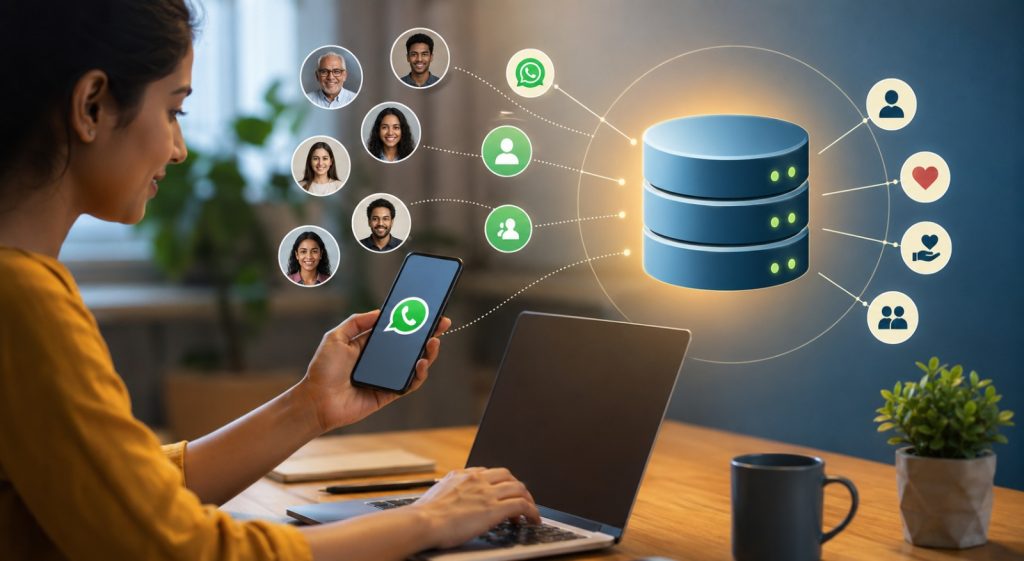
WhatsApp can be an important source of donor and supporter information, but it should not be treated as the database itself. Instead, it can serve as a communication and information-collection channel that feeds into a structured donor-management process.For a charity, the goal is simple: turn scattered conversations into organised, useful, and responsibly managed supporter information.
What is a donor database?
A donor database is an organised record of information about an organisation’s donors and supporters, their contributions, interests, communication preferences, and relevant interactions with the organisation.
A useful donor database does not need to contain every possible detail about a person. It should contain the information the organisation genuinely needs to manage relationships, fundraising, communication, and accountability.
Depending on the organisation’s needs, a donor record might include:
- Name
- Contact details
- Donor or supporter status
- Previous contributions
- Relevant fundraising campaigns
- Areas of interest
- Communication preferences
- Date of last interaction
- Thank-you or acknowledgement status
- Relevant follow-up notes
The key word is organised.
A list of 2,000 phone numbers is not necessarily a useful donor database. The value comes from understanding the relationship behind each contact.
Can a charity build a donor database through WhatsApp?
Yes, but WhatsApp should generally be treated as a channel for collecting and maintaining supporter interactions, rather than the complete donor database.
A charity can use WhatsApp conversations to identify interested supporters, invite people to provide relevant information, answer questions, communicate campaign details, and follow up with existing donors. Those interactions can then be recorded in an appropriate donor-management system.
For example:
WhatsApp conversation → Supporter information → Donor record → Campaign participation → Follow-up → Impact communication
This approach is much more useful than simply keeping a long WhatsApp chat history and expecting staff to remember who everyone is.
Why should charities build a donor database from WhatsApp interactions?
A structured donor database helps an organisation move from contact management to relationship management.
Consider two situations.
Without an organised database
A volunteer receives a WhatsApp message:
“I would like to support your education programme.”
The volunteer replies, receives a contribution, and moves on to other work.
Several months later, another volunteer sends that person a general appeal for an unrelated healthcare campaign.
The organisation may have lost valuable context.
With an organised donor record
The organisation records that the supporter:
- Previously supported the education programme
- Is interested in education-related welfare activities
- Has received the relevant campaign update
- Should be included in appropriate future education communications
Now the next interaction can be more relevant.
The database does not replace human relationships. It helps the organisation remember it.
How can an NGO collect donor information through WhatsApp?
An NGO can use WhatsApp to start conversations and collect only the information it actually needs for a legitimate organisational purpose.
A simple process can be:
Step 1: Start with a clear reason for contact
Instead of asking for a large amount of information immediately, explain why the organisation is asking.
For example:
“We are updating our supporter records so we can send you information about the welfare programmes you are interested in. Would you like to receive these updates?”
The person can then decide how they want to engage.
Step 2: Ask for relevant information
Depending on the organisation’s needs, this might include:
- Name
- Preferred contact details
- Area of interest
- Preferred type of updates
There is usually little value in collecting information simply because a database has a field for it.
Step 3: Record the interaction
The relevant information should move from the conversation into the organisation’s chosen record-keeping system.
Step 4: Keep the record updated
If a supporter changes their interests or communication preferences, the record should be updated rather than creating another duplicate entry.
What information should a charity store in its donor database?
The right fields depend on the organisation, but a practical donor database should usually focus on information that helps with fundraising, communication, administration, and accountability.
A charity might organise information into five broad categories.
1. Basic contact information
- Name
- Phone number
- Email address, where relevant
- Preferred communication channel
2. Supporter relationship
- Donor
- Volunteer
- Community supporter
- Event participant
- Other relevant relationship
3. Fundraising history
Where appropriate, the organisation can record:
- Contribution date
- Contribution amount
- Campaign or project
- Contribution status
- Relevant acknowledgement
4. Interests
For example:
- Education
- Healthcare
- Food distribution
- Emergency relief
- Community development
5. Communication information
- Preferred type of communication
- Relevant consent or communication status
- Last interaction
- Follow-up requirements
The exact structure should reflect the charity’s actual operations.
Should every WhatsApp contact become a donor record?
No. A WhatsApp contact is not automatically a donor.
This distinction is important.
A charity may have thousands of people in its phone or messaging ecosystem, including volunteers, beneficiaries, staff, event participants, suppliers, community members, and donors.
These relationships should not be mixed together without purpose.
A useful database can distinguish between:
Contact → Supporter → Prospect → Donor → Recurring supporter
The exact categories will vary by organisation.
The important thing is to avoid assuming that every person who has communicated with the charity wants fundraising messages.
How can charities segment WhatsApp donors?
Donor segmentation means grouping supporters according to characteristics that help the organisation communicate more appropriately.
For example, an NGO could create groups such as:
Supporter segment | Relevant communication |
Education supporters | Education-related projects |
Healthcare supporters | Healthcare assistance initiatives |
Food-relief supporters | Food distribution campaigns |
Volunteers | Volunteer opportunities |
Previous campaign donors | Updates related to supported projects |
General supporters | Major organisational updates |
Segmentation should make communication more relevant, not simply make it easier to send more messages.
A supporter who previously helped with a school-support project may be interested in another education initiative. That does not automatically mean they should receive every fundraising appeal the organisation launches.
How can WhatsApp help a charity identify potential donors?
WhatsApp can help identify people who show genuine interest in the organisation’s work, but an expressed interest is not the same thing as a confirmed donor.
For example, someone might respond:
“Please let me know when you run another education campaign.”
That interaction can be useful information for the organisation.
Rather than leaving the message buried in an old conversation, the organisation can record an appropriate note such as:
Interest: Education support
Later, when an appropriate campaign is launched, the organisation can communicate with that supporter more meaningfully.
This is one of the practical benefits of connecting WhatsApp communication with donor management.
What is the best way to organise WhatsApp donor information?
The best approach is to create a single, structured source of donor information rather than maintaining separate lists across individual phones and spreadsheets.
A simple operating model might look like this:
Used for:
- Conversations
- Campaign communication
- Questions
- Follow-ups
- Supporter interactions
↓
Donor management
Used for:
- Supporter profiles
- Contribution history
- Interests
- Communication records
- Follow-up information
↓
Welfare management
Used for:
- Fundraising campaigns
- Welfare projects
- Beneficiaries
- Activities
- Reporting
- Outcomes
This creates a connection between communication and the work the organisation is actually doing.
What are the common problems with managing donors only through WhatsApp?
WhatsApp is convenient, but it is not designed to replace every aspect of donor management.
Relying exclusively on chats can create several problems.
Information gets buried
Important donor information can disappear into old conversations.
Staff may have different records
One volunteer may know a donor’s history while another does not.
Duplicate contacts can appear
The same supporter may be recorded under different names or numbers.
Follow-ups can be missed
A supporter may ask for an update, but nobody records the requirement.
Campaign history becomes difficult to track
It can become challenging to understand which supporters participated in which fundraising activities.
Reporting becomes manual
Staff may have to search through conversations to reconstruct information.
The issue is not WhatsApp itself.
The issue is using a communication channel as though it were a complete organisational information system.
How can a charity prevent duplicate donor records?
A charity can reduce duplicate records by establishing a consistent process for identifying and updating supporters.
For example:
- Search for an existing contact before creating a new record.
- Use consistent names and contact details.
- Maintain one primary donor record where appropriate.
- Record important changes instead of creating a second profile.
- Periodically review the database for duplicates.
- Assign clear responsibility for maintaining donor records.
This becomes increasingly important as an NGO grows.
A database should become cleaner over time, not more confusing.
How can charities keep donor information accurate?
A donor database is only useful when people trust the information inside it.
Organisations can improve data quality by establishing simple internal rules.
For example:
- Define what each field means.
- Use consistent formats.
- Avoid unnecessary duplicate records.
- Record updates promptly.
- Review outdated information periodically.
- Restrict editing access where appropriate.
- Keep a clear process for correcting mistakes.
A small charity does not necessarily need a complicated data-management department.
It does need clear ownership and consistent habits.
Lorem ipsum dolor sit amet, consectetur adipiscing elit. Ut elit tellus, luctus nec ullamcorper mattis, pulvinar dapibus leo.
How should charities handle donor privacy when collecting information through WhatsApp?
Charities should treat donor information responsibly and collect only information that is appropriate and necessary for their legitimate organisational purposes.
Before collecting or using personal information, an organisation should consider:
- Why is this information needed?
- Has the person been clearly informed about the purpose?
- Who needs access to it?
- How long should it be retained?
- How will the organisation handle requests to stop communications?
- Is sensitive information being collected unnecessarily?
- Are staff and volunteers handling the information responsibly?
For organisations operating in India, privacy and personal-data practices should be reviewed against applicable requirements and professional advice where necessary. This article is general educational guidance, not legal or compliance advice.
The principle is straightforward: a donor should be treated as a person whose information has been entrusted to the organisation, not simply as a database entry.
How can a charity use a WhatsApp donor database for better fundraising?
A structured donor database can help a charity make fundraising communication more relevant.
Suppose a community organisation has previously run three projects:
- School-support programme
- Food-distribution programme
- Healthcare assistance programme
Instead of sending the same appeal to everyone, the organisation can identify supporters according to their previous interactions and interests.
The fundraising process might become:
Relevant supporters → Relevant campaign → Clear donation request → Contribution record → Thank-you → Project update
This is more thoughtful than treating the entire contact list as one audience.
How can a charity use WhatsApp after receiving a donation?
The relationship should not end when the contribution is received.
After a donation, WhatsApp may be useful for appropriate acknowledgement and updates.
A simple sequence could be:
1. Acknowledge
“Thank you for supporting our education initiative.”
2. Record
Update the relevant donor and contribution records.
3. Deliver
Carry out the welfare activity associated with the campaign.
4. Report
Share an appropriate update about what the organisation accomplished.
5. Maintain the relationship
Keep future communication relevant to the supporter.
This creates a healthier cycle:
Donors → Contributions → Funds → Welfare Projects → Beneficiaries → Outcomes → Reporting → Continued Support
That is much broader than simply collecting donations.
What is the role of donor management in welfare governance?
Donor management is one component of a larger welfare-management system.
A charitable organisation needs to understand not only who contributed, but also how those contributions connect to projects, beneficiaries, activities, resources, and outcomes.
This is where welfare governance becomes relevant.
Welfare governance can be understood as the structured management of an organisation’s welfare activities, resources, people, projects, beneficiaries, accountability, reporting, and impact.
From that perspective:
Donor database → Fundraising → Contributions → Welfare projects → Beneficiaries → Activities → Outcomes → Reporting
Each part is connected.
A donor database becomes more valuable when it is connected to the organisation’s wider welfare operations rather than maintained as an isolated list of names.
Imagine a community organisation building its donor database
Imagine a community organisation running an education-support programme.
It begins with WhatsApp conversations among local supporters. Some people donate, some volunteer, and others simply ask to receive updates.
Instead of keeping all these conversations in separate phones, the organisation creates a structured supporter record.
For each relevant contact, it records information such as:
- Relationship with the organisation
- Interest in education support
- Previous campaign participation
- Contribution information where applicable
- Communication preference
- Follow-up requirements
The organisation can then connect those supporter records to the education project.
As the project progresses, the organisation can maintain appropriate information about:
- Fundraising activity
- Contributions
- Project activities
- Beneficiaries
- Resources
- Updates
- Outcomes
When the project is completed, supporters can receive a suitable update.
The result is a much clearer chain:
Supporter → Contribution → Education project → Beneficiaries → Activity → Outcome → Report
That is the difference between simply collecting donor contacts and building an organised welfare ecosystem.
How can technology help build a WhatsApp-connected donor database?
Technology can help charities bring donor information, fundraising records, welfare projects, and reporting into a more organised environment.
The most useful system is not necessarily the one with the largest number of features. It is the one that matches the organisation’s actual workflow.
For a growing NGO, useful capabilities may include:
- Organised donor records
- Contribution tracking
- Campaign management
- Supporter segmentation
- Beneficiary records
- Welfare project management
- Communication records
- Reporting
- Accountability information
WhatsApp can remain an important communication channel while the organisation maintains its core records in a more structured system.
This distinction matters.
WhatsApp is a channel. A donor-management system is an organisational record.
What should a charity look for in donor-management technology?
Before choosing a system, charity leaders should start with their processes rather than the software.
Ask:
Can we maintain one reliable donor record?
The system should reduce duplication and confusion.
Can we connect donations to campaigns or projects?
Fundraising becomes more useful when the organisation can understand what a contribution relates to.
Can we manage different supporter relationships?
Donors, volunteers, beneficiaries, and community contacts may need different treatment.
Can we record communication preferences?
The organisation should be able to communicate appropriately rather than treating every contact identically.
Can we generate useful reports?
Reports should help administrators and trustees understand fundraising and welfare activities.
Can the system grow with the organisation?
A process that works for a small volunteer team may need to support more structured operations later.
What are the best practices for building a donor database through WhatsApp?
A practical approach can be summarised in eight principles:
- Use WhatsApp as a communication channel, not the entire database.
- Collect only information that serves a clear organisational purpose.
- Distinguish donors from other types of contacts.
- Record supporter interests and communication preferences where appropriate.
- Keep one reliable record for each supporter.
- Connect donor information with fundraising campaigns and welfare projects.
- Protect personal information and limit unnecessary access.
- Use donor information to improve relevance, accountability, and supporter experience—not simply to send more appeals.
These principles can help even a small volunteer-led organisation establish better habits before its database becomes difficult to manage.
FAQ
Can a charity build a donor database using WhatsApp?
Yes. WhatsApp can help a charity collect supporter interactions and identify relevant donor information, but the information should ideally be transferred into a structured donor-management system rather than kept only in chat histories.
What information should an NGO collect from donors?
An NGO should collect information that is genuinely needed for donor management, communication, fundraising, administration, or accountability. Common information includes name, contact details, contribution history, interests, and communication preferences.
Is WhatsApp a donor management system?
No. WhatsApp is primarily a communication platform. It can support donor engagement, but a structured donor-management system is better suited for maintaining organised supporter records, contribution history, campaigns, and follow-up information.
How can NGOs organise WhatsApp donor contacts?
NGOs can organise WhatsApp contacts by identifying supporter relationships, recording relevant information in a structured database, segmenting supporters by appropriate interests, and maintaining consistent records instead of relying only on individual chat histories.
How can a charity avoid duplicate donor records?
Charities can reduce duplicates by searching for existing records before creating new ones, using consistent contact information, maintaining one primary record per supporter where appropriate, and periodically reviewing the database.
Can WhatsApp help with donor segmentation?
Yes. Conversations and previous interactions can provide useful information about supporter interests. That information can be recorded in a donor-management system and used to make future communication more relevant.
Why should charities connect donor data with welfare projects?
Connecting donor information with welfare projects helps an organisation understand how fundraising relates to activities, beneficiaries, outcomes, and reporting. It turns donor management into part of a broader welfare-management process.
How can technology improve donor management for NGOs?
Technology can help NGOs organise donor records, contributions, fundraising campaigns, communication, welfare projects, and reports in a more coordinated system, reducing dependence on scattered spreadsheets, chats, and manual records.
How NidhiMax Can Help
Building a donor database through WhatsApp is useful, but the larger objective should be to create an organised system for managing the organisation’s entire welfare journey.
A charity may begin with WhatsApp conversations, but its operational needs can eventually extend to donor management, contribution tracking, fundraising, welfare projects, beneficiaries, communication, reporting, accountability, and impact.
This is where a broader welfare governance approach can be valuable.
NidhiMax — Welfare Governance Platform is designed for charitable organisations, NGOs, trusts, community organisations, and welfare institutions that want to move toward a more organised digital welfare-management ecosystem.
Rather than viewing a donor as simply a name and phone number, organisations can think about the complete relationship:
Donor → Contribution → Fund → Welfare Project → Beneficiary → Outcome → Report → Continued Support
Technology should help make that journey more organised and understandable.
To explore NidhiMax and its approach to welfare governance, visit NidhiMax.com.
Every charitable organisation has different processes, resources, and priorities. The right technology should therefore support those real-world processes rather than force the organisation into an unnecessarily complicated system.