
 Post by
For many NGOs and charitable organisations in India, fundraising is a continuous responsibility. Donations help support education, healthcare, food distribution, emergency relief, and community development. However, when an organisation depends mainly on one-time contributions, planning its activities and managing ongoing expenses can become difficult.
A recurring donation program offers a practical way to build more consistent support. Instead of asking donors to contribute only when a campaign begins, an NGO invites them to support its mission regularly, such as every month.
The idea is simple: when supporters make a commitment they can comfortably maintain, an organisation can plan its work with a better understanding of expected contributions. However, building a successful program requires more than setting up a payment option. NGOs must communicate a clear purpose, make giving convenient, maintain reliable records, respect donor preferences, and report progress honestly.
This guide explains how Indian NGOs, charitable trusts, foundations, and community organisations can create and manage a recurring donation program step by step.
What Is a Recurring Donation Program?
A recurring donation program is a fundraising arrangement in which a donor agrees to contribute a chosen amount at regular intervals, such as monthly or annually, through an agreed payment process.
For example, a supporter may choose to contribute ₹500 every month towards an NGO’s education initiative. If the payment arrangement remains active and the contributions are successfully processed, the NGO can receive ongoing support without needing to ask that donor to make a completely new donation each month.
Recurring donations may be used to support activities such as:
- Educational assistance for children
- Healthcare support for vulnerable communities
- Food distribution and nutrition programs
- Care for elderly people
- Community development initiatives
- Animal welfare activities
- Long-term rehabilitation and emergency preparedness
A recurring donation program can operate alongside one-time donations, fundraising events, corporate contributions, and grant funding.
The essential difference is that recurring giving creates an ongoing relationship between the donor and the organisation rather than relying entirely on separate fundraising appeals.
Why Should Indian NGOs Build a Monthly Donation Program?
Indian NGOs can benefit from recurring donations because they may provide a more predictable source of support for ongoing activities, strengthen donor relationships, and reduce dependence on repeated one-time fundraising appeals.
Many welfare activities require regular planning. An organisation may need to purchase educational materials, arrange healthcare assistance, distribute food, or coordinate staff and volunteers throughout the year.
When a portion of fundraising comes from recurring contributions, the organisation can use its payment history and active donor commitments to estimate potential income. These estimates must account for failed payments, cancellations, and changes in donor participation.
The main benefits include the following.
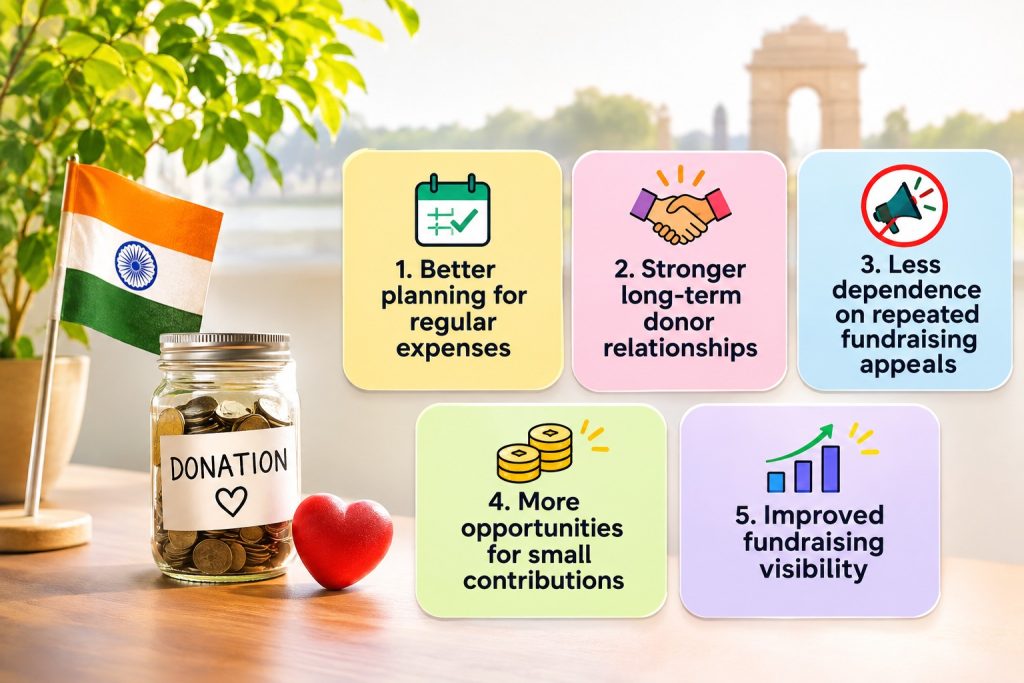
1. Better planning for regular expenses
Recurring donations can help NGOs plan routine activities such as buying learning materials, supporting community kitchens, or providing regular assistance to beneficiaries.
For example, if an NGO receives recurring contributions from a group of supporters, it can use its actual collection history to help plan future purchases. It should still maintain contingency plans because expected donations are not guaranteed income.
2. Stronger long-term donor relationships
Monthly giving creates regular opportunities to communicate with supporters about the organisation’s work.
Instead of contacting donors only when money is needed, an NGO can share project updates, explain progress, acknowledge contributions, and invite feedback.
3. Less dependence on repeated fundraising appeals
One-time fundraising campaigns remain valuable, but relying exclusively on them can create uncertainty between campaigns.
A recurring program can provide an additional fundraising channel while allowing the organisation to continue seeking new donors, grants, and other appropriate sources of support.
4. More opportunities for small contributions
Some supporters may find it easier to contribute a modest amount regularly than to make a larger one-time donation.
For instance, an individual who cannot comfortably donate ₹6,000 at once may prefer to contribute ₹500 per month. Whether this arrangement works depends on the donor’s circumstances and the organisation’s ability to explain how the support will be used.
5. Improved fundraising visibility
Tracking recurring commitments, successful payments, failed transactions, and cancellations helps an NGO understand how its program is performing.
This information can guide decisions about donor communication, payment options, campaign messaging, and future welfare activities.
Recurring donations do not eliminate fundraising uncertainty. Their value comes from combining ongoing support with careful financial planning and responsible management.
How to Build a Recurring Donation Program in India: Step-by-Step
An NGO can build a recurring donation program by defining its purpose, setting realistic contribution options, choosing an appropriate payment process, inviting supporters to participate, and establishing systems for tracking contributions and reporting progress.
The following steps provide a practical framework.
Step 1: Define the purpose of the program
Start by deciding what the recurring donations will support.
A clear purpose helps donors understand why their ongoing contribution matters. It also helps the organisation plan how funds will be allocated and what information it should report.
Possible purposes include:
- Providing learning materials for children
- Supporting regular food distribution
- Funding healthcare assistance
- Maintaining a community support program
- Providing ongoing assistance to elderly people
Avoid beginning with a vague message such as “Donate every month to help us.” Explain the need, the intended activities, and how the organisation will communicate progress.
For example, an NGO supporting children could establish a monthly education-support program that contributes towards approved educational expenses. Its campaign should explain the scope of support without promising specific outcomes that have not been established.
Step 2: Estimate the program’s financial requirements
Before asking donors to commit, calculate the approximate cost of the activities the program is intended to support.
Prepare a simple budget covering relevant expenses, such as:
- Materials and supplies
- Program delivery
- Transportation and distribution
- Staff or service costs, where applicable
- Monitoring and reporting
- Necessary administrative expenses
The budget should distinguish between planned expenditure and funds already available.
Suppose a community organisation needs ₹30,000 per month for an education-support activity. It could use this figure to set a fundraising objective and explore different combinations of contribution amounts.
This is a planning example, not a recommended donation amount or a guarantee that the program can raise the required funds.
The organisation should also consider what it will do if recurring donations fall below the target.
Step 3: Choose suitable monthly contribution options
Offer a small number of contribution options that are easy to understand.
For example:
- ₹250 per month
- ₹500 per month
- ₹1,000 per month
- A custom amount
These are illustrative amounts. Each NGO should choose options that suit its supporters, fundraising goals, and program costs.
Explain the purpose of each suggested amount without implying that a particular donation guarantees a specific result.
For instance, the organisation might describe ₹500 as a contribution towards its overall education-support program rather than claiming that it always covers the complete cost of educating one child.
Allowing donors to select a comfortable amount can make the program more accessible. Avoid language that makes people feel guilty for contributing less or declining to participate.
Step 4: Select an appropriate digital payment method
Choose a payment process that allows supporters to contribute conveniently and enables the NGO to maintain reliable records.
Depending on the provider and the available arrangements, recurring payments may be supported through eligible UPI AutoPay mandates, e-mandates, cards, or other permitted payment methods.
The available options, mandate requirements, transaction limits, authorisation steps, and recurring-payment rules can vary by payment method and provider. NGOs should confirm the current requirements with their payment service provider before launching the program.
When evaluating a payment solution, check whether it supports:
- Clear donor authorisation for recurring payments
- Confirmation of successful and unsuccessful transactions
- Appropriate transaction references
- Payment failure notifications
- Cancellation or mandate-management procedures
- Suitable donor acknowledgements
- Secure handling of payment information
- Reports or exports for reconciliation
Do not assume that a standard QR code or ordinary one-time payment link automatically creates a recurring donation arrangement. A recurring payment generally requires an appropriate setup and the donor’s authorisation.
The NGO should also ensure that donors understand the amount, frequency, authorisation terms, and process for changing or stopping their contributions.
Step 5: Create a simple recurring donation page
The donation page should make it easy for a supporter to understand the program and complete the required payment steps.
Include the following information:
Program purpose: Explain the welfare activity that recurring contributions will support.
Suggested contribution amounts: Display clear monthly options and, where possible, a custom amount.
Payment frequency: State how often the contribution will be collected.
Payment instructions: Explain the authorisation process and what the donor should expect.
Organisation details: Provide appropriate information to help donors identify the charitable organisation.
Contact information: Make it easy to ask questions or seek help with a payment.
Cancellation and support process: Explain how donors can manage or stop their recurring commitment.
Reporting approach: Tell supporters how the organisation intends to communicate progress and the use of funds.
Avoid unnecessary form fields. Request only information required to process the contribution, maintain records, and communicate appropriately.
Before publishing the page, test it on a mobile phone, since many supporters may access the campaign through a messaging app or social media link.
Step 6: Invite existing donors to become recurring supporters
Existing donors may be a useful audience for a recurring donation campaign because they already know something about the organisation’s work.
However, a previous donation should not be treated as permission to create a recurring payment. Donors must make an informed choice and complete the required authorisation process.
The NGO can invite supporters through appropriate channels such as email, WhatsApp, newsletters, community meetings, or personal conversations.
A good invitation should explain:
- Why ongoing support is needed
- What the program intends to achieve
- Which contribution options are available
- How the payment arrangement works
- How supporters can receive updates
- How they can ask questions or stop contributing
For example, an NGO could send a short message explaining that it is introducing a monthly education-support program and inviting interested donors to review the details.
The invitation should be respectful and make it clear that participation is voluntary.
Step 7: Promote the program through suitable channels
A recurring donation program should be visible wherever the organisation communicates with its supporters.
Useful channels may include:
- The NGO’s website
- Email newsletters
- WhatsApp messages sent appropriately
- Social media posts
- Community events
- Fundraising presentations
- Volunteer networks
- Relevant local outreach activities
Keep the core message consistent across channels. Every appeal should explain the program’s purpose and provide a clear route to the donation page.
Instead of asking only for a monthly contribution, explain why ongoing support is useful.
For example, a community kitchen might explain that regular contributions help it plan food purchasing and distribution. The organisation should support such statements with its actual operating process and avoid suggesting that every donation is spent exclusively on a particular expense unless that is accurate.
Step 8: Track recurring donations and payment status
Once the program begins, the NGO needs a reliable method for recording commitments and monitoring payments.
A recurring donation register or suitable software should distinguish between a donor’s active payment arrangement and contributions actually received.
Useful records may include:
- Donor reference
- Authorised contribution amount
- Agreed frequency
- Mandate or payment reference, where appropriate
- Start date
- Successful payment dates
- Failed or pending transactions
- Cancellation or pause status
- Acknowledgement status
- Relevant communication history
Avoid storing sensitive payment credentials or authentication information in ordinary spreadsheets or donor records.
Reconcile the collected amounts with bank statements and payment provider reports. This helps identify discrepancies and prevents an expected payment from being incorrectly recorded as received.
Step 9: Send meaningful updates to recurring donors
Regular supporters should receive useful communication about the organisation’s work, not just repeated donation reminders.
An NGO can create a simple communication calendar that includes:
- Acknowledgements after successful contributions
- Monthly or quarterly program updates, as appropriate
- Important milestones
- Honest explanations of delays or changing needs
- Summaries of activities and relevant outcomes
- Opportunities to ask questions or provide feedback
For example, an education-support NGO might share an update about materials distributed, activities completed, and plans for the next period.
Use photographs and beneficiary stories responsibly, with appropriate permissions and safeguards. Children and vulnerable individuals require particular care when their personal information or images are shared.
Step 10: Review the program and improve it over time
A recurring donation program should be reviewed regularly to understand whether it is meeting donor needs and supporting the organisation’s work.
Review questions such as:
- How many donors have authorised recurring contributions?
- How many payment arrangements remain active?
- How much money has actually been collected?
- How many payments failed or were cancelled?
- How much did the campaign cost to operate?
- Are donors receiving acknowledgements and updates?
- Are the funds supporting the intended activities?
- What feedback have donors shared?
Use the findings to improve payment instructions, simplify the donation page, strengthen communication, and adjust the fundraising plan.
Do not judge the program solely by the number of recurring donors. The amount actually collected, donor experience, operating costs, and the organisation’s ability to use the funds responsibly also matter.
How Can NGOs Calculate a Monthly Donation Target?
NGOs can estimate a monthly donation target by calculating the funding required for their activities, identifying other available resources, and estimating how much recurring support may be needed to cover the remaining requirement.
A simple planning formula is:
Monthly recurring donation target = Planned monthly funding requirement − Other reliable funding available
For example, imagine an NGO has a planned monthly program requirement of ₹50,000 and expects ₹20,000 from other reasonably reliable sources.
Its remaining monthly funding requirement would be ₹30,000.
The organisation could model different combinations of donor contributions to understand what reaching that target might involve.
Illustrative monthly contribution | Number of donors | Total monthly contributions |
₹250 | 40 | ₹10,000 |
₹500 | 30 | ₹15,000 |
₹1,000 | 5 | ₹5,000 |
Total | 75 | ₹30,000 |
This example illustrates a possible combination of contributions; it does not predict how many donors an NGO will attract.
The organisation should also allow for payment failures, donor cancellations, transaction charges where applicable, and changes in funding from other sources. Its actual planning should be based on verified collections and realistic assumptions.
What Are the Best Practices for Managing Recurring Donations?
The best recurring donation programs combine clear communication, convenient payment arrangements, accurate records, responsible fund management, and regular reporting.
Make the commitment clear
Explain the contribution amount, payment frequency, authorisation process, and cancellation options before the donor confirms the arrangement.
Keep payment records accurate
Distinguish between authorised mandates, expected payments, successful transactions, and failed transactions.
Respect donor choice
Make participation voluntary. Avoid repeated pressure, misleading urgency, or unclear cancellation processes.
Acknowledge contributions
Confirm successful payments through an appropriate channel and maintain records of acknowledgements.
Report honestly
Communicate actual activities, financial information appropriate to the report, and progress against the program’s objectives. Be open about setbacks.
Protect donor information
Limit access to donor records, use suitable security controls, and maintain clear procedures for data retention and sharing.
Review recurring commitments regularly
Monitor cancellations, failed payments, and changes in donor preferences. Contact supporters about payment problems only through appropriate channels and without unnecessary pressure.
Maintain financial oversight
Reconcile donations with financial records and ensure fund allocation follows the relevant donation terms and internal approval procedures.
These practices help the NGO protect donor confidence while keeping the program manageable.
What Challenges Do NGOs Face When Building Recurring Donation Programs?
NGOs may face challenges such as low initial participation, payment failures, donor cancellations, inconsistent communication, and uncertainty about future collections.
Understanding these challenges in advance makes it easier to prepare a realistic plan.
Low initial participation: Donors may need time to understand the program. Explain its purpose clearly, start with the organisation’s existing supporter network, and make participation easy to understand.
Payment failures: Mandates may be cancelled, payment methods may fail, or sufficient funds may not be available. Monitor transaction reports and provide a clear process for donors to update their arrangements.
Donor cancellations: A donor’s financial circumstances or priorities may change. Respect the decision and use cancellation feedback, when voluntarily provided, to improve the program.
Limited staff capacity: Small NGOs may not have a dedicated fundraising team. Assign clear responsibilities and use simple processes that staff and volunteers can maintain consistently.
Weak reporting: Donors may lose confidence if updates are irregular or unclear. Establish a realistic reporting schedule and assign responsibility for preparing accurate updates.
Overdependence on recurring donations: Even a well-run program can change over time. Maintain a broader fundraising strategy and avoid treating expected recurring contributions as guaranteed income.
The objective is to build a sustainable fundraising practice, not to eliminate every uncertainty.
What Should Indian NGOs Know About Compliance and Donation Records?
Indian NGOs should verify the legal, tax, payment, and reporting requirements that apply to their organisation and donation arrangements before launching a recurring donation program.
The relevant requirements can depend on the organisation’s legal status, the nature and source of the contributions, the payment method, and the activities being funded.
Organisations should consider the following:
- Maintain accurate donation and financial records.
- Issue acknowledgements or receipts as appropriate to the organisation’s circumstances and applicable requirements.
- Make sure any claims about tax benefits are accurate and supported by the organisation’s actual eligibility and applicable rules.
- Check relevant requirements before accepting foreign contributions or promoting a campaign involving overseas donors.
- Review payment provider terms and recurring-payment authorisation procedures.
- Protect personal information and assess applicable data-protection obligations.
- Keep supporting documents for fund allocation and expenditure.
An NGO should not promise tax deductions simply because it accepts donations. Tax treatment depends on the relevant legal requirements and the organisation’s circumstances.
Likewise, organisations that may be subject to requirements relating to 80G, FCRA, CSR funding, or other regulatory matters should obtain current guidance from a qualified professional. This article provides general operational information, not legal, tax, or regulatory advice.
How Does Recurring Fundraising Fit Into Welfare Governance?
Welfare governance is the structured management of an organisation’s welfare activities, resources, people, projects, beneficiaries, accountability, reporting, and impact.
Recurring donations can support this broader system by providing a fundraising process that is connected to financial planning, project delivery, and reporting.
A well-organised welfare ecosystem links:
Donors → Contributions → Funds → Welfare Projects → Beneficiaries → Outcomes → Reporting → Continued Support
Each stage has a distinct role.
- Donors: Individuals and organisations that choose to support the mission.
- Contributions: Donations that are authorised, received, and recorded accurately.
- Funds: Resources managed according to their intended purposes and applicable controls.
- Welfare projects: Activities planned and delivered by the organisation.
- Beneficiaries: Individuals or communities receiving support.
- Outcomes: Changes or results assessed using appropriate evidence.
- Reporting: Clear communication about finances, activities, progress, and limitations.
- Continued support: Donor relationships built through trust, responsible management, and credible communication.
For example, an NGO that raises monthly contributions for healthcare assistance needs more than a payment collection process. It must also document the program’s requirements, maintain appropriate financial records, coordinate assistance, protect beneficiary information, and report what was accomplished.
Connecting these activities helps trustees and managers understand how fundraising supports the organisation’s broader mission.
A recurring donation program is therefore one component of welfare governance rather than a complete welfare management system on its own.
How Can Technology Help NGOs Manage Recurring Donations?
Technology can help NGOs organise recurring donor records, monitor payment outcomes, manage acknowledgements, coordinate communication, and prepare reports, depending on the tools they select.
A small organisation might begin with a structured spreadsheet and payment provider reports. A growing NGO may need dedicated donor management software or a broader platform that supports additional welfare operations.
Before selecting a tool, consider whether it can help the organisation:
- Maintain accurate donor profiles and contribution histories
- Distinguish recurring commitments from actual collections
- Identify failed payments and pending follow-ups
- Record donor communications and preferences
- Connect contributions to relevant fundraising campaigns
- Prepare useful management reports
- Protect sensitive information through appropriate access controls
- Export records when needed
The best system is one that staff can maintain consistently and that supports the organisation’s actual processes.
Technology should reduce confusion and improve oversight. It should not create unnecessary complexity or replace the financial controls, human relationships, and professional judgement required for responsible fundraising.
Frequently Asked Questions
1. What is a recurring donation program?
A recurring donation program allows supporters to contribute a chosen amount at regular intervals, such as monthly or annually. It helps NGOs develop ongoing donor relationships and plan fundraising activities.
2. How can an NGO start a monthly donation program in India?
An NGO can start by defining its fundraising purpose, estimating its budget, selecting contribution amounts, choosing a suitable recurring payment method, creating a donation page, and inviting supporters to participate.
3. Which payment methods can NGOs use for recurring donations in India?
Depending on provider support and applicable requirements, NGOs may be able to use UPI AutoPay, e-mandates, cards, or other permitted recurring payment methods. They should verify current availability and authorisation requirements with their payment provider.
4. How much should an NGO ask donors to contribute monthly?
The amount should reflect the organisation’s funding needs and what its supporters can comfortably afford. Offering several options, such as ₹250, ₹500, and ₹1,000 per month, can provide flexibility. These are illustrative amounts, not universal recommendations.
5. How can NGOs encourage donors to give every month?
NGOs can explain the value of ongoing support, make payment arrangements easy to understand, offer flexible contribution options, acknowledge donations, and share honest updates about their welfare activities.
6. How can an NGO track recurring donations?
An NGO can maintain records of donor commitments, authorised payment arrangements, successful collections, failed payments, cancellations, and acknowledgements. Regular reconciliation with bank statements and payment provider reports helps maintain accurate records.
7. Are recurring donations eligible for tax benefits in India?
Tax benefits depend on the organisation’s eligibility, the nature of the donation, and applicable rules. NGOs should verify their current status and consult a qualified tax professional before making claims about deductions.
8. How can NGOs retain monthly donors?
NGOs can encourage donor retention through respectful communication, timely acknowledgements, transparent reporting, convenient payment management, and honest explanations of project progress. Donors should be free to change or cancel their contributions.