 Post by
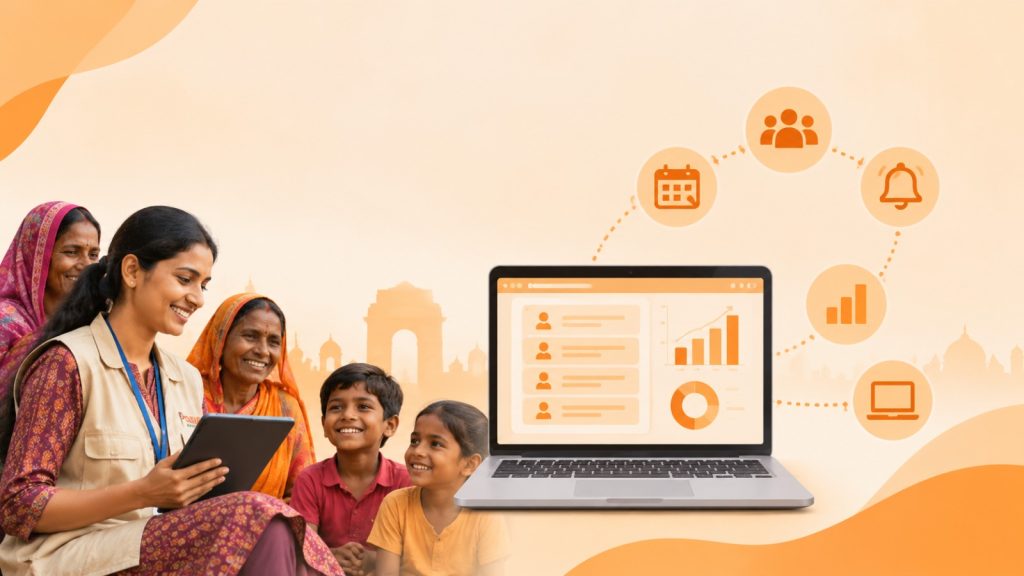
Managing donors is one of the most important responsibilities of an NGO. Every contribution represents someone’s trust in the organisation and its mission. However, as a charitable organisation grows, keeping track of donors, recording donations, sending updates, maintaining records, and building long-term relationships can become increasingly difficult.
Many Indian NGOs still rely on spreadsheets, paper registers, email inboxes, WhatsApp conversations, and individual team members to manage donor information. These methods may work initially, but they can create confusion when donation records are scattered across different places or when multiple people handle fundraising activities.
Digital donor management helps NGOs organise donor information, track contributions, improve communication, and maintain clearer records of fundraising activities. With a suitable digital process, an organisation can spend less time searching for information and more time focusing on its welfare projects and beneficiaries.
For NGOs, charitable trusts, foundations, and community organisations in India, the goal is not simply to collect donations online. It is to build a reliable system that connects donors, contributions, welfare activities, and reporting.
What Is Digital Donor Management?
Digital donor management is the process of using digital tools and organised records to manage donor information, track donations, communicate with supporters, and maintain relationships with people who contribute to an organisation’s work.
Instead of keeping donor details in separate notebooks, spreadsheets, messages, and email accounts, an NGO can maintain a structured digital record that authorised team members can access when needed.
A digital donor management process may include:
- Donor information: Names, contact details, communication preferences, and relevant relationship history.
- Donation records: Contribution amounts, dates, payment methods, purposes, and transaction references.
- Communication history: Thank-you messages, campaign updates, meeting notes, and previous interactions.
- Fundraising records: Campaigns supported by donors and contributions received for particular initiatives.
- Reporting: Summaries of donations, donor engagement, fundraising progress, and outstanding follow-up tasks.
- Record maintenance: Updating contact details, correcting errors, and managing access to donor information.
For example, an NGO that receives donations for children’s education could maintain records of supporters who contribute towards school supplies, tuition assistance, uniforms, or educational materials.
When the organisation needs to prepare a fundraising update, it can refer to organised records rather than searching through old messages and files.
Why Should Indian NGOs Manage Donors Digitally?
Indian NGOs can benefit from digital donor management because it makes donor information easier to organise, supports timely communication, and improves visibility into fundraising activities.
As an organisation expands its programs, it may receive contributions through bank transfers, online payment services, fundraising events, QR codes, and direct appeals. Recording these contributions consistently becomes essential.
Here are some common challenges that digital donor management can help address.
1. Donor information is scattered across different places
A donor’s phone number might be saved on one staff member’s mobile phone, while their donation history is recorded in a spreadsheet and their communication history remains in WhatsApp.
This makes it difficult to understand the complete relationship with that donor.
A centralised donor record helps bring relevant information together, reducing duplication and making follow-ups easier.
2. Donation tracking becomes difficult
When an NGO receives multiple contributions for different purposes, manually matching transactions with donor records can take considerable time.
A structured system helps the team record each contribution with the relevant date, amount, purpose, and transaction reference. Bank statements and payment records should still be reconciled to confirm that entries are accurate.
3. Donor communication becomes inconsistent
Supporters appreciate knowing that their contributions have been acknowledged and that the organisation communicates responsibly about its activities.
Without a clear process, some donors may receive repeated messages while others receive no updates.
Digital records can help teams identify whom to thank, when to follow up, and which project updates may be relevant to particular supporters.
4. Staff changes can disrupt donor relationships
In smaller NGOs, one person may manage most donor relationships. If that person leaves, takes a break, or changes responsibilities, important information may become difficult to recover.
A shared, access-controlled record helps preserve organisational knowledge instead of leaving it entirely with individual team members.
5. Fundraising reports take longer to prepare
Trustees, internal teams, and donors may need summaries of contributions received and the progress of fundraising campaigns.
When donation records are maintained consistently, preparing these reports becomes more straightforward.
Digital donor management therefore supports more organised fundraising operations and helps the organisation maintain donor confidence.
How Can an NGO Manage Donors Digitally? A Step-by-Step Process
An NGO can begin managing donors digitally by creating a reliable donor database, recording every contribution consistently, establishing communication routines, and reviewing fundraising information regularly.
The following steps provide a practical starting point for organisations of different sizes.
Step 1: Create a centralised donor database
Begin by bringing existing donor records into one organised location.
If your NGO already uses spreadsheets, review them before importing or consolidating the information. Remove unnecessary duplicate entries and correct obvious errors.
Depending on the organisation’s needs, a donor record may contain:
- Donor name or organisation name
- Preferred contact details
- Date of the first contribution
- Donation history
- Campaigns or projects supported
- Communication preferences
- Relevant follow-up notes
- A unique donor reference, where useful
Collect only the information needed for legitimate organisational purposes. Sensitive personal information should not be collected merely because a digital system allows it.
Practical example: If three spreadsheets contain information about the same supporter, consolidate the records carefully so the NGO can view the person’s contribution history without counting the same donor multiple times.
Step 2: Record every donation consistently
Every donation should have a clear record, whether it arrives through a bank transfer, online payment, cheque, fundraising event, or another channel.
Useful fields include:
- Donation date
- Amount received
- Donor reference
- Payment method
- Transaction reference, where applicable
- Fundraising campaign or designated purpose
- Receipt status, where relevant
- Verification or reconciliation status
The team should distinguish between a donation that has been pledged and one that has actually been received. Similarly, a payment notification should not automatically be treated as final confirmation if the transaction has not been verified.
For example, suppose an NGO receives ₹5,000 from a supporter for a healthcare assistance program. The contribution should be recorded against the correct donor and campaign, and the transaction should be reconciled with the organisation’s financial records.
This creates a clearer record for internal review and subsequent reporting.
Step 3: Organise donors into meaningful groups
Donor segmentation means grouping supporters according to relevant characteristics so the NGO can communicate more appropriately.
An organisation might group donors by:
- First-time and returning donors
- Monthly or recurring supporters
- Individuals and corporate contributors
- Campaign or project supported
- Communication preferences
- Recent engagement or last contribution date
These groups can help fundraising teams plan suitable communication without sending the same message to everyone.
For example, someone who regularly supports a food distribution program may appreciate updates about that initiative. A supporter who contributed to an emergency relief campaign may be more interested in learning about the relief work they helped fund.
Segmentation should be used to improve relevance, not to pressure people into donating.
Step 4: Establish a consistent donor acknowledgement process
Acknowledging contributions promptly is an important part of donor relationship management.
An NGO should define who is responsible for acknowledging donations and what information each acknowledgement should contain.
A practical process may include:
- Verify the contribution and identify the donor.
- Confirm the amount and relevant transaction details.
- Issue the appropriate acknowledgement or receipt according to the organisation’s process and applicable requirements.
- Thank the donor through their preferred communication channel.
- Record that the acknowledgement has been completed.
Where suitable tools are available, some of these tasks may be automated. However, the organisation should still check that messages contain accurate information and are sent to the correct recipients.
Step 5: Communicate regularly with donors
Donor management involves more than sending fundraising requests. Supporters should receive meaningful updates about the work they help make possible.
An NGO can plan communications around:
- Project progress
- Distribution activities
- Educational or healthcare assistance
- Campaign milestones
- Challenges and changing needs
- Financial or activity summaries
- Opportunities to participate in future initiatives
WhatsApp, email, phone calls, and newsletters can all play a role, depending on donor preferences and the organisation’s communication practices.
For example, an NGO supporting schoolchildren could send an update explaining how an education program is progressing, what activities have taken place, and what work remains.
The update should be truthful and respectful of beneficiary privacy. Photographs, personal stories, and identifying details should only be shared when appropriate permissions and safeguards are in place.
Step 6: Connect donations with fundraising campaigns
A donor database becomes more useful when contributions can be associated with the campaigns and projects they support.
An NGO may run separate initiatives for education, medical assistance, food distribution, or emergency relief. Each initiative should have clearly defined records so the team can understand how much has been received for the relevant purpose.
For example, a campaign to provide school supplies may track:
- Its fundraising goal
- Total contributions received
- Number of verified transactions
- Funds allocated to the initiative
- Purchases and distributions completed
- Remaining activities
- Updates shared with donors
Where donations are restricted to a particular purpose, the organisation should follow the applicable terms and its financial controls when allocating and using those funds.
This approach helps connect fundraising activity with the welfare work it is intended to support.
Step 7: Review donor records regularly
A donor database is useful only when its information remains accurate.
Assign responsibility for reviewing records and establish a routine that suits the organisation’s activity level.
Regular checks should identify:
- Duplicate donor profiles
- Missing donation references
- Incorrect contact details
- Unmatched transactions
- Unsent acknowledgements
- Incomplete follow-up tasks
- Outdated communication preferences
It is also important to document who can update records and how corrections are made.
These small practices help prevent errors from accumulating and make the system more reliable over time.
What Are the Best Digital Tools for NGO Donor Management?
The best donor management tool is one that fits an NGO’s size, budget, workflow, and reporting needs without making everyday work unnecessarily complicated.
An organisation does not always need an elaborate software system at the beginning. It should first identify its operational problems and choose tools that address them.
Spreadsheets
Spreadsheets can be suitable for small NGOs with a manageable number of donors and relatively simple fundraising activities.
They allow teams to organise names, contact details, donation dates, amounts, and campaign references.
However, spreadsheets can become difficult to maintain when several people edit separate copies, donor histories become extensive, or detailed reports are needed frequently.
Access controls, backups, clear ownership, and consistent data-entry rules are important even when using spreadsheets.
Digital payment and donation tools
Online payment tools can make it easier for supporters to contribute through available digital payment methods.
They may provide transaction references or payment reports, depending on the service.
However, payment collection and donor management are different activities. An NGO should not assume that a payment tool alone will maintain complete donor histories, record all communications, or connect contributions to welfare outcomes.
The organisation may need a separate process for consolidating payment records and maintaining donor relationships.
Donor management software
Donor management software is designed to organise donor profiles, contribution histories, communication records, and fundraising information.
Depending on the product, it may also support reporting, donor segmentation, reminders, or integrations with other systems.
Before selecting software, assess whether the available features match your requirements. Do not assume that every product includes all these capabilities.
Welfare management platforms
Some organisations need to coordinate activities beyond fundraising. They may also need to manage beneficiaries, welfare projects, fund allocation, service delivery, and reporting.
In such cases, a broader welfare management platform may be worth evaluating alongside a dedicated donor management tool.
The aim is to create a practical connection between the people supporting an organisation and the work being carried out in the community.
How Can NGOs Choose the Right Donor Management Software?
NGOs should choose donor management software by comparing its practical capabilities, ease of use, data protection measures, cost, and suitability for their existing processes.
Before making a decision, ask the following questions.
Does it maintain complete donor records?
Check whether the system can store the information your organisation actually needs and maintain a useful history of contributions and communications.
Can the team reconcile donations accurately?
Look for ways to record transaction references, identify unmatched payments, and review contribution records against financial statements.
Can authorised staff use it easily?
A tool should be understandable to the people who will use it daily. A complicated interface can create extra work and reduce adoption.
Does it protect donor information?
Review access permissions, authentication options, backup arrangements, data export capabilities, and the provider’s privacy and security practices. Avoid giving every volunteer unrestricted access to donor records.
Can the organisation obtain useful reports?
Consider whether the system can provide the information needed for campaign reviews, donor follow-ups, internal oversight, and management reporting.
Does it fit the budget?
Compare the total cost, including subscription charges, setup, training, integrations, and ongoing administration where applicable.
Can the organisation retrieve its data if it changes systems?
Check whether donor records can be exported in a usable format. This reduces dependence on one provider and makes future transitions easier.
A short demonstration using realistic organisational tasks can help trustees and staff evaluate a tool before committing to it.
How Can NGOs Protect Donor Data When Managing It Digitally?
NGOs should protect donor data by collecting only necessary information, restricting access, securing accounts, maintaining backups, and establishing clear procedures for handling and sharing records.
Donor information may include names, contact details, contribution histories, and personal correspondence. Mishandling this information can damage trust and create operational risks.
Useful safeguards include:
- Role-based access: Allow staff and volunteers to access only the information needed for their responsibilities.
- Strong authentication: Use strong, unique passwords and additional authentication protections where available.
- Secure storage: Choose tools with appropriate security measures and review how data is stored, transferred, and protected.
- Regular backups: Maintain backups and periodically check whether records can be restored.
- Safe sharing practices: Avoid circulating complete donor databases through personal email accounts or unrestricted messaging groups.
- Data minimisation: Collect and retain only information that is necessary for legitimate organisational purposes.
- Permission management: Review access when a staff member or volunteer leaves or changes responsibilities.
- Communication preferences: Respect donor preferences and maintain appropriate procedures for opting out of non-essential communications.
Indian organisations should also assess their applicable privacy and data-protection obligations and seek qualified advice where necessary. A digital tool can support good practices, but it cannot replace organisational policies, staff training, or responsible oversight.
How Can Digital Donor Management Improve Transparency and Accountability?
Digital donor management improves transparency when it creates reliable records connecting contributions with fundraising activities, financial processes, project implementation, and appropriate reporting.
Donors often want to understand what an organisation is doing, what progress it has made, and how their support contributes to its mission.
A structured digital process can help an NGO prepare clearer updates by organising information about:
- Contributions received for a campaign
- Fund allocation and expenditure records
- Activities completed
- Beneficiaries reached, where appropriately documented
- Remaining project requirements
- Challenges and corrective actions
- Supporting documents and internal approvals
For example, an NGO running a food distribution initiative may maintain separate records of contributions, procurement, distribution dates, quantities distributed, and relevant beneficiary information.
The organisation can then prepare a report showing the activities completed and the resources used, subject to verification against its financial and operational records.
It is important to distinguish between fundraising records and accounting records. A donor database supports oversight, but financial statements, bank reconciliation, supporting documents, and appropriate approvals remain essential.
Transparency also requires honest communication. If a project is delayed or a fundraising target is not reached, donors should receive an accurate explanation rather than an overly positive account.
How Can NGOs Build Stronger Relationships With Digital Donor Management?
NGOs can build stronger donor relationships by using accurate records to communicate consistently, acknowledge support, share meaningful progress, and understand each donor’s interests and preferences.
Digital tools help teams remember important details, but genuine relationships still depend on respectful communication and responsible use of contributions.
Consider these practices:
Thank donors personally where possible. A simple, accurate acknowledgement can help supporters feel recognised.
Share progress rather than only asking for money. Give donors useful updates about completed activities, ongoing work, and challenges.
Respect communication preferences. Do not overwhelm supporters with repetitive messages or use their contact information in ways they have not agreed to.
Recognise different kinds of support. Donations are important, but some supporters may also contribute time, professional expertise, equipment, or community connections.
Follow up consistently. Record commitments and follow-up tasks so that conversations do not disappear when a team member becomes busy.
Be honest about outcomes. Explain what the organisation achieved, what remains incomplete, and what it learned.
The purpose of donor management is not to treat people as entries in a database. It is to help an NGO maintain the relationships and trust that support its long-term mission.
What Common Mistakes Should NGOs Avoid in Digital Donor Management?
NGOs should avoid inconsistent data entry, duplicate records, unverified donation entries, excessive messaging, weak access controls, and choosing software before understanding their actual needs.
Some common mistakes include:
- Using multiple unconnected databases: This creates conflicting information and makes it difficult to identify the latest record.
- Recording pledges as received donations: Expected contributions should be distinguished from verified payments.
- Ignoring reconciliation: Digital entries should be checked against available bank and payment records.
- Collecting unnecessary personal information: More data does not automatically mean better donor management.
- Sending generic messages to everyone: Communication should be relevant, respectful, and consistent with donor preferences.
- Failing to assign responsibility: Every important process needs a responsible person or team.
- Ignoring staff training: Even suitable software can fail if users do not understand how to maintain records.
- Choosing a tool based only on its price: The organisation should also consider usability, security, reporting, support, and long-term suitability.
- Treating software as a substitute for governance: Digital systems support responsible processes; they do not replace financial controls or trustee oversight.
Avoiding these mistakes helps an NGO build a digital system that is useful in daily operations rather than creating another layer of administration.
How an NGO Can Manage Donors for an Education Project
Imagine a community organisation running an education-support program for 100 children. It wants to raise contributions for learning materials, school supplies, and other approved educational needs.
Without an organised system, the organisation may record donations in one spreadsheet, keep donor conversations in WhatsApp, store purchase details in separate files, and maintain beneficiary records elsewhere.
A digital donor management process can bring greater structure to this work.
First, organise the fundraising campaign. Define the project’s purpose, funding requirements, timeline, responsibilities, and reporting process.
Second, record donors and contributions. Maintain donor profiles and record each verified contribution against the appropriate campaign or purpose.
Third, document fund allocation. Keep supporting records of how funds are allocated and spent, following the terms attached to contributions and the organisation’s internal controls.
Fourth, maintain project records. Document the educational activities, materials distributed, and relevant progress information. Keep beneficiary information appropriately protected.
Fifth, communicate with donors. Share accurate updates about the project’s progress, activities completed, challenges, and remaining needs.
Finally, prepare a project report. Bring together the fundraising summary, relevant expenditure records, activities completed, and appropriately aggregated beneficiary information.
This process creates a clearer relationship between donor support and the welfare work being delivered.
The organisation should not assume that raising funds automatically proves impact. Actual outcomes must be assessed using appropriate evidence, and personal information about children must be handled with particular care.
What Is the Role of Welfare Governance in Digital Donor Management?
Welfare governance is the structured management of an organisation’s welfare activities, resources, people, projects, beneficiaries, accountability, reporting, and impact.
Digital donor management contributes to this broader system, but it is only one part of the process.
A well-organised welfare ecosystem connects:
Donors → Contributions → Funds → Welfare Projects → Beneficiaries → Outcomes → Reporting → Continued Support
Each stage depends on reliable information and clear responsibilities.
For example, a donation record should help the organisation identify the contribution received. Financial records should show how resources were allocated and used. Project records should document the activities carried out. Appropriate outcome measures should help explain what changed, while reporting should communicate the results honestly.
When these processes are managed separately without clear coordination, information gaps can develop. Fundraising teams may know how much money was collected without knowing whether the related project has been completed. Project teams may know which activities took place without having access to the records needed for reporting.
A welfare governance approach encourages organisations to connect these activities while maintaining appropriate financial controls, privacy safeguards, and accountability.
For NGOs that are expanding their work, this broader perspective can help them move from simply collecting donations towards managing welfare programs in a more organised and responsible way.
er mattis, pulvinar dapibus leo.
Frequently Asked Questions
1. How can Indian NGOs manage donors digitally?
Indian NGOs can manage donors digitally by maintaining a central donor database, recording verified donations, organising donors into relevant groups, acknowledging contributions, and tracking communication and fundraising activities.
2. What is the best donor management software for NGOs?
The best software depends on an NGO’s size, budget, fundraising methods, reporting needs, and data protection requirements. Organisations should compare features, usability, security, support, and data export options before choosing a tool.
3. Can small NGOs manage donors using Excel?
Yes. Small NGOs can use Excel or similar spreadsheet tools to maintain donor details, donation records, and follow-up tasks. They should use consistent formats, restrict access, keep backups, and reconcile donation entries regularly.
4. How can NGOs track donations received through different channels?
NGOs can maintain a central donation register that records the date, amount, donor reference, payment method, transaction reference, and campaign purpose. Entries should be reconciled with relevant bank statements and payment records.
5. How can NGOs use WhatsApp for donor management?
NGOs can use WhatsApp to acknowledge contributions, share project updates, and communicate with supporters who prefer that channel. Important interactions should be recorded in the donor database, and messages should respect privacy and communication preferences.
6. How can digital donor management improve transparency?
Digital donor management creates organised records of donor contributions and fundraising activity. When connected with financial reconciliation, project documentation, and accurate reporting, these records can help an NGO explain how resources support its welfare activities.
7. Is donor management software necessary for every NGO?
No. An NGO with a small donor base may manage effectively using a well-maintained spreadsheet. As donor numbers, fundraising channels, reporting needs, and operational complexity increase, dedicated software may become more practical.
8. What is the difference between donor management and welfare management?
Donor management focuses on donor information, contributions, communications, and fundraising relationships. Welfare management covers a broader set of activities, including fund allocation, beneficiary management, project coordination, service delivery, accountability, and outcome reporting.
How NidhiMax Can Help
Digital donor management is an important step towards building a more organised charitable organisation. However, managing donor records alone may not address every operational challenge an NGO faces.
As welfare activities expand, organisations may also need better coordination between fundraising, contributions, fund allocation, beneficiaries, projects, communication, and reporting.
NidhiMax — Welfare Governance Platform is focused on helping charitable organisations, NGOs, trusts, community organisations, and welfare institutions move towards a more organised digital welfare-management ecosystem.
For organisations exploring this approach, the important consideration is how technology can support their actual processes, improve access to relevant information, and strengthen accountability without adding unnecessary complexity.
Before adopting any platform, NGOs should identify their current challenges, define the information they need to manage, and assess which digital capabilities suit their operational requirements.
To learn more about NidhiMax and its approach to welfare governance, visit NidhiMax.com and explore how a more structured digital system could support your organisation’s work.