 Post by
For an NGO or charitable organisation, every donor relationship matters. A person who contributes ₹500 to an education programme, a local business supporting a food-distribution project, or a long-term supporter funding healthcare assistance all become part of the organisation’s wider welfare journey.
But as the number of donors, donations, fundraising campaigns, and welfare projects grows, managing these relationships manually can become difficult. Donor details may be spread across spreadsheets, notebooks, emails, messaging apps, payment records, and individual team members’ files. This makes it harder to understand who has donated, when they contributed, what they supported, and how the organisation should communicate with them.
This is where donor management becomes important.
Donor management is the organised process of recording, maintaining, communicating with, and building relationships with people and organisations that support a charity or NGO. It helps an organisation keep donor information organised, communicate appropriately, acknowledge contributions, and develop stronger long-term relationships.
For modern NGOs, donor management is more than maintaining a list of contributors. It is one part of a broader system connecting donors, contributions, welfare projects, beneficiaries, reporting, and continued support.
What Is Donor Management?
Donor management is the process of organising and managing information about a charity’s donors and supporters throughout their relationship with the organisation.
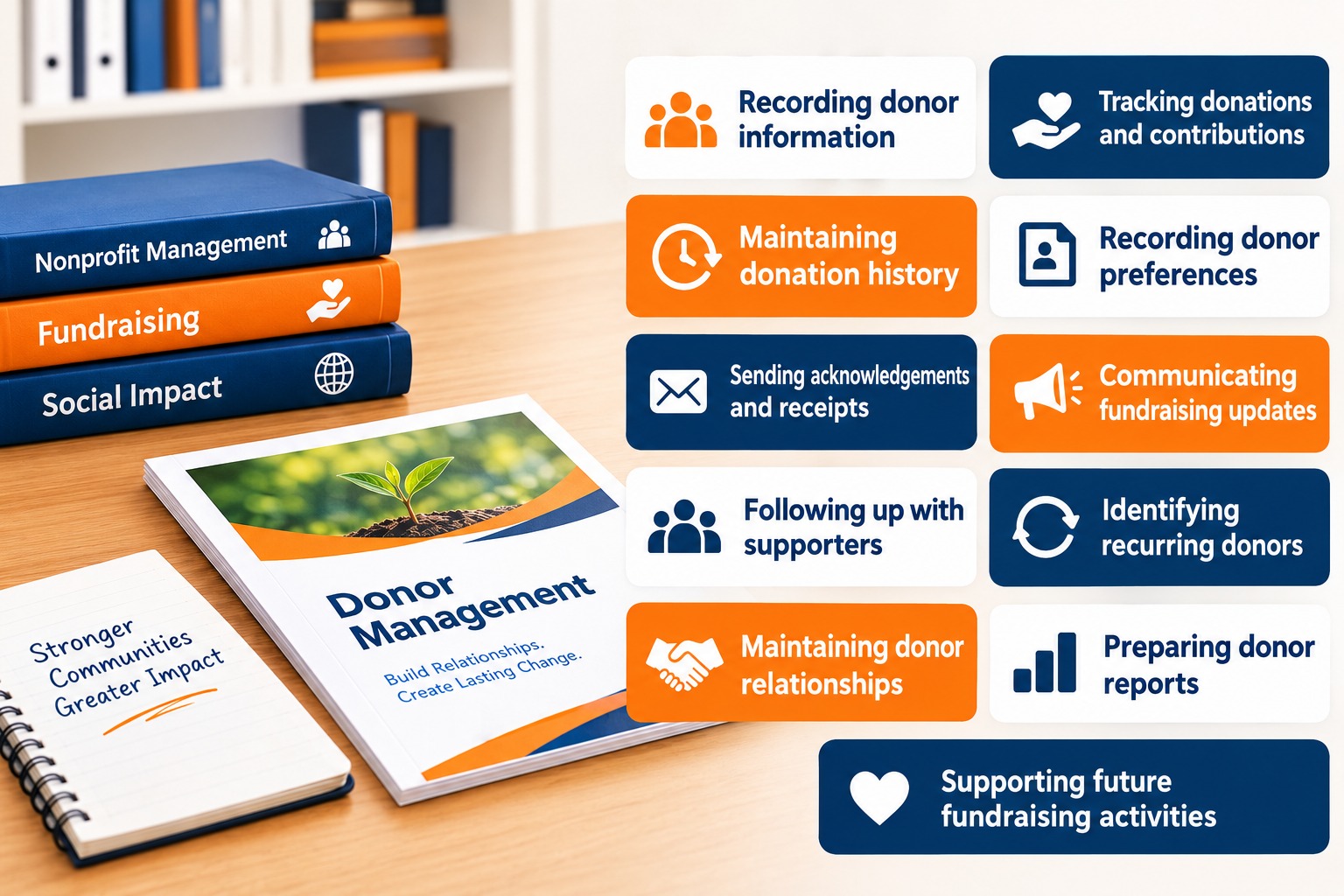
A donor management process can include:
- Recording donor information
- Tracking donations and contributions
- Maintaining donation history
- Recording donor preferences
- Sending acknowledgements and receipts
- Communicating fundraising updates
- Following up with supporters
- Identifying recurring donors
- Maintaining donor relationships
- Preparing donor reports
- Supporting future fundraising activities
The objective is simple: help an NGO understand and manage its relationships with the people and organisations that support its work.
For a small charity, this might initially be handled through a spreadsheet. As the organisation grows, however, a more structured donor management system can make the process easier to maintain.
Why Is Donor Management Important for NGOs?
Donor management is important because fundraising is based on relationships, not just transactions.
A donation represents a financial contribution, but the donor behind that contribution may have a long-term interest in the organisation’s work. Good donor management helps the NGO remember that relationship and communicate with the supporter appropriately.
Effective donor management can help an NGO:
- Keep donor information organised
- Understand donation history
- Improve communication
- Acknowledge supporters promptly
- Reduce administrative confusion
- Support recurring fundraising
- Build donor trust
- Improve reporting
- Coordinate fundraising activities
- Make better use of existing donor relationships
Without an organised process, valuable donor information can easily become difficult to find or use.
What Information Should an NGO Keep About Its Donors?
An NGO should maintain information that is genuinely useful for managing donor relationships and its operational requirements.
Depending on the organisation’s needs, this may include:
- Donor name
- Contact information
- Donation dates
- Contribution amounts
- Donation frequency
- Supported projects or causes
- Communication history
- Donation acknowledgements
- Receipt information
- Relevant preferences
- Notes about donor interactions
Organisations should collect and retain information responsibly and only use personal information for legitimate organisational purposes.
A useful donor record should answer basic questions such as:
Who is the donor?
When did they contribute?
How much did they contribute?
What programme or campaign did they support?
Has the organisation acknowledged the contribution?
What communication has already taken place?
These details become increasingly valuable as an NGO’s fundraising activities expand.
How Does Donor Management Work?
Donor management generally follows a cycle that begins when a supporter first interacts with an organisation and continues throughout the relationship.
A simplified donor management cycle looks like this:
Donor Identification → Contribution → Recording → Acknowledgement → Communication → Engagement → Continued Support
For example, imagine an NGO running an education-support programme.
A supporter discovers the campaign and contributes towards educational materials for children. The organisation records the contribution, acknowledges the donor, provides an appropriate update about the programme, and later communicates the progress of the initiative.
The donor is therefore not treated as a single transaction.
Instead, the organisation manages the relationship as an ongoing connection between the supporter and the welfare work.
What Are the Main Functions of Donor Management?
A practical donor management process usually covers several connected activities.
1. Donor Information Management
The organisation needs a reliable place to maintain donor information.
Instead of keeping separate records in multiple spreadsheets, notebooks, emails, and messaging applications, a structured system can help bring relevant information together.
This makes it easier for authorised team members to find information when needed.
2. Donation Tracking
Donation tracking involves recording contributions and maintaining an accurate history.
An NGO may want to know:
- How much has a donor contributed?
- How frequently do they contribute?
- Which campaign did they support?
- Was the contribution acknowledged?
- What is the donor’s previous contribution history?
A clear record can reduce confusion during fundraising and reporting activities.
3. Donor Communication
Communication is a major part of donor relationships.
Depending on the organisation and donor preferences, communication can include:
- Donation acknowledgements
- Campaign updates
- Welfare project updates
- Event information
- Impact stories
- Thank-you messages
- Periodic organisational updates
The goal should not be to send more messages. The goal should be to send more relevant and meaningful communication.
4. Donor Engagement
Donor engagement refers to the ways an organisation maintains a meaningful relationship with its supporters.
A donor may engage by:
- Making another contribution
- Supporting a campaign
- Attending an event
- Volunteering
- Sharing a campaign
- Introducing another supporter
- Following project updates
Good donor management helps organisations understand these interactions.
5. Reporting
Organisations may need to review donor and contribution information for internal planning and reporting.
A structured donor management process can make it easier to understand fundraising activity and identify areas that need attention.
What Is the Difference Between Donor Management and Donation Management?
Donor management focuses primarily on the relationship with the supporter, while donation management focuses more specifically on the contribution itself.
For example:
Donation management may answer:
How much was received and when?
Donor management may answer:
Who contributed, what is their history with the organisation, what did they support, and how should the organisation maintain the relationship?
The two areas are closely connected.
A donation is a transaction, while donor management considers the broader relationship surrounding that transaction.
For a growing NGO, managing both effectively can help create a more organised fundraising operation.
Why Do NGOs Struggle With Donor Management?
Many NGOs do not struggle because they lack committed people. They struggle because donor information often grows faster than their internal processes.
Common challenges include:
Donor information stored in multiple places
One team member may maintain an Excel sheet while another keeps information in email conversations or messaging applications.
Duplicate records
The same donor may appear multiple times with slightly different spellings or contact information.
Missing donation history
Older contribution records may be difficult to locate when information is spread across different files.
Delayed communication
When teams are busy managing welfare projects, donor acknowledgements or updates may be delayed.
Difficulty identifying active supporters
An NGO may have many historical donor records but limited visibility into which supporters are currently engaged.
Manual reporting
Preparing donor summaries manually can consume valuable administrative time.
Lack of coordination
Fundraising, finance, programme, and communication teams may each have different information.
These challenges become more significant as the organisation grows.
Can a Small NGO Benefit From Donor Management?
Yes. Small NGOs can benefit from donor management even when they have a relatively small donor base.
In fact, establishing good processes early can prevent unnecessary confusion later.
A small organisation might begin with:
- One central donor record
- Consistent contribution recording
- Clear acknowledgement procedures
- Regular donor communication
- Simple fundraising reports
- Defined responsibilities within the team
The system does not need to be complicated.
The important thing is to establish a reliable process that the organisation can maintain consistently.
How Can an NGO Organise Donor Information Effectively?
An NGO can start by creating a clear and consistent donor-management process.
Step 1: Create a central donor record
Avoid keeping essential donor information in unrelated locations whenever possible.
Create a central record containing the information the organisation genuinely needs.
Step 2: Standardise information
Use consistent formats for:
- Names
- Phone numbers
- Email addresses
- Dates
- Contribution records
- Campaign names
Consistency makes searching and reporting easier.
Step 3: Record every contribution
Each contribution should be recorded according to the organisation’s internal process.
Do not rely on memory or temporary notes.
Step 4: Maintain communication history
Where appropriate, record important donor interactions so that future communication is informed by previous conversations.
Step 5: Review donor information regularly
Organisations should periodically check for:
- Duplicate records
- Missing information
- Outdated information
- Unresolved communication
- Unacknowledged contributions
Step 6: Protect donor information
Donor information should be handled responsibly, with access limited to people who need it for legitimate organisational work.
How Can Donor Management Improve Donor Relationships?
Donor management can improve relationships by helping an NGO communicate with supporters in a more organised and relevant way.
Consider two situations.
In the first, a donor contributes to an education campaign but receives no acknowledgement and hears nothing about the project afterwards.
In the second, the organisation acknowledges the contribution, keeps the donor informed about appropriate project developments, and communicates the outcome of the initiative.
The second experience can make the donor feel more connected to the work they supported.
The objective is not simply to encourage another donation. It is to help supporters understand how their contribution fits into the organisation’s mission.
How Should NGOs Communicate With Donors?
NGOs should communicate with donors in a way that is relevant, respectful, timely, and appropriate to the relationship.
Useful communication can include:
- Thank-you messages
- Donation acknowledgements
- Project progress updates
- Stories from welfare programmes
- Fundraising campaign information
- Event invitations
- Periodic impact reports
Communication should have a purpose.
If every message is simply another request for money, supporters may become less engaged. A healthier approach is to maintain a balance between asking, informing, acknowledging, and sharing progress.
How Does Donor Management Support Transparency?
Donor management can support transparency by creating a clearer record of contributions and communication.
For example, an NGO may be able to trace a contribution from the donor record to the relevant fundraising activity and then connect that activity with the welfare project it supports.
This contributes to a broader chain:
Donor → Contribution → Fund → Welfare Project → Beneficiaries → Outcomes → Reporting
The exact reporting process will vary between organisations, but maintaining organised records makes internal accountability easier.
Transparency is not simply about publishing information. It also depends on having reliable internal processes that allow an organisation to understand where resources came from and how they were managed.
How Can Donor Management Support Fundraising?
Donor management can support fundraising by helping NGOs understand their existing supporter relationships.
For example, an organisation may identify:
- People who regularly contribute
- Previous campaign supporters
- Donors who supported a particular welfare programme
- Supporters who have not engaged recently
- Individuals interested in a particular cause
This information can help fundraising teams plan communication more thoughtfully.
Instead of sending the same message to every contact, an NGO can consider the donor’s previous relationship with the organisation.
This approach can make fundraising communication more relevant and less repetitive.
What Is Donor Segmentation?
Donor segmentation means grouping supporters according to useful characteristics so that an organisation can communicate with them more appropriately.
Possible segments might include:
- First-time donors
- Recurring donors
- Previous donors
- Campaign-specific supporters
- Event participants
- Corporate supporters
- Volunteers who also contribute
- Supporters interested in specific programmes
Segmentation should have a practical purpose.
For example, someone who previously supported education initiatives may be more interested in a new education campaign than a campaign unrelated to their previous interests.
How Can an NGO Turn One-Time Donors Into Long-Term Supporters?
An NGO can encourage longer-term relationships by focusing on trust, communication, and meaningful engagement rather than immediately asking for another contribution.
A practical approach can include:
- Thank the donor appropriately.
- Confirm that the contribution was received.
- Explain what the supported programme is trying to achieve.
- Share relevant progress.
- Communicate outcomes when appropriate.
- Invite continued involvement without creating pressure.
- Maintain the relationship even when there is no immediate fundraising campaign.
The relationship should extend beyond the donation itself.
What Should an NGO Track in a Donor Management System?
The exact information will depend on the organisation, but useful areas may include:
Area | What It Can Help Track |
Donor profile | Basic supporter information |
Contributions | Donation history |
Campaigns | Which fundraising activities received support |
Projects | Welfare initiatives supported |
Communication | Important donor interactions |
Acknowledgements | Whether contributions were appropriately acknowledged |
Engagement | Other forms of supporter involvement |
Reporting | Relevant donor and fundraising summaries |
The objective is to create useful visibility without collecting unnecessary information.
Can Technology Improve Donor Management?
Yes. Technology can make donor management more organised by bringing relevant information and processes into a structured digital environment.
Instead of depending entirely on disconnected spreadsheets and manual records, an organisation can use appropriate digital tools to manage donor information, contributions, communication, and reporting.
Technology can be particularly useful when an NGO has:
- A growing donor base
- Multiple fundraising campaigns
- Several welfare projects
- Multiple team members handling donor relationships
- Frequent donor communication
- Increasing reporting requirements
However, technology should solve a real operational problem. An NGO does not need complicated software simply because it is available.
The right system should fit the organisation’s size, processes, team capacity, and welfare activities.
What Should NGOs Look for in a Donor Management System?
Before selecting a donor management solution, an NGO should consider its actual requirements.
Important questions include:
Is donor information easy to organise?
The system should make it practical to maintain accurate donor records.
Can contribution information be tracked?
The organisation should be able to maintain a useful history of contributions.
Can different teams work with the information?
If fundraising, administration, finance, or programme teams need access, the system should support appropriate coordination.
Can communication be managed?
The organisation should be able to maintain an organised approach to donor communication.
Can reports be generated?
Reporting should help the team understand its fundraising and donor activity without creating unnecessary administrative work.
Is the system easy for non-technical users?
A technically powerful system is not useful if staff cannot comfortably use it.
Can the system grow with the organisation?
An NGO should consider whether the solution will remain useful as donors, campaigns, projects, and operational activities increase.
What Is the Role of Donor Management in Welfare Governance?
Donor management is one part of a larger welfare governance system.
A charitable organisation does not exist only to collect donations. It must manage the journey from resources to welfare outcomes.
That journey can be understood as:
Donors → Contributions → Funds → Welfare Projects → Beneficiaries → Outcomes → Reporting → Continued Support
Donor management primarily helps strengthen the first part of this relationship, but its value becomes greater when it connects with the organisation’s wider welfare activities.
For example, if an NGO raises funds for an education-support programme, donor information is only one part of the picture.
The organisation may also need to understand:
- What funds were received
- Which project received the funds
- What activities were conducted
- Which beneficiaries were supported
- What outcomes were achieved
- What information should be reported
- How future support can be managed
This broader perspective is where Welfare Governance becomes important.
Welfare Governance can be understood as the structured management of an organisation’s welfare activities, resources, people, projects, beneficiaries, accountability, reporting, and impact.
A Practical Example of Donor Management in an NGO
Imagine a community organisation running an education-support programme for 100 children.
The organisation launches a fundraising campaign to support educational materials and related programme expenses.
Several supporters contribute through the campaign.
Without a structured system, the team might maintain donor names in one spreadsheet, contribution information in another file, project information somewhere else, and communication records in email or messaging applications.
A more organised approach connects the information.
The organisation can maintain:
Donor records
Who supported the campaign?
Contribution records
What contributions were received?
Fundraising information
Which campaign generated the contributions?
Project information
Which education-support programme is being funded?
Beneficiary information
Which group of children is being supported?
Communication
What appropriate updates should supporters receive?
Reporting
What information should the organisation use when reviewing the programme?
The important point is that donor management does not operate in isolation.
It becomes more valuable when it forms part of the organisation’s broader welfare-management process.
What Are Common Donor Management Mistakes?
Even organisations with good intentions can develop inefficient donor-management practices.
1. Keeping everything in one spreadsheet forever
Spreadsheets can be useful, particularly for smaller organisations, but they may become difficult to manage as information grows.
2. Recording only the donation amount
A contribution amount alone does not provide a complete picture of the donor relationship.
3. Failing to update records
Outdated information can lead to communication problems and duplicate records.
4. Sending identical messages to everyone
Different supporters may have different relationships with the organisation.
5. Treating donors only as funding sources
Donors are people and organisations that choose to support a mission. Relationship-building matters.
6. Ignoring historical information
Previous donor interactions can provide valuable context for future communication.
7. Collecting unnecessary personal information
Organisations should avoid gathering information they do not genuinely need.
8. Neglecting data access and security
Donor information should be protected and accessible only to authorised people according to the organisation’s internal policies and applicable requirements.
How Can an NGO Start Improving Donor Management Today?
An organisation does not have to implement a complicated system immediately.
It can begin with a few practical steps:
1. Map the current process
Write down what happens from the moment someone becomes a donor to the point where the organisation follows up with them.
2. Identify information gaps
Find out what donor information is currently missing or difficult to retrieve.
3. Remove duplicate records
Review existing lists and consolidate duplicate donor entries where appropriate.
4. Establish consistent procedures
Decide how contributions, acknowledgements, communications, and donor interactions should be recorded.
5. Define responsibilities
Make sure team members know who is responsible for maintaining donor information.
6. Review the process periodically
Donor management should evolve as the organisation’s fundraising and welfare activities change.
7. Consider digital tools when manual processes become difficult
Technology can help when the volume and complexity of information make manual management inefficient.
Why Is Donor Management More Than a Database?
A donor database stores information. Donor management uses that information to support relationships and organisational decisions.
This distinction matters.
Simply knowing that someone donated does not automatically create a strong donor relationship.
The organisation needs a process around that information.
That process may involve:
- Acknowledging the contribution
- Understanding the donor’s history
- Communicating relevant updates
- Connecting support with welfare activities
- Maintaining accurate records
- Reviewing engagement
- Building appropriate long-term relationships
The database is therefore a tool. The broader objective is better donor relationship management
How Can Donor Management Help Build Trust?
Trust develops through consistent organisational behaviour.
Donor management can contribute to that process by helping an NGO:
- Keep reliable records
- Acknowledge contributions
- Communicate consistently
- Share appropriate project information
- Maintain organised reporting
- Avoid unnecessary communication
- Understand supporter history
A donor who can see that an organisation is organised and accountable may have greater confidence in continuing the relationship.
Donor management cannot create trust by itself. But good systems can support the practices that help organisations earn and maintain it.
How NidhiMax Can Help
Donor management is an important part of running a modern charitable organisation, but it is only one part of the larger welfare ecosystem.
When donor records, contributions, fundraising activities, welfare projects, beneficiaries, communication, and reporting are handled through disconnected processes, teams can spend significant time moving information from one place to another.
NidhiMax — Welfare Governance Platform is designed around the broader needs of charitable organisations, NGOs, trusts, community organisations, and welfare institutions.
The idea is to move beyond viewing fundraising as an isolated activity and instead organise the wider connection between resources, welfare activities, beneficiaries, and accountability.
For organisations looking to improve their donor-management processes, a broader welfare-management approach can help connect areas such as donor information, contribution tracking, fundraising activities, welfare projects, communication, and reporting where those capabilities are appropriate to the organisation’s needs.
Every NGO operates differently. A local community organisation may have very different requirements from a large charitable trust or foundation. Technology should therefore support the organisation’s actual processes rather than force the team into an unnecessarily complicated workflow.
For organisations exploring a more organised approach to welfare governance, NidhiMax.com provides a place to learn more about the NidhiMax approach.
The goal should ultimately be simple: better organised welfare activities, clearer accountability, stronger relationships with supporters, and a more connected view of the work being done for beneficiaries.
Frequently Asked Questions
What is donor management in an NGO?
Donor management is the organised process of maintaining donor information, tracking contributions, managing communication, and building ongoing relationships with supporters of an NGO or charitable organisation.
Why does an NGO need donor management?
An NGO needs donor management to keep supporter information organised, understand contribution history, improve communication, support fundraising activities, and maintain stronger donor relationships.
What is the difference between donor management and donation management?
Donation management focuses primarily on contributions, while donor management focuses on the broader relationship with the person or organisation making those contributions.
Can small NGOs use donor management systems?
Yes. Small NGOs can benefit from simple donor-management processes and can introduce digital tools as their donor base, fundraising activities, and operational requirements grow.
How can NGOs manage donors digitally?
NGOs can manage donors digitally by maintaining structured donor records, recording contributions, organising communication, tracking donor engagement, and generating relevant reports through suitable technology.
How does donor management improve fundraising?
Donor management helps organisations understand supporter history, identify relevant donor groups, maintain communication, and develop longer-term relationships that can support future fundraising.
Is donor management only about storing donor information?
No. A donor record is only one part of donor management. Effective donor management also involves communication, acknowledgement, engagement, contribution tracking, reporting, and relationship-building.
How does donor management support welfare governance?
Donor management can connect the supporter side of an organisation with its wider welfare activities. It can help create a clearer relationship between donors, contributions, funds, welfare projects, beneficiaries, outcomes, and reporting.