 Post by
Technology has become an important part of how organisations communicate, raise funds, manage information, and deliver services. Charities are no exception.
For a small community organisation, a few simple digital tools may be enough to manage donors, volunteers, projects, and records. As the organisation grows, however, managing everything through spreadsheets, paper files, email threads, and separate messaging groups can become difficult.
The answer is not to adopt every new technology available. A modern charity needs to identify the systems that solve real operational problems.
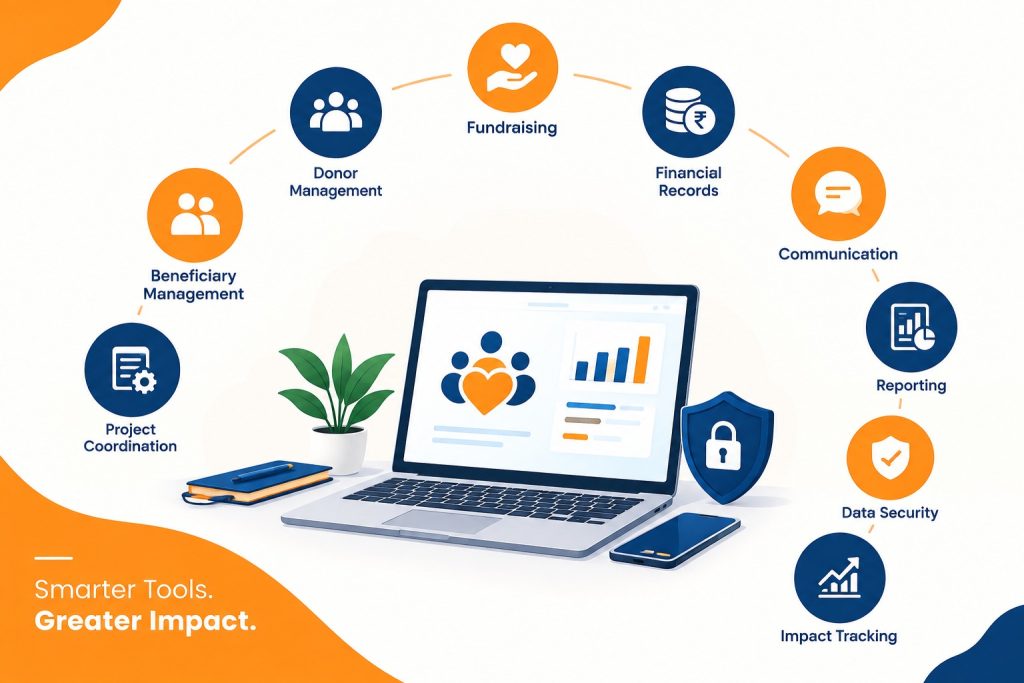
The most useful technology solutions for charities generally support areas such as fundraising, donor management, financial record-keeping, beneficiary management, welfare project coordination, communication, reporting, data security, and impact tracking.
The objective is simple: use technology to help people spend less time managing fragmented information and more time managing meaningful welfare work.
What Technology Solutions Does a Modern Charity Need?
A modern charity typically benefits from technology solutions for fundraising, donor management, financial management, project coordination, beneficiary management, communication, reporting, data protection, and impact measurement.
The exact combination depends on the organisation’s size, activities, team, and resources.
A volunteer-led community initiative may need only a few basic systems. A larger NGO running multiple welfare programmes may need a more connected digital ecosystem.
The important question is not:
“What technology should we buy?”
It is:
“Which organisational problems are preventing us from managing our welfare work effectively?”
That distinction can prevent charities from investing in complicated systems they do not actually need.
1. Digital Fundraising Tools
Digital fundraising technology helps charities organise campaigns, receive contributions through appropriate digital channels, communicate with supporters, and maintain better fundraising records.
Fundraising is often one of the first areas where charities adopt technology.
A digital fundraising process can support:
- Online donation campaigns
- Campaign pages
- Digital contribution records
- Donor communication
- Fundraising updates
- Campaign monitoring
- Contribution history
For example, an NGO running an emergency relief campaign may need to communicate its objective, receive contributions, record them properly, and provide appropriate updates to supporters.
Technology can make these processes easier to coordinate.
However, digital fundraising should not be viewed simply as a way to collect money faster. The contribution is the beginning of a wider process involving fund management, welfare activities, beneficiaries, and reporting.
2. Donor Management Systems
A donor management system helps charities organise information about supporters, contributions, communication, and engagement in a structured way.
A growing charity can quickly accumulate donor information.
Without a proper system, donor records may exist across:
- Spreadsheets
- Paper receipts
- Messaging applications
- Online forms
- Payment records
This makes it difficult to maintain a consistent donor history.
A structured donor management approach can help an organisation keep track of:
- Donor information
- Contribution history
- Campaign participation
- Communication records
- Acknowledgements
- Relevant supporter preferences
Good donor management also improves the supporter experience.
Instead of sending generic messages to everyone, a charity can communicate more thoughtfully based on its relationship with different supporters.
3. Digital Financial and Fund Management
Digital financial management tools help charities organise information about funds received, allocations, expenses, and financial activity.
Fund management is central to accountability.
A charity needs to understand not only how much money it receives but also how resources are allocated to its welfare activities.
For example:
Contribution → Fund → Welfare Project → Activity → Expense → Report
A digital system can help organise these relationships.
It can also reduce dependence on multiple spreadsheets and make information easier for authorised users to review.
Technology does not replace financial controls or professional accounting. Instead, it provides a structured environment for maintaining and accessing records.
4. Beneficiary Management
Beneficiary management technology helps organisations maintain organised records about the people or communities receiving support and the programmes associated with that support.
For a welfare organisation, beneficiaries are at the centre of its work.
Depending on the programme, an organisation may need to manage information related to:
- Beneficiary registration
- Programme participation
- Assistance provided
- Service history
- Follow-up activities
- Project association
- Outcomes
Consider an NGO providing educational assistance to children.
A beneficiary management system can help the organisation understand which children are associated with the programme and what support has been provided.
However, beneficiary information can be sensitive. Charities should collect only information they genuinely need and apply appropriate privacy, security, and access controls.
5. Welfare Project Management
Welfare project management technology helps charities organise programmes, activities, responsibilities, resources, timelines, and progress.
A charity may operate several projects simultaneously.
For example:
- Education support
- Healthcare assistance
- Food distribution
- Community development
- Emergency relief
Each project may involve different teams, beneficiaries, budgets, activities, and reporting requirements.
A project-management system can provide a clearer picture of:
- What projects are active
- Who is responsible
- What activities are planned
- What has been completed
- What resources are being used
- What information needs to be reported
This is especially useful when an organisation moves beyond a small number of informal initiatives.
6. Communication and Collaboration Tools
Digital communication tools help charity teams coordinate activities, communicate with supporters, and share information more efficiently.
Charities often work with a combination of:
- Full-time employees
- Part-time staff
- Volunteers
- Trustees
- Community members
- Fundraising teams
- Programme teams
Without clear communication systems, important information can become scattered across individual messages and conversations.
Collaboration tools can help teams organise:
- Internal discussions
- Documents
- Tasks
- Meetings
- Project updates
- Volunteer coordination
The key is to establish clear communication practices rather than simply adding more applications.
Too many communication channels can create confusion instead of solving it.
7. Digital Reporting and Dashboards
Digital reporting tools help charities turn operational information into reports that support decision-making, accountability, and communication with stakeholders.
A charity leader may need to answer questions such as:
- How much was raised?
- Which projects are active?
- What activities were completed?
- How many beneficiaries received support?
- What resources were used?
- Which projects require attention?
If the answers require manually combining information from several spreadsheets, reporting can become time-consuming.
A structured digital environment can make it easier to bring relevant information together.
Dashboards can also help leadership see trends and exceptions without having to examine every individual record.
The quality of any dashboard, however, depends on the quality of the data behind it.
8. Document and Record Management
Digital document management helps charities organise important files, records, receipts, reports, agreements, project documents, and other information in a controlled environment.
Many organisations accumulate years of documentation.
Without a clear system, finding an old document can become surprisingly difficult.
A charity may have records stored across:
- Personal computers
- Cloud folders
- Email attachments
- Physical filing cabinets
- USB drives
- Messaging applications
A structured document-management approach can make records easier to locate and maintain.
It is also useful to establish naming conventions, folder structures, access permissions, backup practices, and retention procedures.
9. Data Security and Access Controls
Data security technology helps charities protect donor, beneficiary, financial, employee, and organisational information from inappropriate access or loss.
Charities may hold information that should not be accessible to everyone.
For example, a volunteer may need access to project information without needing access to all donor or financial records.
Appropriate access controls can help organisations limit information according to responsibilities.
Charities should consider practices such as:
- Strong authentication
- Role-based access
- Regular permission reviews
- Secure backups
- Software updates
- Device security
- Staff awareness
- Responsible data handling
Security should be considered from the beginning rather than added only after a problem occurs.
10. Impact Tracking Tools
Impact-tracking technology helps organisations record and review what their welfare programmes are accomplishing, using appropriate indicators for each project.
Fundraising tells an organisation about resources.
Impact tracking asks what those resources helped accomplish.
For example, an education programme may monitor appropriate indicators such as:
- Activities delivered
- Beneficiaries supported
- Resources distributed
- Programme participation
- Follow-up activities
- Relevant outcomes
The exact measures should depend on the organisation’s objectives.
Technology can help collect and organise this information, but charities should avoid measuring things simply because they are easy to count.
A meaningful measure is more useful than a large collection of irrelevant numbers.
How Do These Technology Solutions Work Together?
The greatest value often comes when different charity-management processes are connected rather than operated as isolated systems.
Consider the complete welfare cycle:
Donors → Contributions → Funds → Welfare Projects → Beneficiaries → Outcomes → Reporting → Continued Support
Each stage produces information that can be useful at the next stage.
For example:
A donor contributes to an education campaign.
↓
The contribution is recorded.
↓
The funds are associated with an education-support project.
↓
The project delivers activities to beneficiaries.
↓
Project resources and activities are documented.
↓
Relevant outcomes are recorded.
↓
The organisation prepares a report.
↓
Appropriate information is shared with stakeholders.
This is more than digital fundraising.
It is a broader approach to Welfare Governance.
What Is Welfare Governance and Why Does Technology Matter?
Welfare Governance is the structured management of an organisation’s welfare activities, resources, people, projects, beneficiaries, accountability, reporting, and impact.
Traditional charity management can sometimes separate these areas.
The fundraising team manages donations.
The finance team manages expenses.
The programme team manages beneficiaries.
Volunteers manage activities.
Leadership receives reports.
When these functions operate independently, important connections can be lost.
Welfare Governance takes a broader view.
It asks how the organisation’s resources, people, projects, beneficiaries, and outcomes fit together.
Technology can provide the digital structure needed to support this approach.
How Should a Charity Choose the Right Technology?
A charity should choose technology based on its actual operational needs, team capacity, data requirements, security considerations, reporting processes, and long-term objectives.
Before selecting a solution, ask these questions.
1. What problem are we solving?
Define the problem clearly.
For example:
- Donor records are fragmented.
- Project information is difficult to track.
- Reports take too long to prepare.
- Financial information is spread across multiple files.
2. Who will use the system?
Consider:
- Administrators
- Fundraising staff
- Programme teams
- Finance teams
- Volunteers
- Trustees
The system should be practical for the people who actually use it.
3. What information needs to be connected?
Think beyond individual departments.
Can donor information be connected with contributions?
Can contributions be associated with projects?
Can project information support reporting?
These connections can determine whether technology genuinely improves operations.
4. Is the system easy to maintain?
A charity should consider who will manage the system after implementation.
Technology that requires extensive technical knowledge may be difficult for a small organisation to maintain.
5. How will sensitive information be protected?
Understand access permissions, security practices, backups, and data-handling procedures before moving important information into a platform.
Should Every Charity Use the Same Technology?
No. Technology requirements vary according to the charity’s size, activities, funding model, team structure, beneficiaries, and operational complexity.
A volunteer-led community organisation may need:
- Basic donor management
- Digital communication
- Simple fundraising tools
- Document storage
A larger NGO may need a broader ecosystem covering:
- Fundraising
- Donor management
- Financial management
- Beneficiary management
- Project coordination
- Reporting
- Impact tracking
The right technology is therefore not necessarily the one with the most features.
It is the one that fits the organisation’s actual work.
What Technology Mistakes Should Charities Avoid?
Technology can solve operational problems, but poor implementation can create new ones.
Using Too Many Separate Tools
A charity may end up with one system for donations, another for projects, several spreadsheets for finance, and messaging applications for everything else.
This can create information silos.
Digitising Poor Processes
If an existing process is confusing, simply moving it online does not automatically improve it.
Review the process first.
Ignoring Staff Training
Even a useful system will fail if users do not understand how or why to use it.
Collecting Unnecessary Data
More data is not always better. Collect information with a clear purpose and handle it responsibly.
Choosing Technology Based Only on Features
A long feature list does not guarantee that a platform is suitable for the organisation.
Forgetting Data Quality
Duplicate, outdated, or incorrect records can undermine the value of digital reporting.
How Can a Charity Introduce Technology Gradually?
Charities can introduce technology gradually by identifying their highest-priority problems, digitising essential workflows first, training users, and improving the system as their needs develop.
A practical roadmap could look like this:
Step 1: Map Current Processes
Document how donations, projects, beneficiaries, expenses, and reporting are currently managed.
Step 2: Identify Information Gaps
Find where information is being lost, duplicated, delayed, or difficult to retrieve.
Step 3: Prioritise
Start with one or two processes that would produce meaningful operational improvements.
Step 4: Standardise Data
Decide how names, projects, campaigns, funds, and other important information should be recorded.
Step 5: Train Users
Make sure staff and volunteers understand the new workflow.
Step 6: Review
After implementation, ask what is working and what needs adjustment.
This approach is generally more sustainable than attempting a complete digital transformation in a single step.
A Practical Example: A Community Organisation Running Multiple Welfare Programmes
Imagine a community organisation managing three initiatives:
- Education support
- Food distribution
- Healthcare assistance
It receives contributions from individuals and uses volunteers to conduct activities.
Initially, the organisation maintains donor information in a spreadsheet, project information in separate documents, and expense records in another file.
As activities increase, leadership finds it difficult to answer simple questions:
How much was raised for each programme?
What activities have been completed?
Which beneficiaries received support?
What resources were used?
What should be included in the next report?
A more organised digital ecosystem could connect these areas.
Donors
↓
Contributions
↓
Funds
↓
Welfare Projects
↓
Activities
↓
Beneficiaries
↓
Outcomes
↓
Reports
The organisation does not necessarily need dozens of applications.
It needs a clear structure for managing its welfare operations.
Why Technology Should Support People, Not Replace Them
Technology is valuable when it helps people make better decisions and spend less time dealing with fragmented information.
A charity still needs:
- Responsible leadership
- Financial oversight
- Ethical decision-making
- Programme expertise
- Community understanding
- Volunteer coordination
- Human relationships
A digital platform cannot understand every community need or replace the judgement of people working directly with beneficiaries.
Its role is to provide better organisation, visibility, coordination, and access to information.
That distinction is important when evaluating technology for NGOs.
NidhiMax — Welfare Governance Platform
Modern charity management increasingly involves more than fundraising.
An organisation needs to manage the entire journey from resources to welfare outcomes:
Donors → Contributions → Funds → Welfare Projects → Beneficiaries → Outcomes → Reporting → Continued Support
This is the broader context in which Welfare Governance becomes useful.
NidhiMax — Welfare Governance Platform is designed to help charitable organisations, NGOs, trusts, community organisations, and welfare institutions move toward a more organised digital welfare-management ecosystem.
The focus should not be on adopting technology for its own sake. Each organisation has different workflows, priorities, resources, and challenges. The right digital approach should therefore be built around how the organisation actually manages its welfare activities.
For charities considering their next step, the most useful question may be:
“How can we create a more organised system for managing our entire welfare ecosystem?”
That question moves the conversation beyond individual tools and toward better welfare governance.
FAQ
What technology does a modern charity need?
A modern charity may benefit from technology for fundraising, donor management, financial and fund management, beneficiary management, project coordination, communication, reporting, document management, data security, and impact tracking.
How can technology help charities raise funds?
Digital fundraising tools can help charities organise campaigns, receive contributions through appropriate channels, maintain donation records, and communicate with supporters.
What is charity management software?
Charity management software is a digital system designed to help organisations manage areas such as donors, fundraising, projects, beneficiaries, records, reporting, or other welfare operations.
Can small NGOs benefit from digital technology?
Yes. Small NGOs can start with simple solutions for their most important workflows, such as donor records, fundraising, project management, communication, and reporting.
How can technology improve transparency in charities?
Technology can improve transparency by helping organisations maintain structured records of contributions, funds, projects, activities, expenses, beneficiaries, and reports.
Should a charity use multiple technology platforms?
It depends on its needs. Multiple specialised tools can be useful, but too many disconnected systems can create information silos and additional administrative work.
What is Welfare Governance?
Welfare Governance is the structured management of an organisation’s welfare activities, resources, people, projects, beneficiaries, accountability, reporting, and impact.
How should a charity choose the right technology?
A charity should consider its actual problems, users, workflows, data requirements, security needs, reporting processes, ease of use, and ability to maintain the system over time.
NidhiMax Conclusion
Building a More Organised Digital Welfare Ecosystem
The best technology for a charity is not necessarily the newest or most feature-rich solution.
It is the technology that helps the organisation manage its work with greater clarity.
For some organisations, that may begin with digital fundraising. For others, the priority may be donor management, project coordination, beneficiary records, reporting, or fund management.
Ultimately, these activities are connected.
Donors → Contributions → Funds → Welfare Projects → Beneficiaries → Outcomes → Reporting → Continued Support
A Welfare Governance approach brings these relationships into a broader operational framework.
NidhiMax — Welfare Governance Platform is designed to support charitable organisations, NGOs, trusts, community organisations, and welfare institutions as they move toward a more organised digital welfare-management ecosystem.
Technology should complement the organisation’s people and processes—not make them more complicated.
To explore how a more connected approach to welfare management could fit your organisation, visit