
 Post by
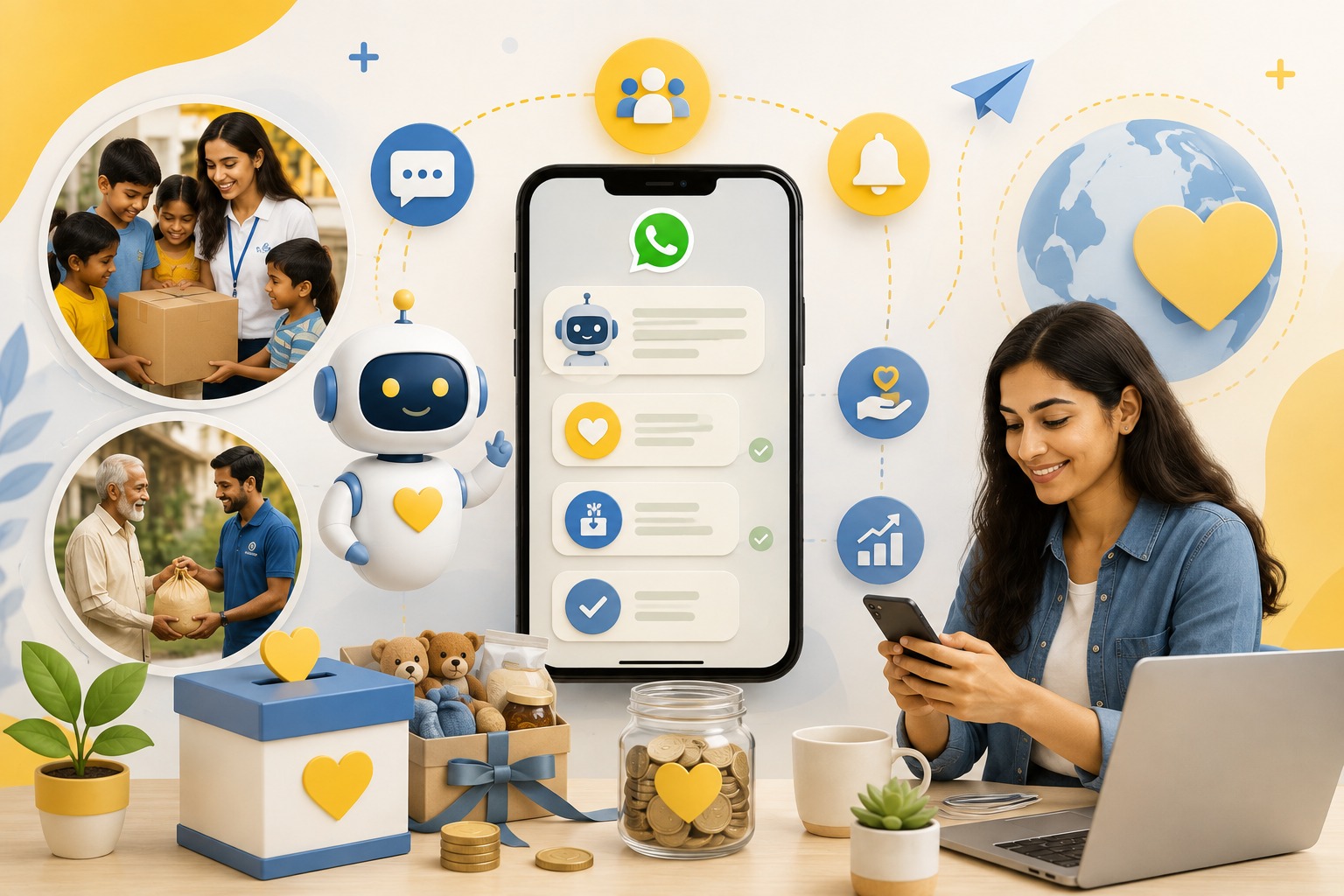
WhatsApp can be a useful communication channel for charities and NGOs that want to stay connected with donors, share fundraising campaigns, answer questions, and follow up with supporters. But as the number of conversations grows, managing every message manually can become difficult.
A fundraising team may need to answer the same questions repeatedly, send campaign information to interested supporters, follow up with people who ask how to donate, acknowledge contributions, and keep track of which conversations require further attention.
This raises an important question: Can WhatsApp fundraising be automated?
The answer is yes, parts of the fundraising communication process can be automated using appropriate tools and workflows, while other interactions still benefit from human attention. The goal should not be to remove people from donor relationships. Instead, automation can help NGOs reduce repetitive work, organise communication, and ensure supporters receive timely and consistent information.
For charities, however, WhatsApp fundraising is only one part of a larger process. A successful contribution journey should connect communication with donor records, contributions, funds, welfare projects, beneficiaries, outcomes, reporting, and continued support.
This guide explains what WhatsApp fundraising automation can involve, which activities may be suitable for automation, where human involvement remains important, and how NGOs can build a more organised fundraising workflow.
What Is WhatsApp Fundraising Automation?
WhatsApp fundraising automation is the use of structured digital workflows and appropriate communication tools to handle repetitive parts of donor communication, such as responding to common questions, sharing campaign information, sending follow-up messages, and directing supporters toward the next step.
Instead of requiring a staff member to manually type the same response every time someone asks, “How can I donate?”, a structured process can provide consistent information and alert the appropriate team member when personal follow-up is needed.
Depending on the organisation’s systems and approved communication setup, automation may support activities such as:
- Responding to frequently asked donor questions
- Sharing information about a fundraising campaign
- Providing donation instructions
- Sending a confirmation or acknowledgement message
- Sharing relevant campaign updates
- Routing conversations to the right team member
- Recording communication activity
- Reminding staff about conversations that need follow-up
The exact possibilities depend on the technology and communication systems an organisation uses. NGOs should also ensure that their communication practices are appropriate for their circumstances and follow relevant platform rules, consent expectations, privacy requirements, and other applicable obligations.
Can NGOs Fully Automate WhatsApp Fundraising?
NGOs can automate certain repetitive fundraising tasks on WhatsApp, but fully automating every donor interaction is usually neither necessary nor desirable.
Fundraising involves relationships and trust. A supporter may need information that can be answered automatically, such as where to find campaign details. But another donor may have a specific question about a welfare project, want clarification about their contribution, or wish to discuss a long-term relationship with the organisation.
A practical approach is to divide the process into two categories.
Tasks That May Be Suitable for Automation
These may include:
- Welcome or acknowledgement messages
- Frequently asked questions
- Basic campaign information
- Donation instructions
- Standard responses to common queries
- Initial campaign follow-ups
- Communication routing
- Reminders for internal follow-up
- Confirmation messages after defined actions
Tasks That Often Need Human Attention
These may include:
- Complex donor questions
- Sensitive conversations
- Complaints or concerns
- Major donor relationships
- Requests requiring individual judgement
- Questions about how funds are being used
- Partnership discussions
- Situations involving incomplete or unclear information
The best system combines efficiency with genuine human communication.
Why Would an NGO Automate WhatsApp Fundraising?
An NGO may automate parts of WhatsApp fundraising to reduce repetitive work, respond more consistently, organise donor communication, and help staff focus on conversations that require personal attention.
Consider a small charity running several welfare initiatives. During a fundraising campaign, the team may receive messages such as:
- How can I contribute?
- What is this campaign for?
- Can you share more information?
- Has my contribution been received?
- How can I support this project?
- Who will benefit from the campaign?
If staff members answer every routine question manually, communication can become time-consuming.
Automation can create a structured first response while allowing staff to take over when needed.
For example:
Supporter sends a message → Automated welcome → Campaign options shared → Supporter selects an option → Relevant information provided → Donation interest recorded or directed appropriately → Human follow-up where needed
This can make the initial donor journey easier to manage.
How Can an NGO Automate WhatsApp Fundraising?
An NGO can automate WhatsApp fundraising by mapping its donor journey first, identifying repetitive communication tasks, creating clear message flows, connecting communication with internal records where appropriate, and keeping a process for human follow-up.
A practical approach can be built step by step.
Step 1: Define the Fundraising Goal
Start with a clear purpose.
For example:
- Raising support for education
- Funding healthcare assistance
- Supporting food distribution
- Responding to an emergency
- Supporting a community development project
The fundraising objective should be clear before creating automated messages.
A vague campaign can lead to vague communication.
Instead of simply saying:
Please support our cause.
Explain what supporters are being asked to support.
For example:
We are raising support for our community education initiative. Your contribution will help us continue planned educational assistance activities.
The organisation should communicate only information it can support and verify.
Step 2: Map the Donor Journey
Before selecting technology, understand what happens from the first message to continued donor communication.
A simple journey might look like:
Supporter discovers campaign → Sends WhatsApp message → Receives campaign information → Asks questions → Decides to contribute → Contribution is processed and recorded → Receives appropriate acknowledgement → Receives relevant updates → Continues relationship with the organisation
Mapping this journey helps identify where automation may be useful.
For example:
Stage | Possible Need |
First contact | Welcome and campaign introduction |
Information request | Campaign details |
Donation interest | Clear next steps |
Contribution | Internal recording and acknowledgement workflow |
After contribution | Thank-you communication |
Later engagement | Relevant updates and continued communication |
Not every stage needs to be automated. The purpose is to identify repetitive work and reduce unnecessary manual effort.
Step 3: Identify Repetitive Questions
Review the questions your organisation receives repeatedly.
Common examples might include:
- How do I donate?
- What is the fundraising campaign about?
- Can I receive more information?
- How can I contact your team?
- Where can I learn about the project?
Create clear answers that staff members have reviewed.
Automated messages should be:
- Easy to understand
- Accurate
- Relevant to the campaign
- Free from unsupported claims
- Updated when campaign information changes
Avoid creating long message sequences that overwhelm supporters.
Step 4: Create a Clear Message Flow
A good automated WhatsApp fundraising flow should guide the supporter toward useful information without making the conversation feel confusing or impersonal.
For example:
Welcome message
Hello, and thank you for contacting our organisation. We would be happy to share information about our current welfare initiatives.
Options
- Learn about the current campaign
- Find out how to contribute
- Ask a question
- Speak with our team
If a supporter selects the campaign option, the system can provide a short explanation and offer the next relevant action.
If the person needs individual assistance, the conversation can be directed to a staff member.
The exact design will depend on the organisation’s communication setup.
What Fundraising Activities Can Be Automated on WhatsApp?
The most suitable activities for automation are repetitive, predictable tasks that can be handled using approved and accurate information without requiring individual judgement.
Campaign Information
An organisation can prepare consistent responses about:
- The purpose of the campaign
- The welfare initiative involved
- General ways to learn more
- Basic next steps for interested supporters
Frequently Asked Questions
Automated responses can help answer common questions quickly.
However, an organisation should regularly review these responses to make sure they remain accurate.
Initial Donor Engagement
A welcome message can acknowledge that someone has contacted the organisation and guide them toward the information they need.
Donation Instructions
Where the organisation has an established donation process, automation may help communicate the appropriate next steps.
These instructions should be reviewed carefully to avoid sharing outdated or incorrect information.
Follow-Up Prompts
A workflow may help identify supporters who expressed interest but still require a response from the fundraising team.
The focus should be helpful follow-up rather than repeatedly sending unwanted messages.
Campaign Updates
For supporters who have appropriately agreed to receive communications, organisations may use structured workflows to share relevant updates.
Messages should remain purposeful and relevant.
What Should Not Be Carelessly Automated?
NGOs should avoid treating automation as a substitute for judgement, accountability, or genuine donor relationships.
Certain situations deserve careful human review.
Sensitive Donor Questions
Questions about a person’s circumstances or concerns may require an individual response.
Complaints
A donor who is unhappy with their experience should not be trapped in a long automated message sequence.
There should be a clear route to human assistance.
Questions About Fund Use
Where supporters ask detailed questions about how contributions relate to projects or welfare activities, the organisation should provide accurate and appropriately reviewed information.
Complex Contribution Issues
Problems involving missing information, unclear transactions, duplicate records, or other exceptions may need human investigation.
Personal Donor Relationships
Long-term supporters, major contributors, partners, and other important relationships often benefit from direct communication.
Automation should support the relationship, not replace it.
A Realistic Example of Automated WhatsApp Fundraising
Imagine a community organisation running an education-support initiative for children who need learning materials and related assistance.
The organisation launches a fundraising campaign and shares information through its communication channels.
An interested supporter sends a WhatsApp message.
The Workflow Could Look Like This:
- Initial message
The supporter writes:
I would like to know how I can support this campaign.
- Automated response
The supporter receives a short welcome message explaining the campaign and offering options to learn more or ask for assistance.
- Campaign information
The supporter receives a concise explanation of the welfare initiative and the available next steps.
- Donation interest
The supporter indicates an interest in contributing.
The organisation provides the appropriate information through its established process.
- Contribution management
The contribution is handled and recorded through the organisation’s internal procedures.
- Acknowledgement
The organisation sends an appropriate acknowledgement and, where relevant, follows its established receipt process.
- Donor communication
The organisation maintains an organised record of the donor relationship and relevant communication.
- Welfare management
The organisation manages the contribution as part of its wider financial and welfare processes, including the relevant project and beneficiary activities.
- Reporting and continued support
Over time, the organisation can use appropriate reporting and communication to keep its supporters connected with the broader welfare journey.
The important point is that WhatsApp communication should connect with the organisation’s real operational processes. A campaign should not become a collection of disconnected messages.
What Are the Benefits of Automating Parts of WhatsApp Fundraising?
Automating suitable parts of WhatsApp fundraising can help organisations create more consistent communication and reduce repetitive administrative work.
Potential benefits include:
Faster Initial Responses
Supporters can receive basic information without waiting for a team member to manually respond.
Consistent Campaign Information
A structured workflow helps reduce situations where different staff members provide different answers to the same question.
Better Team Coordination
When communication activity is organised, teams can more easily identify conversations that require follow-up.
Less Repetitive Work
Staff can spend less time repeatedly typing the same basic responses.
Improved Donor Experience
Supporters can receive clear guidance on what to do next.
More Organised Communication
An NGO can move away from relying entirely on individual staff members remembering every conversation.
These benefits depend on good planning. Automation alone does not create a good fundraising experience.
What Are the Challenges of WhatsApp Fundraising Automation?
The main challenges are maintaining accurate information, preventing communication from becoming impersonal, keeping donor data organised, and ensuring automation does not create gaps between fundraising and the organisation’s wider welfare operations.
Poor Data Can Create Poor Communication
If donor or campaign information is incomplete, automation may repeat the same confusion more quickly.
Too Many Messages Can Frustrate Supporters
A fundraising workflow should not become a constant stream of promotional messages.
Communication should be relevant and purposeful.
Campaign Information Can Become Outdated
Automated responses must be reviewed when a campaign changes or ends.
Disconnected Systems Create Extra Work
If WhatsApp conversations, donor records, contribution information, and project records are all managed separately, staff may still need to manually piece information together.
Automation Needs Clear Ownership
Someone should be responsible for reviewing:
- Message content
- Campaign information
- Follow-up workflows
- Exceptions
- Questions requiring human attention
Without ownership, automated communication can quickly become outdated.
How Can NGOs Make Automated Fundraising Messages More Human?
Automated fundraising messages can feel more human when they are clear, respectful, relevant, and designed to help the supporter rather than simply push for a donation.
Good practices include:
- Use simple language.
- Explain why the person is receiving the information.
- Avoid excessive promotional wording.
- Give supporters meaningful options.
- Make it easy to contact a real person.
- Avoid sending unnecessary messages.
- Review messages from the donor’s perspective.
- Update information when circumstances change.
For example, this:
Donate now! Hurry! Don’t miss your chance!
may feel generic and overly promotional.
A clearer approach may be:
Thank you for your interest in supporting this initiative. We can share more information about the project and explain the available ways to contribute.
The second approach gives the supporter more context and choice.
How Does WhatsApp Automation Connect With Donor Management?
WhatsApp fundraising works best when communication is connected to an organised donor management process rather than existing only inside individual chat conversations.
As an organisation grows, it may need to understand:
- Who has contacted the organisation
- Who has expressed interest
- Who has contributed
- Which campaign they supported
- What communication has been sent
- Whether follow-up is needed
- How the donor relates to the wider welfare journey
A disconnected approach might look like this:
WhatsApp chat → Spreadsheet → Another spreadsheet → Payment record → Separate project file
This can create duplication and make information harder to track.
A more organised approach connects relevant information around the same journey:
Donor → Communication → Contribution → Fund → Welfare Project → Beneficiaries → Outcomes → Reporting
This does not mean every organisation needs the same system. The right approach depends on its size, processes, and welfare activities.
The key is to avoid creating unnecessary information silos.
Why Fundraising Automation Should Be Part of Welfare Governance
Fundraising automation should support the organisation’s wider welfare processes because collecting a contribution is only the beginning of the journey.
A charitable organisation needs to manage more than fundraising messages.
It may need to coordinate:
- Donors and supporters
- Contributions
- Funds and resources
- Welfare projects
- Beneficiaries
- Staff and volunteers
- Activities
- Communication
- Reporting
- Accountability
- Outcomes and social impact
This broader approach can be understood as Welfare Governance: the structured management of an organisation’s welfare activities, resources, people, projects, beneficiaries, accountability, reporting, and impact.
The complete relationship can be viewed as:
Donors → Contributions → Funds → Welfare Projects → Beneficiaries → Outcomes → Reporting → Continued Support
WhatsApp automation may improve the communication stage, but it is most valuable when the organisation understands what happens before and after that communication.
For example, a donor receives an automated campaign response. That interaction may lead to a contribution. The contribution may support a welfare project. The project may involve beneficiaries and planned activities. The organisation then needs appropriate records, coordination, accountability, and reporting.
Fundraising and welfare management should not operate as completely separate worlds.
How Can Technology Help NGOs Build a Better Fundraising Workflow?
Technology can help NGOs create a more organised fundraising workflow by connecting communication, donor information, contributions, operational activities, and reporting processes where appropriate.
Before adopting any technology, an organisation should first understand its actual workflow.
Ask questions such as:
- How do supporters currently contact us?
- Which fundraising questions do we answer repeatedly?
- How are donor details recorded?
- How are contributions tracked?
- Who follows up with interested supporters?
- How do we know whether communication has been completed?
- How are contributions connected with welfare activities?
- How are projects and beneficiaries managed?
- What information is needed for reporting?
- Where do staff currently spend unnecessary time?
The answers can reveal where automation is genuinely useful.
The aim should not be to automate everything. It should be to organise the right parts of the process.
Best Practices for Automating WhatsApp Fundraising
Before launching an automated fundraising workflow, NGOs should consider the following principles:
- Start with the donor journey, not the technology.
- Automate repetitive tasks, not every relationship.
- Keep automated messages short and useful.
- Use accurate and reviewed campaign information.
- Give supporters a clear path to human assistance.
- Avoid excessive or unwanted communication.
- Review and update campaign workflows regularly.
- Keep donor and contribution information organised.
- Create clear responsibility for monitoring the process.
- Connect fundraising communication with wider organisational workflows.
- Treat transparency and accountability as ongoing responsibilities.
- Use technology to support staff judgement rather than replace it.
Conclusion
Yes, WhatsApp fundraising can be automated, particularly for repetitive communication such as welcome messages, frequently asked questions, campaign information, and structured follow-ups. However, successful fundraising automation requires more than setting up automatic replies.
NGOs need clear campaign information, organised donor records, accurate contribution processes, thoughtful communication, and a reliable way to involve people when a conversation needs human attention.
The strongest approach combines automation with personal engagement. Technology can handle routine tasks, while staff members focus on building trust, answering important questions, and managing relationships.
Most importantly, fundraising should be viewed as part of a larger welfare journey. A WhatsApp conversation can lead to a donor, a contribution, a welfare project, support for beneficiaries, measurable outcomes, reporting, and continued support.
When these processes are connected, automation becomes more than a way to send messages. It becomes one part of a more organised approach to managing welfare activities.
FAQ
Can WhatsApp fundraising be automated?
Yes. NGOs can automate suitable parts of WhatsApp fundraising, such as welcome messages, frequently asked questions, campaign information, and some structured follow-ups, while keeping human support available for more complex conversations.
Can an NGO automatically reply to donor questions on WhatsApp?
An NGO can use appropriate communication tools and workflows to provide structured responses to common questions. Complex, sensitive, or unusual questions should have a clear route to human assistance.
What fundraising tasks are best suited for WhatsApp automation?
Repetitive tasks such as campaign information, common questions, welcome messages, basic donation guidance, and communication routing are often suitable for structured automation.
Can WhatsApp automation replace a fundraising team?
No. Automation can reduce repetitive work, but fundraising still depends on human judgement, trust, relationship-building, and appropriate responses to individual donor needs.
How can NGOs make automated WhatsApp messages feel personal?
Use clear and respectful language, provide relevant information, avoid excessive messaging, offer meaningful options, and make it easy for supporters to speak with a real person.
Should NGOs automate donation acknowledgements on WhatsApp?
Technology may help streamline acknowledgement workflows, but organisations should ensure that contribution information is accurate and that any communication or documentation process is appropriate for their circumstances.
How does WhatsApp automation help donor management?
It can help organise initial communication, identify donor interest, support consistent responses, and reduce reliance on individual chat histories when connected appropriately with the organisation’s wider donor-management processes.
What should an NGO do before automating WhatsApp fundraising?
Map the donor journey, identify repetitive tasks, review common questions, prepare accurate message content, define when human intervention is needed, and establish how communication connects with donor and contribution records.
NidhiMax Conclusion
How NidhiMax Can Help
Automating WhatsApp fundraising is not simply about sending messages faster. For charitable organisations, the bigger challenge is often connecting fundraising communication with the wider journey of donors, contributions, welfare activities, beneficiaries, reporting, and accountability.
NidhiMax — Welfare Governance Platform is designed to help charitable organisations, NGOs, trusts, community organisations, and welfare institutions move toward a more organised digital welfare-management ecosystem.
As organisations review their fundraising processes, they may need a more structured approach to areas such as:
- Fundraising management
- Donor management
- Contribution tracking
- Communication coordination
- Welfare project management
- Beneficiary management
- Reporting
- Transparency and accountability
- Operational coordination
- Impact tracking
Every organisation works differently, so technology should support its actual welfare processes rather than forcing teams into disconnected workflows.
A more organised approach connects the complete journey:
Donors → Contributions → Funds → Welfare Projects → Beneficiaries → Outcomes → Reporting → Continued Support