
 Post by
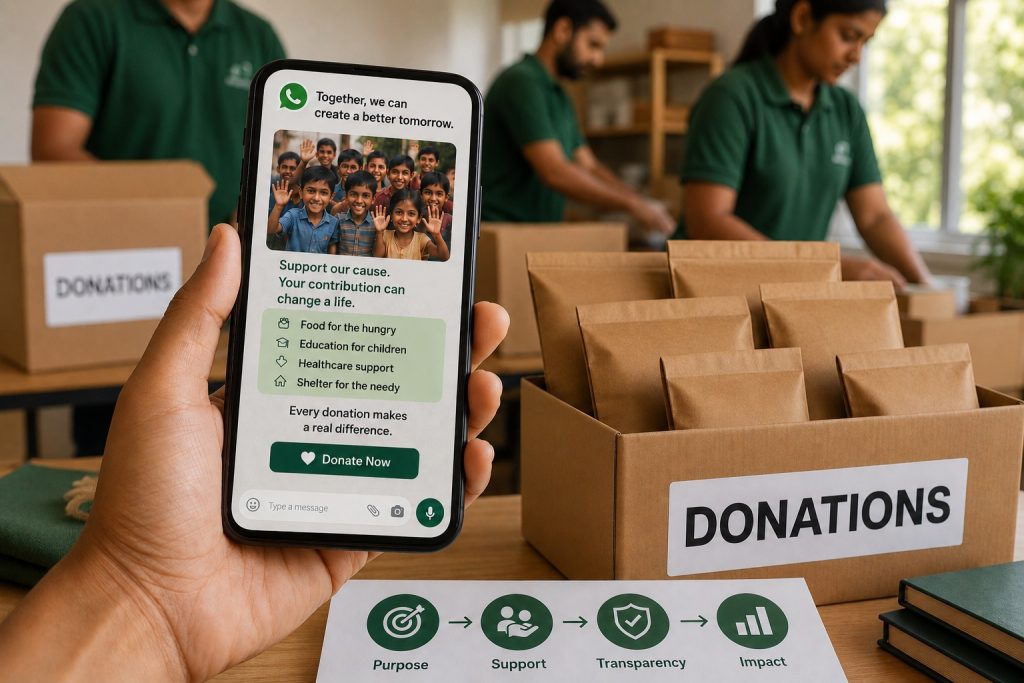
A donation campaign can begin with a simple message, but successful fundraising requires much more than asking people to contribute.
For NGOs, charitable trusts, community organisations, and welfare institutions, a WhatsApp donation campaign can provide a direct way to communicate with supporters, explain a welfare need, answer questions, share campaign updates, and maintain engagement. However, a poorly planned campaign can lead to repeated messages, unclear fundraising requests, scattered donor information, and missed follow-ups.
The strongest WhatsApp donation campaigns are built around a clear purpose. Supporters should understand what the campaign is for, why support is needed, how they can participate, and what happens after contributions are received.
This guide explains how NGOs can plan and manage a WhatsApp donation campaign step by step. It also covers campaign communication, donor engagement, transparency, common mistakes, and the bigger management process that connects fundraising with welfare projects and outcomes.
What Is a WhatsApp Donation Campaign?
A WhatsApp donation campaign is a planned fundraising effort that uses WhatsApp as a communication channel to inform supporters about a welfare need, encourage contributions, answer questions, share updates, and maintain engagement throughout the campaign.
WhatsApp can support different parts of a fundraising campaign, including:
- Campaign announcements
- Fundraising appeals
- Supporter enquiries
- Donation-related communication
- Campaign reminders
- Project updates
- Donor acknowledgements
- Volunteer communication
- Continued supporter engagement
However, WhatsApp is only the communication channel. A complete campaign also needs clear fundraising objectives, organised contribution processes, donor records, follow-up responsibilities, and appropriate reporting.
A useful way to think about the campaign is:
Awareness → Interest → Questions → Contribution → Acknowledgement → Project Updates → Outcomes → Continued Support
Why Should an NGO Use WhatsApp for a Donation Campaign?
An NGO can use WhatsApp for a donation campaign because it allows direct and timely communication with supporters who are already connected to the organisation or choose to engage with its welfare work.
For many small and medium-sized organisations, maintaining regular communication can be difficult. A fundraising team may not have the resources to organise a large event or contact every supporter individually.
WhatsApp can help the organisation:
- Share campaign information quickly
- Communicate with existing supporters
- Answer common questions
- Provide timely updates
- Follow up where appropriate
- Encourage voluntary sharing of useful campaign information
- Keep supporters connected with the welfare work
The key advantage is not simply speed. It is the ability to maintain an ongoing communication journey.
A person may first learn about a campaign through WhatsApp, ask questions, decide to contribute later, and remain interested in receiving updates. A well-planned campaign should support this journey.
How Can an NGO Plan a WhatsApp Donation Campaign?
An NGO should plan a WhatsApp donation campaign by first defining the welfare need, fundraising purpose, target audience, campaign communication, contribution process, responsibilities, and follow-up plan.
Starting with messages before planning the campaign often creates confusion.
A practical campaign can be planned in the following stages.
1. Define the Welfare Need
Start with the reason for fundraising.
For example:
- Education support
- Healthcare assistance
- Food distribution
- Emergency relief
- Community development
- Support for a specific welfare project
The organisation should be able to explain the need clearly and accurately.
Ask:
- What problem are we trying to address?
- Who is expected to benefit?
- What activities are being planned?
- Why is fundraising required?
- What information can be shared with supporters?
A clear welfare purpose gives the campaign direction.
2. Set a Clear Campaign Objective
The campaign objective should explain what the organisation is trying to achieve.
For example:
To raise support for the planned activities of an education-support programme for children in the community.
The objective does not need complicated language.
It should give the fundraising team a shared focus and help supporters understand the purpose of the campaign.
3. Identify the Supporters You Want to Reach
A charity should not assume that every person needs the same campaign message.
Possible groups may include:
- Existing donors
- Previous supporters
- Volunteers
- Community members
- Trustees and well-wishers
- Event participants
- People interested in a particular welfare project
Consider what each group already knows.
A long-term donor may need a campaign update. A new supporter may first need a clear introduction to the organisation and its welfare work.
4. Decide What Information the Campaign Must Communicate
Before writing the first message, prepare the essential information.
A supporter should be able to understand:
- What the campaign is about
- Why support is needed
- What welfare activity the campaign relates to
- How they can contribute through the organisation’s established process
- How they can ask questions
- What communication or updates may follow
The campaign should avoid vague requests that leave supporters uncertain about the purpose.
How Do You Create an Effective WhatsApp Donation Message?
An effective WhatsApp donation message clearly explains the welfare need, gives supporters enough context to understand the campaign, and provides a simple next step without using unnecessary pressure.
A message does not need to be long, but it should answer important questions.
A Simple Donation Message Structure
A useful structure is:
- Start with the welfare need
What is happening or what support is required? - Explain the purpose
What is the organisation planning to do? - Connect the appeal to a welfare activity
How will the fundraising support the planned work? - Explain how to participate
What should an interested supporter do next? - Provide a contact option
How can someone ask a question or request more information?
Example
We are raising support for our planned community education programme. The programme is intended to provide educational assistance to children who need additional support. If you would like to know more about the programme or explore ways to contribute, please contact our team for further information.
The message is clear without making exaggerated promises or using emotional pressure.
What Should an NGO Include in a WhatsApp Donation Campaign?
An NGO should include clear campaign information, a defined communication plan, an organised contribution process, donor follow-up, and relevant updates about the welfare work connected to the campaign.
A campaign can include the following elements.
Campaign Introduction
Explain:
- The welfare issue
- The purpose of the campaign
- The organisation’s planned response
Fundraising Appeal
Explain what kind of support is being requested and guide interested supporters toward the organisation’s established contribution process.
Supporter Information
Provide answers to likely questions where appropriate.
Communication Plan
Decide when to share:
- The campaign launch
- Important updates
- Relevant reminders
- Progress information
- Closing or next-step communication
Donor Acknowledgement
Develop a process for acknowledging support appropriately.
Welfare Project Updates
Where relevant, communicate how the associated project is progressing.
Continued Engagement
A supporter relationship should not necessarily end after a contribution.
Appropriate updates can help maintain trust and keep supporters connected with the organisation’s work.
How Often Should an NGO Send WhatsApp Donation Campaign Messages?
An NGO should send WhatsApp campaign messages when there is relevant information to share, rather than repeatedly sending fundraising appeals simply to increase message frequency.
There is no universal number of messages that works for every campaign.
A short emergency campaign may require timely updates. A long-term community project may use a more gradual communication schedule.
A campaign could include:
- Campaign introduction
- Welfare need and fundraising purpose
- Relevant campaign update
- Carefully timed reminder where appropriate
- Project or campaign progress update
- Thank-you or continued engagement communication
Every message should have a purpose.
Before sending it, ask:
Does the supporter need or benefit from receiving this information?
If the answer is no, the message may not be necessary.
How Can an NGO Encourage People to Share a Donation Campaign?
An NGO can encourage wider campaign reach by creating clear and trustworthy information that supporters may choose to share voluntarily with people who could be interested in the welfare cause.
People are more likely to share information when they understand:
- What the campaign is about
- Why it matters
- Who is organising it
- What kind of support is being requested
- How others can learn more
A campaign message should be easy to understand before it is shared.
The organisation can also create useful supporting materials such as:
- A short campaign summary
- Frequently asked questions
- Welfare project updates
- Event information
- Volunteer opportunities
The aim should be informed sharing, not pressure.
How Can an NGO Manage Donor Communication During a WhatsApp Campaign?
An NGO can manage donor communication more effectively by defining who responds to supporters, maintaining important donor and campaign information, and ensuring that conversations do not become scattered across multiple personal chats.
As a campaign grows, supporters may:
- Ask questions
- Request more information
- Express interest in contributing
- Make a contribution
- Ask for project updates
Without a clear process, messages can easily be missed.
A simple communication workflow could be:
Enquiry received → Information provided → Question answered → Follow-up identified → Contribution recorded where applicable → Acknowledgement → Relevant updates
The organisation should decide:
- Who monitors campaign communication?
- Who answers routine questions?
- Who handles complex questions?
- Where are important interactions recorded?
- Who follows up with interested supporters?
Clear responsibilities are especially important for volunteer-led organisations.
Why Is Donor Acknowledgement Important in a WhatsApp Donation Campaign?
Donor acknowledgement is important because it confirms that the organisation has recognised the support and helps create a more respectful and organised communication experience.
A contribution should not disappear into a communication gap.
The organisation should have an appropriate process for:
- Recording the contribution
- Confirming receipt where applicable
- Acknowledging the support
- Identifying any necessary follow-up
- Maintaining relevant records
A simple message may be enough for an initial acknowledgement:
Thank you for supporting our welfare work. We appreciate your contribution and will continue to share relevant updates about the activities connected to our work.
The wording should reflect the organisation’s actual communication process.
How Can a Charity Make Its WhatsApp Donation Campaign More Transparent?
A charity can improve transparency by clearly explaining the purpose of the campaign, maintaining organised records, connecting contributions with welfare activities, and communicating relevant progress and outcomes to supporters.
Transparency is not achieved through one message.
It depends on how the organisation manages the full journey after support is received.
A stronger process connects:
Donors → Contributions → Funds → Welfare Projects → Beneficiaries → Outcomes → Reporting → Continued Support
For example, imagine a community organisation raising funds for an education-support initiative.
The organisation should be able to manage the journey from fundraising through to the planned welfare activities.
This may involve:
- Recording donor contributions
- Managing available funds
- Coordinating project activities
- Maintaining appropriate beneficiary information
- Recording relevant progress
- Preparing reporting information
- Communicating meaningful updates
The more clearly these stages connect, the easier it becomes to build accountability into the organisation’s work.
A Practical Example of a WhatsApp Donation Campaign for an NGO
A successful campaign should connect the fundraising message with the actual welfare work the organisation intends to carry out.
Imagine a community organisation planning an education-support programme for 100 children.
Stage 1: Prepare the Campaign
The organisation identifies:
- The welfare need
- The programme objective
- Planned activities
- Fundraising requirements
- The people responsible for communication and follow-up
Stage 2: Create the Campaign Message
The organisation explains the programme in clear language and shares information with its existing supporter community.
Interested people can ask questions and learn more.
Stage 3: Manage Supporter Enquiries
A team member or defined communication process responds to enquiries.
Important interactions are recorded through the organisation’s chosen management process.
Stage 4: Record Contributions
As contributions are received through the organisation’s established process, relevant information is recorded.
Supporters are acknowledged appropriately.
Stage 5: Connect Support to the Welfare Project
The organisation moves from fundraising to project management.
Support now connects to:
- Programme activities
- Beneficiaries
- Resources
- Coordination
Stage 6: Share Relevant Updates
As activities progress, the organisation shares meaningful information with supporters.
For example:
- The programme has begun
- Planned educational support activities are underway
- A project milestone has been reached
- Further activities are planned
Stage 7: Support Reporting and Continued Engagement
The organisation can use its project and activity information to support reporting and future communication.
The campaign becomes part of a longer relationship rather than a one-time request.
What Are the Common Mistakes in WhatsApp Donation Campaigns?
Common mistakes include unclear fundraising messages, excessive communication, poor follow-up, scattered donor information, and treating fundraising as separate from the welfare work that follows.
Mistake 1: Starting Without a Clear Campaign Purpose
A vague message can create uncertainty.
Better approach: Clearly define the welfare need and campaign objective before communication begins.
Mistake 2: Sending Too Many Donation Requests
Repeated appeals can lead to message fatigue.
Better approach: Balance fundraising communication with useful updates and relevant information.
Mistake 3: Giving Supporters Too Little Information
People may want to understand the purpose before deciding whether to support it.
Better approach: Explain the welfare activity and provide a way to ask questions.
Mistake 4: Failing to Record Important Information
If donor and contribution information is left across individual chats and personal records, managing the campaign becomes difficult.
Better approach: Use an organised process for maintaining important information.
Mistake 5: Forgetting the Follow-Up
A supporter may ask a question or express interest but receive no further response.
Better approach: Define communication responsibilities and follow-up processes.
Mistake 6: Ending Communication After Receiving a Contribution
Fundraising is not only about collecting donations.
Better approach: Where appropriate, acknowledge support and keep donors connected with relevant welfare updates.
Mistake 7: Treating WhatsApp as the Entire Fundraising System
WhatsApp can support communication, but it does not replace organised fundraising, donor management, project management, or reporting processes.
Better approach: Use communication as part of a connected welfare-management approach.
How Can Technology Improve WhatsApp Donation Campaign Management?
Technology can help NGOs organise campaign information, donor communication, contribution records, follow-ups, and connections between fundraising and welfare activities.
As the number of supporters grows, teams may find it difficult to manage information across chats, spreadsheets, documents, and individual devices.
A more organised approach can help the organisation understand:
- Which supporters are connected to a campaign
- What enquiries have been received
- Which communications have been sent
- Which contributions have been recorded
- What follow-up is required
- Which welfare project the campaign supports
- What project information is available for reporting
The purpose of technology should be to reduce unnecessary fragmentation and improve operational coordination.
It should support the charity’s real processes rather than force the organisation into an unsuitable workflow.
Why Does a WhatsApp Donation Campaign Need Welfare Governance?
A WhatsApp donation campaign needs a broader governance approach because collecting contributions creates responsibilities that continue through fund management, welfare projects, beneficiary support, outcomes, reporting, and continued donor communication.
Fundraising is one part of a larger welfare ecosystem.
The complete journey can be viewed as:
Donors → Contributions → Funds → Welfare Projects → Beneficiaries → Outcomes → Reporting → Continued Support
Each stage generates responsibilities.
For example:
- Donations need organised records.
- Funds need to connect with welfare activities.
- Projects need coordination.
- Beneficiary support requires appropriate management.
- Activities and outcomes may need to be recorded.
- Reporting supports accountability.
- Communication helps maintain supporter relationships.
This broader and structured approach is Welfare Governance.
Welfare Governance means managing an organisation’s welfare activities, resources, people, projects, beneficiaries, accountability, reporting, and impact in an organised way.
A WhatsApp campaign can therefore be more effective when it connects with the organisation’s wider welfare-management system.
WhatsApp Donation Campaign Checklist for NGOs
Before launching a campaign, review the following:
- Define the welfare need clearly
- Set a specific campaign objective
- Identify the supporters you want to reach
- Prepare clear campaign information
- Establish the contribution process
- Decide who manages supporter communication
- Create useful campaign messages
- Prepare answers to common questions
- Plan updates and follow-up communication
- Create a process for acknowledging support
- Keep important donor and contribution information organised
- Connect fundraising information with the relevant welfare project
- Plan appropriate reporting and continued engagement
- Review the campaign and improve future communication
Frequently Asked Questions
What is a WhatsApp donation campaign?
A WhatsApp donation campaign is a planned fundraising effort that uses WhatsApp to communicate a welfare need, engage supporters, answer questions, encourage contributions, and share relevant updates.
Can an NGO collect donations through a WhatsApp campaign?
WhatsApp can be used to communicate with supporters and guide interested people through the organisation’s established contribution process. The charity should ensure that its fundraising and contribution processes are properly organised.
How do I write a WhatsApp donation message?
Explain the welfare need, describe the purpose of the campaign, provide enough context for supporters to understand the request, and give a clear next step for people who want more information or wish to participate.
How often should an NGO send donation campaign messages?
Messages should be sent when they are relevant and useful. A campaign may include an introduction, updates, carefully timed reminders, acknowledgements, and continued communication rather than repeated donation requests.
How can an NGO get more people to share a WhatsApp donation campaign?
Create clear, trustworthy, and easy-to-understand campaign information that supporters may choose to share voluntarily with people interested in the welfare cause.
Why is donor acknowledgement important?
Acknowledging support helps create a respectful donor experience and confirms that the organisation has recognised the contribution. It should be part of an organised donor communication process.
How can an NGO make a donation campaign more transparent?
Clearly communicate the campaign purpose, maintain organised records, connect contributions with welfare activities, and share relevant information about project progress and outcomes.
What should happen after a WhatsApp donation campaign ends?
The organisation should review the campaign, complete necessary follow-up, continue managing the associated welfare project, prepare relevant reporting, and maintain appropriate communication with supporters.
To explore how NidhiMax can support a more organised Welfare Governance system for your organisation.
How NidhiMax Can Help
A WhatsApp donation campaign may begin with a message, but the organisation’s responsibility continues long after the fundraising appeal is sent.
As supporters contribute, a charity may need to manage donor relationships, contribution information, funds, welfare projects, beneficiaries, activities, communication, outcomes, and reporting.
This is why fundraising should be viewed as part of a wider Welfare Governance system.
NidhiMax — Welfare Governance Platform is designed to help charitable organisations, NGOs, trusts, community organisations, and welfare institutions move toward a more organised digital welfare-management ecosystem.
Every organisation has its own processes. The right technology should support the way it manages fundraising and welfare activities while helping create stronger connections between relevant areas such as donor management, contribution tracking, welfare project management, beneficiary management, communication, reporting, transparency, accountability, and operational coordination.
A more connected approach can help organisations think beyond a single campaign and focus on the full journey:
Donors → Contributions → Funds → Welfare Projects → Beneficiaries → Outcomes → Reporting → Continued Support
To explore how NidhiMax can support a more organised Welfare Governance system for your organisation.