
 Post by
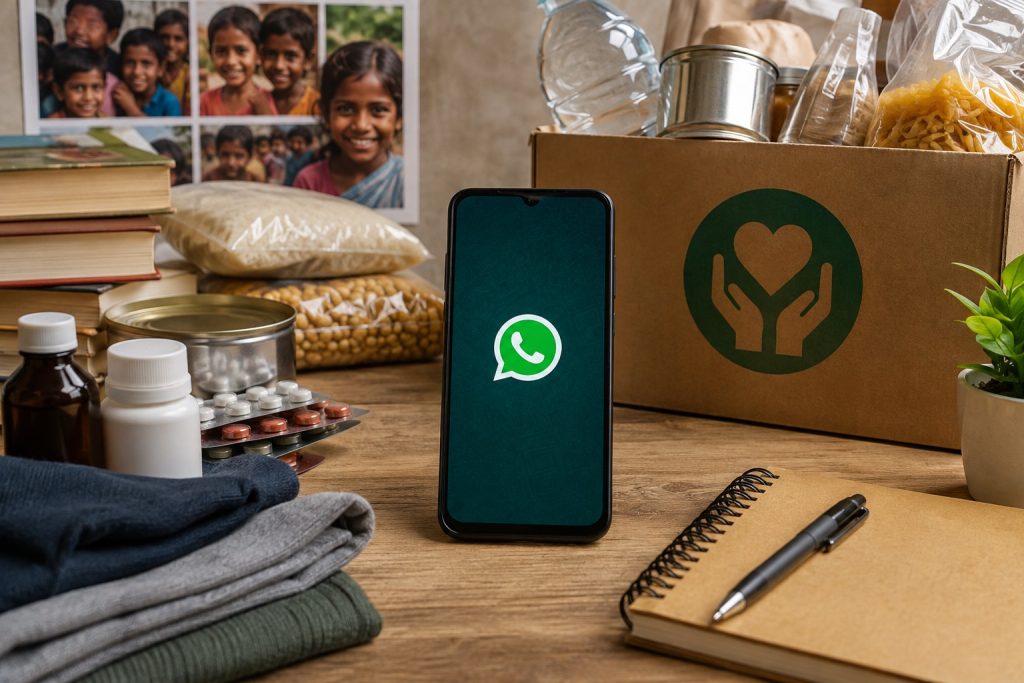
For many NGOs, charitable trusts, community organisations, and welfare institutions, fundraising does not always require a large advertising budget. Sometimes, the most useful channel is one that supporters already use every day.
That is where WhatsApp can become part of a practical digital fundraising strategy.
A WhatsApp donation campaign can help a charity explain a specific need, communicate directly with supporters, share a donation link or payment option, and provide updates after contributions are received. In India, WhatsApp has also become increasingly integrated with business communication and digital payments, making it a familiar environment for many users. Meta has continued expanding WhatsApp’s business and payment capabilities in India. (About Facebook)
However, simply sending a message that says “Please donate” is not a fundraising strategy.
An effective campaign needs a clear purpose, a credible story, an easy donation process, responsible communication, proper donor records, and a plan for reporting how funds are used.
This guide explains how an NGO or charity can create a WhatsApp donation campaign from planning through follow-up.
What Is a WhatsApp Donation Campaign?
A WhatsApp donation campaign is a fundraising initiative that uses WhatsApp to communicate a charitable need to potential supporters and guide them toward making a contribution.
The campaign might involve:
- A one-time fundraising appeal
- An emergency relief campaign
- An education-support initiative
- A medical assistance campaign
- A food distribution project
- A community development project
- A recurring donor campaign
- A campaign connected to a specific welfare project
WhatsApp itself is primarily the communication channel. The actual donation may happen through a payment link, QR code, UPI-enabled payment process, donation page, or another method provided by the organisation.
The important distinction is that WhatsApp should support the fundraising journey, rather than become the entire fundraising system.
Why Use WhatsApp for Charity Fundraising?
WhatsApp can be useful for charity fundraising because it supports direct, conversational communication. Instead of expecting a supporter to discover an organisation’s website independently, an NGO can share a campaign message directly with an existing supporter network, subject to appropriate consent and messaging practices.
For Indian organisations, the familiarity of WhatsApp can also reduce friction in communication. Meta has reported that WhatsApp is widely used for business conversations in India and has continued adding business, payment, and messaging capabilities to the platform. (About Facebook)
A WhatsApp campaign can help an organisation:
- Explain a specific welfare need.
- Reach existing supporters quickly.
- Share campaign updates.
- Direct people to a donation mechanism.
- Answer questions from potential donors.
- Follow up with appropriate acknowledgements.
- Build longer-term supporter relationships.
But reach alone does not create trust.
A supporter is more likely to respond positively when the organisation clearly explains what the campaign is for, who it is intended to help, how contributions will be used, and how updates will be communicated.
How Do You Create a WhatsApp Donation Campaign?
Creating a WhatsApp donation campaign is easiest when it is treated as a structured fundraising project rather than a single broadcast message.
A practical process is:
- Define the fundraising objective.
- Identify the welfare project or need.
- Establish the campaign target internally.
- Identify the intended audience.
- Prepare the campaign story.
- Create a simple donation process.
- Prepare the WhatsApp message.
- Test the donor journey.
- Launch the campaign.
- Track contributions and donor information.
- Send meaningful updates.
- Report the outcome.
Let’s look at each step in detail.
Step 1: Define Exactly What You Are Raising Money For
The first question should be:
What will the donation support?
Avoid starting with a vague objective such as “We need funds for our NGO.”
Instead, define a concrete welfare purpose.
For example:
A community organisation is raising funds to provide school-support materials for children from low-income households before the new academic year.
That is easier for a supporter to understand than a general appeal for organisational funding.
Possible campaign purposes include:
- Educational assistance
- Medical support
- Food distribution
- Emergency relief
- Shelter support
- Community development
- Welfare equipment
- Support for a specific community programme
A clear purpose also makes later reporting easier because the organisation can connect contributions to a defined project.
Step 2: Define the People the Campaign Is Intended to Help
A strong donation campaign explains the beneficiary group without compromising individual privacy.
For example:
“This campaign supports children participating in our community education programme.”
The organisation does not necessarily need to publish sensitive personal information about individual beneficiaries.
Think about the relationship:
Donor → Contribution → Welfare Project → Beneficiary → Outcome
The campaign should make that relationship understandable.
This is particularly important for organisations that want to build long-term donor relationships rather than generate only one-time contributions.
Step 3: Decide What Success Looks Like
Before sending the first message, establish what the campaign is trying to achieve.
Internally, an organisation may track:
- Fundraising target
- Number of expected contributors
- Campaign duration
- Average contribution
- Number of people reached
- Number of responses
- Number of completed donations
- Funds received
- Funds allocated to the project
- Follow-up communication completed
Do not assume that the number of WhatsApp messages sent is the main measure of success.
A campaign that reaches fewer people but generates meaningful support and strong donor trust may be more valuable than a campaign that reaches a large audience but produces little engagement.
Step 4: Know Who You Are Messaging
A donation appeal should not be sent indiscriminately.
Consider dividing supporters into relevant groups, such as:
- Existing donors
- Former donors
- Volunteers
- Community supporters
- Event participants
- Members
- Local supporters
- Corporate or institutional contacts, where appropriate
- People who have explicitly opted to receive updates
Different groups may need different messages.
For example, an existing donor may respond well to a short update about a project they already know, while someone unfamiliar with the organisation may first need basic information about the charity and its work.
Respect communication preferences and avoid treating every contact as a fundraising prospect
Step 5: Write a Clear WhatsApp Donation Message
The best fundraising messages are usually focused rather than overloaded with information.
A useful structure is:
- Who are you?
Briefly identify the organisation. - What is happening?
Explain the welfare need. - Who will benefit?
Describe the intended beneficiaries. - What are you asking for?
State the fundraising requirement clearly. - How can someone help?
Provide the donation mechanism. - What happens next?
Explain how supporters will receive acknowledgement or campaign updates.
For example:
Help Support Community Education
Our organisation is working to provide educational support to children in our local community.
We are currently raising funds for learning materials and related programme expenses.
If you would like to support this initiative, you can contribute through the donation option below:
[Donation link / payment instructions]
We will share an update on the project and how the campaign progressed.
Thank you for supporting the community.
The exact wording should reflect the organisation’s actual activities. Never add emotional claims, beneficiary stories, or financial details that cannot be substantiated.
Step 6: Make the Donation Process Simple
A donor should not have to search through multiple messages to understand how to contribute.
The campaign should ideally lead to one clear action.
Depending on the organisation’s setup, that could be:
- A dedicated donation page
- A payment link
- A QR code
- A UPI-based payment method
- Another established donation mechanism
WhatsApp supports payment functionality in India, and Meta continues to expand payment-related experiences on the platform. However, organisations should distinguish between WhatsApp as a communication channel and the payment or donation infrastructure they use to receive and reconcile contributions. (About Facebook)
Before launching, test the entire journey yourself.
Ask:
- Does the link work?
- Is the organisation name clear?
- Is the payment destination correct?
- Can a donor understand what the contribution supports?
- Is there a confirmation or acknowledgement process?
- Can the organisation reconcile the contribution afterward?
A technically simple donation process can still fail if the internal record-keeping is poor.
Step 7: Build Trust Into the Campaign
Trust is one of the most important assets in charitable fundraising.
A WhatsApp message should give supporters enough context to distinguish a genuine campaign from an unsolicited or suspicious request.
Where appropriate, include:
- Organisation name
- Official contact details
- Campaign purpose
- Donation mechanism
- Project information
- Website or other official information source
- A clear explanation of how updates will be provided
Consistency also matters. The organisation name, payment details, website information, and communication identity should not create unnecessary confusion.
Meta has introduced business verification and impersonation-protection features for eligible businesses on WhatsApp, illustrating the broader importance of establishing an authentic organisational presence on messaging platforms. (About Facebook)
Verification, where available and appropriate, should not be treated as a substitute for financial transparency or good governance.
Step 8: Use Stories Carefully
A real story can make a fundraising campaign easier to understand.
But charities should be careful when sharing beneficiary stories.
For example, instead of publishing unnecessary personal details about a child receiving educational support, an organisation could explain the broader situation:
“Our community education programme supports children who need additional learning resources. This campaign will help us provide materials for the next programme cycle.”
If a photograph, name, quote, medical detail, or other personal information is used, the organisation should consider whether it has appropriate permission and whether sharing the information is genuinely necessary.
Good fundraising communication should protect dignity as well as generate support.
Step 9: Create a Campaign Timeline
A WhatsApp donation campaign should have a beginning, middle, and end.
A simple campaign might look like this:
Day 1: Campaign Launch
Introduce the project and explain the fundraising objective.
Day 3–4: Reminder
Share a short update rather than simply repeating the original appeal.
Mid-Campaign: Progress Update
Explain what has happened so far and what remains to be achieved.
Final Stage: Closing Appeal
Let supporters know that the campaign is approaching its planned end.
After the Campaign: Outcome Update
Explain what the campaign achieved and what happens next.
This approach is generally more useful than sending the exact same appeal repeatedly.
How Often Should a Charity Send WhatsApp Donation Messages?
There is no universal number of messages that is right for every organisation.
The appropriate frequency depends on the campaign, the relationship with supporters, the urgency of the need, and the communication preferences of recipients.
A charity should prioritise relevance over volume.
Before sending a message, ask:
“Does the recipient have a reasonable reason to receive this update?”
If the answer is unclear, reconsider the message.
Repeated unsolicited fundraising messages can damage trust and make people less receptive to future communication.
What Should an NGO Track During a WhatsApp Fundraising Campaign?
The campaign should be connected to proper donor and contribution records.
At a minimum, an organisation may want to track:
Area | Information to Track |
Campaign | Campaign name and purpose |
Donor | Supporter identity and relevant contact information |
Contribution | Amount and date |
Payment | Reference or reconciliation information |
Project | Welfare project supported |
Communication | Relevant acknowledgement or update |
Outcome | How funds contributed to the project |
The exact fields will depend on the organisation’s processes.
The key principle is simple: a WhatsApp conversation should not become the organisation’s donor database.
Messages can be lost, staff can change, and conversations can become difficult to search.
Important fundraising information should be transferred into an appropriate donor-management or charity-management system.
What Are the Common Mistakes in WhatsApp Donation Campaigns?
Several problems can reduce the effectiveness of a campaign.
1. Asking for money without explaining the need
“Please donate” gives the supporter very little context.
2. Making the message too long
A donor should not have to read a full organisational history before understanding the campaign.
3. Using excessive emotional pressure
Strong emotions can be appropriate in storytelling, but guilt, fear, or manipulation can undermine trust.
4. Providing unclear payment instructions
A donor who is unsure where the money is going may abandon the process.
5. Repeatedly sending the same message
Repetition without meaningful updates can feel like spam.
6. Failing to record contributions
A successful campaign can become an administrative problem if the organisation cannot reconcile donations properly.
7. Forgetting the post-donation experience
The relationship should not end immediately after the payment.
8. Publishing beneficiary information carelessly
Fundraising should never come at the expense of dignity, privacy, or responsible communication.
How Can a Charity Improve Donor Follow-Up After WhatsApp Donations?
The donation is not the end of the donor journey.
A simple acknowledgement can confirm that the contribution was received and show appreciation.
Later, an organisation can provide a meaningful project update.
For example:
“Thank you for supporting our education programme. The campaign has now concluded, and the funds are being used toward the planned programme activities. We will share a further update as the project progresses.”
The follow-up should be truthful and proportionate.
If the organisation promised a campaign outcome, it should report whether that outcome was achieved.
This creates a stronger relationship between:
Contribution → Use of Funds → Project Activity → Outcome → Reporting
That relationship is central to responsible digital fundraising.
How Can WhatsApp Support a Larger Digital Fundraising Strategy?
WhatsApp should usually be viewed as one part of a broader fundraising system.
A mature digital fundraising process might look like:
Campaign Planning
↓
Supporter Communication
↓
Donation
↓
Contribution Recording
↓
Fund Allocation
↓
Welfare Project Activity
↓
Beneficiary Support
↓
Outcome Tracking
↓
Donor Reporting
This is where the idea of Welfare Governance becomes important.
Fundraising is only one part of running a charitable organisation. The organisation also needs to understand what happens to resources after they are received.
What Is Welfare Governance?
Welfare Governance is the structured management of an organisation’s welfare activities, resources, people, projects, beneficiaries, accountability, reporting, and impact.
For a charity, this means looking beyond the question:
“How much did we raise?”
and asking:
“What happened to those resources, which welfare project used them, who benefited, and what outcome did the organisation achieve?”
The broader ecosystem can be understood as:
Donors → Contributions → Funds → Welfare Projects → Beneficiaries → Outcomes → Reporting → Continued Support
A WhatsApp campaign sits near the beginning of this chain.
Good welfare management ensures that the rest of the chain is not forgotten.
A Practical Example: WhatsApp Fundraising for an Education Programme
Imagine a community organisation running an education-support programme for children.
The organisation decides to run a WhatsApp donation campaign before the next programme cycle.
Instead of sending a generic fundraising request, the team creates a campaign around a defined need: educational materials and programme-related support.
The process could look like this:
Fundraising
The organisation explains the programme and shares a donation option with relevant supporters.
Donor Management
Each contribution is recorded against the appropriate donor record and campaign.
Project Management
The organisation records how the campaign funds are allocated to the education programme.
Beneficiary Management
The organisation maintains appropriate records about the people receiving support, while protecting sensitive information.
Communication
Supporters receive relevant acknowledgements and project updates.
Reporting
The organisation reviews the campaign and prepares an internal or donor-facing summary of what was achieved.
Now the WhatsApp campaign is not an isolated activity.
It is part of a broader welfare process.
How Can Technology Help Manage WhatsApp Fundraising?
Technology becomes valuable when it connects fundraising activity with the organisation’s wider operations.
For example, an organisation may need to connect:
- Donor records
- Campaign information
- Contribution records
- Welfare projects
- Beneficiary records
- Communication
- Fund allocation
- Reports
- Outcomes
The objective is not to add technology for its own sake.
The objective is to reduce fragmented information and give the organisation a clearer view of its welfare activities.
A messaging platform can help start a conversation. A proper management system helps an organisation understand what happens after that conversation.
What Should a Charity Consider Before Scaling WhatsApp Fundraising?
Before increasing the number of messages or campaigns, review the organisation’s operational readiness.
Check the communication process
Who is responsible for creating, approving, and sending campaign messages?
Check the donation process
Who verifies incoming contributions?
Check donor records
Where are donor details and contribution histories maintained?
Check project records
Can the organisation connect donations with the welfare projects they support?
Check reporting
Can the team explain what happened after the funds were received?
Check privacy and security
Are sensitive donor and beneficiary details handled appropriately?
Check staff capacity
Can the organisation respond to donor questions without creating delays?
Scaling fundraising without strengthening these processes can create administrative pressure.
WhatsApp Donation Campaign Best Practices
Before launching a campaign, use this practical checklist:
- Define one clear fundraising purpose.
- Identify the intended beneficiary group.
- Set an internal campaign target.
- Identify appropriate supporters.
- Use clear and honest language.
- Explain how contributions will be used.
- Provide one obvious donation action.
- Test the payment or donation journey.
- Keep donor records outside the chat itself.
- Track campaign contributions.
- Acknowledge donations appropriately.
- Share meaningful progress updates.
- Protect beneficiary privacy and dignity.
- Avoid excessive messaging.
- Reconcile contributions with financial records.
- Review the campaign after it ends.
- Report meaningful outcomes where appropriate.
The strongest campaigns are usually the ones where communication, fundraising, finance, project management, and reporting work together.
Frequently Asked Questions
Can a charity raise funds using WhatsApp?
Yes. A charity can use WhatsApp as a communication channel for fundraising by explaining a specific need and directing supporters to an appropriate donation or payment method. WhatsApp should be combined with proper contribution records and responsible donor communication.
How do I create a WhatsApp donation message?
Start by explaining who the organisation is, what welfare need the campaign addresses, who benefits, what support is required, and how someone can contribute. Keep the message concise and provide a clear next step.
Can NGOs use WhatsApp for fundraising in India?
Yes. NGOs and other charitable organisations can use WhatsApp to communicate fundraising campaigns with appropriate supporters. The organisation should ensure that its donation process, financial records, communications, and internal controls are properly managed.
How can NGOs manage donors digitally?
NGOs can use donor-management or charity-management technology to maintain donor records, contribution histories, campaign information, communication records, and relevant reports instead of relying only on individual WhatsApp conversations or spreadsheets.
Should a charity send donation requests to all WhatsApp contacts?
No. Fundraising communication should be relevant to the recipient and consistent with the organisation’s communication practices and applicable requirements. Sending large volumes of unsolicited messages can damage donor trust.
How can a charity build trust through WhatsApp fundraising?
A charity can build trust by clearly identifying itself, explaining the purpose of the campaign, providing a credible donation mechanism, acknowledging contributions appropriately, protecting beneficiary information, and reporting meaningful outcomes.
What should an NGO do after receiving a WhatsApp donation?
The organisation should record and reconcile the contribution, acknowledge it appropriately, associate it with the relevant campaign or project where applicable, and provide meaningful updates according to its donor communication process.
Is WhatsApp enough to manage a charity’s fundraising?
Usually, WhatsApp should be viewed as a communication channel rather than a complete charity-management system. Sustainable fundraising also requires donor management, contribution tracking, project management, reporting, accountability, and outcome tracking.
How NidhiMax Can Help
A WhatsApp donation campaign can make it easier for a charity to start a fundraising conversation. But effective welfare management extends beyond the message and the payment.
An organisation needs a structured way to understand its donors, contributions, welfare projects, beneficiaries, activities, reporting, and outcomes.
NidhiMax — Welfare Governance Platform is designed around this broader need: helping charitable organisations, NGOs, trusts, community organisations, and welfare institutions move toward a more organised digital welfare-management ecosystem.
For an organisation using WhatsApp as part of its fundraising strategy, the larger objective is not simply to collect more contributions. It is to create a connected process in which fundraising can be linked with donor management, welfare projects, beneficiary activities, accountability, reporting, and social impact.
Every charitable organisation has different processes and priorities. Technology should therefore support the organisation’s actual welfare model rather than force every organisation into the same workflow.
To explore how a more organised welfare governance approach could fit your organisation, visit