
 Post by
Donors want to know that their contributions are being handled responsibly and used for the purpose they intended to support. For a charity or NGO, sharing the right information is therefore more than a communication exercise—it is an important part of building transparency, accountability, and long-term donor relationships.
A charity does not need to overwhelm supporters with every internal detail. Instead, it should provide clear, relevant, timely information about how donations are received, where funds are directed, what activities are being carried out, who benefits, and what progress has been made. Good donor communication helps supporters understand the journey from their contribution to the welfare outcome it helps enable.
This becomes especially important as organisations manage multiple fundraising campaigns, welfare projects, beneficiaries, volunteers, and sources of funding. A structured approach to donor information can make communication more consistent while strengthening the organisation’s broader welfare governance practices.
What Information Should a Charity Share With Its Donors?
A charity should generally share information that helps donors understand the purpose of the organisation, the use of their contribution, progress on supported activities, and the outcomes being pursued. The exact information will depend on the organisation, project, type of donation, and communication preferences of its supporters.
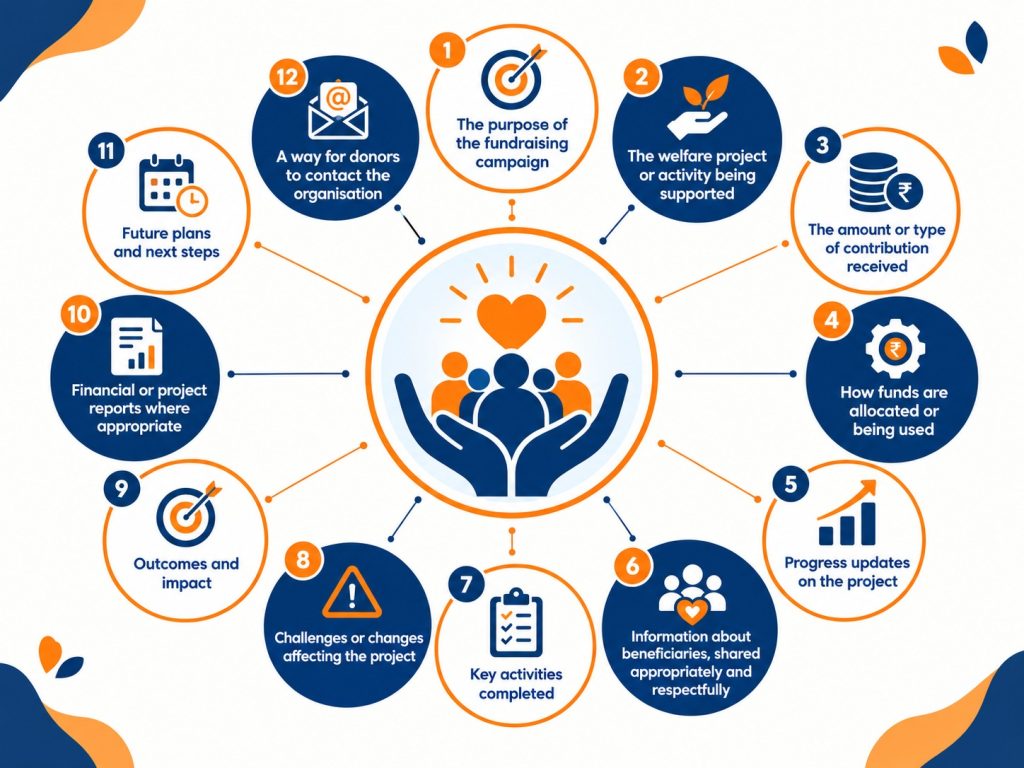
Useful donor information can include:
- The purpose of the fundraising campaign
- The welfare project or activity being supported
- The amount or type of contribution received
- How funds are allocated or being used
- Progress updates on the project
- Information about beneficiaries, shared appropriately and respectfully
- Key activities completed
- Challenges or changes affecting the project
- Outcomes and impact
- Financial or project reports where appropriate
- Future plans and next steps
- A way for donors to contact the organisation
The goal is not to send every donor every piece of information. The goal is to provide enough meaningful information for supporters to understand what their contribution is helping the organisation accomplish.
Why Is Transparency Important in Donor Communication?
Transparency matters because donors need confidence that an organisation is managing resources responsibly. Clear communication can help supporters understand the connection between fundraising, spending, welfare activities, and outcomes.
For example, consider a community organisation raising funds for an education-support programme. A donor may reasonably want to know:
- Why the programme is needed
- What activities the organisation plans to conduct
- How contributions will support those activities
- What progress has been made
- What challenges have emerged
- What outcomes the programme is working toward
A simple update explaining these points can be more useful than a generic message saying that the campaign is progressing well.
Transparency also works internally. When an organisation maintains organised records, it becomes easier for its fundraising, finance, programme, and leadership teams to communicate consistently.
What Should a Charity Tell Donors About Their Contributions?
Donors should receive clear information about their contribution and the fundraising purpose associated with it. This can include an acknowledgement of the contribution, the relevant campaign or project, and appropriate information about how the funds are being managed.
Depending on the organisation’s processes, donor records may include:
- Donor name or preferred identification
- Contribution date
- Contribution amount
- Campaign or fund associated with the contribution
- Payment or transaction reference
- Purpose of the contribution, where applicable
- Communication preferences
- Acknowledgement or receipt status
For example, if a supporter contributes to a food-distribution initiative, the organisation should be able to identify that contribution within its records and understand which fundraising effort or welfare activity it relates to.
This does not mean every donor needs to receive an internal accounting statement. Rather, the organisation should maintain sufficient records to answer reasonable questions accurately.
How Much Financial Information Should a Charity Share?
A charity should share enough financial information to demonstrate responsible stewardship without exposing confidential donor information or creating unnecessary complexity.
Useful information may include:
- Funds raised for a particular campaign
- Broad categories of expenditure
- Amount allocated to the relevant welfare activity
- Progress against the campaign’s purpose
- Significant changes to the original plan
- Appropriate financial summaries or reports
The level of detail should match the nature of the organisation and the expectations of its supporters.
For example, an NGO running a healthcare assistance programme might provide a periodic summary showing how funds supported medical assistance, supplies, coordination, or other relevant activities. It does not necessarily need to publish every individual transaction in a donor-facing update.
The principle is meaningful transparency rather than information overload.
Should Charities Tell Donors How Their Money Is Being Used?
Yes. Where practical, charities should explain how contributions are being used in relation to the stated fundraising purpose.
A useful update can connect three elements:
Contribution → Activity → Outcome
For example:
Supporters contributed toward an education programme → the organisation used funds to support programme activities and resources → participating children received educational assistance.
This approach helps donors see that their contribution is part of a broader welfare process rather than an isolated financial transaction.
When funds are flexible or unrestricted, the organisation should communicate that clearly rather than implying that the contribution is tied to a specific expense when it is not.
What Project Updates Should a Charity Give Its Donors?
Project updates should explain what has happened since the donor’s contribution and what remains to be done. They can be short, but they should contain useful information.
A strong project update may cover:
1. What was planned?
Briefly remind supporters of the purpose of the welfare project.
2. What has happened?
Describe activities that have been completed or are currently underway.
3. Who has benefited?
Share appropriate information about beneficiaries without compromising dignity, privacy, or safety.
4. What has changed?
Explain meaningful progress, developments, or unexpected challenges.
5. What happens next?
Tell supporters what the organisation plans to do in the next stage.
This makes donor communication more informative than simply sending repeated fundraising requests.
How Should Charities Share Information About Beneficiaries?
Charities should communicate beneficiary information with care, dignity, and respect. Donor transparency should never become an excuse for unnecessarily exposing a person’s identity, personal circumstances, or sensitive information.
Before sharing beneficiary stories, photographs, names, or other personal details, organisations should consider:
- Whether the information is genuinely necessary
- Whether appropriate permission has been obtained where required
- Whether sharing could create risk or embarrassment
- Whether the person’s dignity is being respected
- Whether sensitive details can be removed or generalised
For example, instead of publishing extensive personal details about a child receiving educational assistance, an organisation may describe the programme and its impact while protecting the child’s identity.
Responsible transparency means showing impact without turning beneficiaries into content.
What Should a Charity Include in a Donor Report?
A donor report should provide a concise picture of what happened with the relevant fundraising effort or welfare project.
Depending on the purpose, it could include:
- Project overview
- Fundraising objective
- Contribution summary
- Activities completed
- Funds allocated
- Beneficiary information in an appropriate format
- Progress and outcomes
- Challenges encountered
- Supporting photographs or documents where suitable
- Next steps
- Contact information
The report should be easy to understand. Avoid filling it with technical financial language when a simple explanation would communicate the same information more effectively.
How Often Should a Charity Communicate With Donors?
There is no single communication frequency that works for every charity. The appropriate schedule depends on the nature of the campaign, project duration, donor expectations, and the amount of meaningful information available.
A practical approach is to communicate at important points such as:
- After receiving a contribution
- When a significant project milestone is reached
- When there is a meaningful change or challenge
- When a project is completed
- When an impact or financial report is available
- When the organisation has an important update relevant to supporters
For long-running programmes, periodic updates can help supporters remain connected without turning every communication into another donation request.
Quality and relevance are more important than sending messages frequently.
What Is the Difference Between a Donation Receipt and a Donor Update?
A donation receipt primarily confirms a contribution, while a donor update explains what is happening with the relevant fundraising effort, project, or programme.
A receipt may answer:
“Did the charity receive my contribution?”
A project update may answer:
“What happened after I contributed?”
A healthy donor communication system can support both. Keeping these functions separate makes communication clearer and helps organisations maintain better records.
Where tax, regulatory, or formal receipt requirements apply, charities should follow the rules applicable to their organisation and seek professional advice when necessary.
How Can Charities Personalise Donor Communication?
Donor communication can be more relevant when it reflects the supporter’s relationship with the organisation.
For example, a charity may distinguish between:
- First-time contributors
- Recurring supporters
- Campaign-specific donors
- Major supporters
- Community volunteers who also contribute
- Supporters interested in particular welfare programmes
Personalisation does not require complicated marketing. Even simple practices—such as using the donor’s preferred name, referencing the relevant campaign, or providing an update about a project they supported—can make communication feel more meaningful.
The important requirement is accurate donor information. Poorly maintained records can result in incorrect names, duplicate messages, irrelevant updates, or missed acknowledgements.
What Are Common Donor Communication Mistakes?
Several communication practices can weaken donor confidence even when an organisation is doing valuable welfare work.
1. Only contacting donors when asking for money
If every message is a fundraising appeal, supporters may feel that their relationship with the organisation is purely transactional.
2. Using vague statements
Messages such as “Your support made a huge difference” are less informative when they provide no explanation of what actually happened.
3. Overloading donors with information
Transparency does not mean sending lengthy spreadsheets or internal documents without context.
4. Failing to explain changes
If a project is delayed, redesigned, or unable to proceed as initially planned, communicating the change is generally better than leaving supporters uncertain.
5. Sharing beneficiary information carelessly
Stories and images should be handled responsibly, particularly when children or vulnerable individuals are involved.
6. Maintaining inconsistent records
If fundraising, finance, and programme teams work from different records, it becomes harder to provide accurate donor updates.
7. Ignoring donor preferences
Not every supporter wants the same frequency or type of communication.
How Can Technology Improve Donor Communication?
Technology can help charities organise donor information, contribution records, fundraising activities, welfare projects, and reporting so that communication is based on reliable organisational records.
A digital system can help an organisation maintain a structured view of:
Donors → Contributions → Funds → Welfare Projects → Beneficiaries → Outcomes → Reporting
This relationship is important because donor communication becomes stronger when the organisation can connect a contribution with the welfare activity it supports and the progress associated with that activity.
Technology can also reduce dependence on disconnected spreadsheets, messages, emails, and manually maintained records. However, technology alone does not create transparency. The organisation still needs clear processes, responsible data management, appropriate approvals, and a culture of accountability.
Can Small NGOs Maintain Good Donor Communication?
Yes. Small NGOs do not need a large technology team to communicate effectively with donors. They can begin with a simple and consistent process for recording contributions, assigning them to the appropriate fundraising purpose, documenting project progress, and communicating meaningful updates.
A small organisation could establish a basic workflow:
- Record every contribution consistently.
- Connect the contribution to a campaign or fund where appropriate.
- Maintain project-level records.
- Document major activities and milestones.
- Keep beneficiary information organised and protected.
- Reconcile financial and project records regularly.
- Send clear donor acknowledgements and updates.
- Maintain a record of communication.
As the organisation grows, this process can gradually move into a more structured digital system.
How Can a Charity Create a Donor Communication Policy?
A donor communication policy gives staff and volunteers a common standard for what to communicate, when to communicate, and how donor information should be handled.
A simple policy can define:
Communication purposes
Specify when the organisation will send acknowledgements, project updates, reports, appeals, and other messages.
Information standards
Define what information should be included in different types of donor communications.
Approval responsibilities
Identify who reviews financial, programme, beneficiary, and public-facing information before it is shared.
Privacy practices
Set rules for protecting donor and beneficiary information.
Communication preferences
Record whether supporters have expressed preferences about the type or frequency of communication.
Record keeping
Maintain a history of relevant communications so the organisation knows what information has already been shared.
This creates consistency even when multiple staff members or volunteers communicate with supporters.
What Makes Donor Communication Trustworthy?
Trustworthy donor communication is usually clear, accurate, relevant, timely, respectful, and consistent.
Before sending an important update, a charity can ask:
- Is the information accurate?
- Does it explain something meaningful?
- Does it match our internal records?
- Are we protecting confidential information?
- Are we representing beneficiaries respectfully?
- Are we clearly explaining any important changes?
- Is the message appropriate for this donor?
- Does it help the supporter understand the organisation’s work?
These questions are simple, but they can significantly improve the quality of donor communication.
How Does Donor Communication Support Welfare Governance?
Donor communication is part of a wider system of accountability. A charity’s responsibility does not end when a contribution is received.
The broader welfare journey can be understood as:
Donors → Contributions → Funds → Welfare Projects → Beneficiaries → Outcomes → Reporting → Continued Support
Each stage needs appropriate records and coordination.
When an organisation knows where contributions came from, how funds are associated with welfare projects, what activities took place, who benefited, and what outcomes were achieved, it becomes easier to communicate responsibly with donors.
This is where the broader idea of Welfare Governance becomes relevant.
Welfare Governance means the structured management of an organisation’s welfare activities, resources, people, projects, beneficiaries, accountability, reporting, and impact. Donor communication is one part of that larger system.
Why Should Donor Communication Go Beyond Fundraising?
A strong donor relationship is not built entirely around asking for another contribution. Supporters should also have opportunities to understand the organisation’s work, learn about progress, and see how their relationship with the organisation fits into its broader mission.
For example, an NGO working on community healthcare might communicate:
- The need being addressed
- The programme’s objectives
- Funds raised
- Activities undertaken
- General beneficiary information
- Progress achieved
- Challenges encountered
- Lessons learned
- Next steps
This creates a more complete picture of the organisation’s work.
It also helps supporters understand that their contribution is part of a continuing welfare process rather than a one-time financial transaction.
Best Practices for Sharing Information With Donors
Charities can improve donor communication by following a few practical principles:
Be specific
Explain what happened instead of relying on broad statements.
Be honest about challenges
A project does not have to be presented as perfect. Responsible communication can include genuine difficulties and how the organisation is responding.
Connect money with purpose
Where appropriate, explain how contributions relate to activities and welfare objectives.
Protect privacy
Avoid unnecessary disclosure of personal information about donors or beneficiaries.
Keep records
Make sure the information communicated to donors can be supported by organisational records.
Communicate after the campaign
The relationship should continue beyond the fundraising period through relevant updates and reporting.
Make reports readable
Use simple language, headings, summaries, and visuals where appropriate.
Maintain consistency
Finance, fundraising, programme, and leadership teams should work from aligned information.
A Practical Example: Education Support Programme
Imagine a community organisation raising funds for an education-support programme.
Instead of sending only a fundraising appeal, the organisation can create a communication journey:
Before the contribution:
Explain the programme, its purpose, activities, and fundraising need.
After the contribution:
Acknowledge the donor and record the contribution accurately.
During implementation:
Share appropriate progress updates about programme activities.
At a milestone:
Explain what has been completed and what remains.
At project completion:
Provide a summary of the activities, fund use, outcomes, and next steps.
After completion:
Continue communicating relevant developments if the programme is ongoing.
This approach creates a clearer connection between fundraising and welfare delivery.
How NidhiMax Can Help
Good donor communication depends on good organisational information.
For a charity managing multiple donors, contributions, welfare projects, beneficiaries, and activities, maintaining a connected view of these elements can become increasingly difficult when information is spread across separate records and communication channels.
NidhiMax — Welfare Governance Platform is designed to help charitable organisations, NGOs, trusts, community organisations, and welfare institutions move toward a more organised digital welfare-management ecosystem.
For organisations where it is relevant, a broader welfare governance approach can bring areas such as fundraising management, donor management, contribution tracking, beneficiary management, welfare project management, communication, reporting, transparency, accountability, and impact tracking into a more structured operational framework.
The objective is not simply to collect more donations. It is to create a clearer connection between the people who contribute, the resources being managed, the welfare activities being delivered, the beneficiaries being supported, and the outcomes being pursued.
For organisations looking to build a more organised approach to welfare management and donor accountability, exploring NidhiMax.com can be a useful next step.
Frequently Asked Questions
What information should a charity share with donors?
A charity should generally share relevant information about the purpose of a contribution, the associated campaign or project, progress, appropriate fund-use information, outcomes, and important changes. Donor and beneficiary privacy should always be respected.
Should charities tell donors how donations are used?
Yes. Charities should provide meaningful information about how contributions relate to the stated purpose of fundraising and the activities being supported, while avoiding unnecessary internal detail or confidential information.
How often should charities update donors?
There is no universal schedule. Charities should communicate after important milestones, meaningful developments, project completion, and when relevant reports are available rather than sending frequent but uninformative messages.
Should charities share beneficiary stories with donors?
They can, when appropriate and responsibly handled. Beneficiary stories should protect privacy, dignity, safety, and any applicable permissions or consent requirements.
What is the difference between a donation receipt and a donor report?
A donation receipt confirms that a contribution was received, while a donor report provides broader information about a campaign, project, activities, fund use, progress, and outcomes.
How can NGOs improve donor transparency?
NGOs can improve transparency by maintaining accurate contribution records, connecting fundraising with welfare projects, documenting activities and outcomes, communicating meaningful updates, and maintaining consistent reporting processes.
Can small charities manage donor communication effectively?
Yes. Small charities can establish simple processes for recording contributions, tracking projects, documenting progress, and sending timely acknowledgements and updates. These processes can later be supported by digital tools as the organisation grows.
How can technology help charities communicate with donors?
Technology can help organise donor and contribution information, connect fundraising activities with welfare projects, support reporting, and maintain more consistent organisational records. The technology should support clear processes rather than replace them.
NidhiMax Conclusion
Donor trust is built through more than a successful fundraising campaign. It grows when supporters can understand what an organisation is doing, how resources are being managed, what progress has been made, and what outcomes the organisation is working toward.
For charities and NGOs, transparent donor communication is therefore part of a much larger responsibility: managing the complete journey from contribution to welfare impact.
A structured approach to Welfare Governance can help organisations connect donors, funds, projects, beneficiaries, activities, reporting, and outcomes in a more organised way.
NidhiMax approaches this broader challenge as a Welfare Governance Platform, helping organisations think beyond donation collection and toward a more connected digital welfare-management ecosystem.
To explore how this approach may fit your organisation’s needs, visit NidhiMax.com.