
 Post by
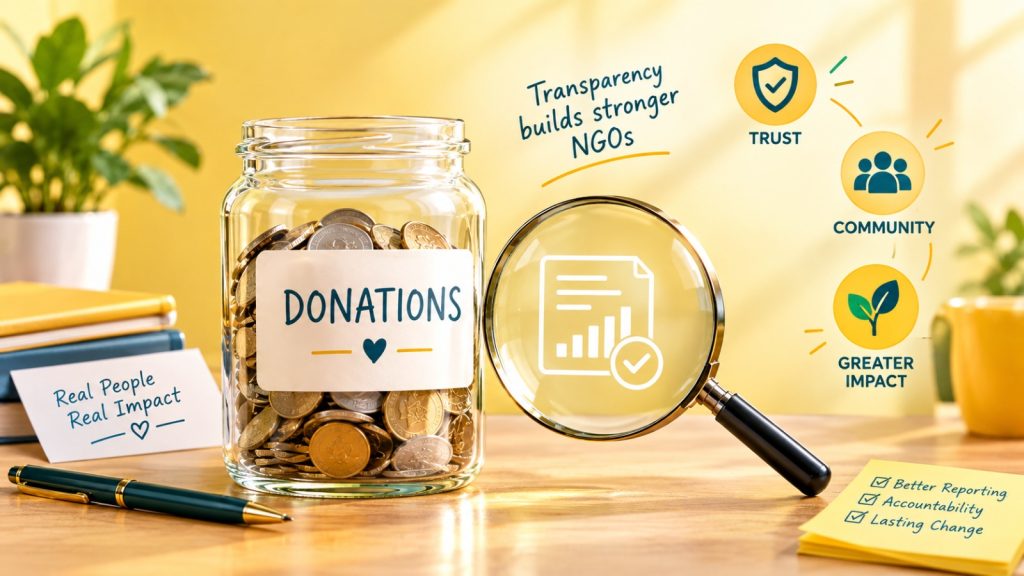
For an NGO, receiving a donation is the beginning of a responsibility, not the end of a fundraising campaign. Donors want to know that their contributions are being handled responsibly and connected to meaningful welfare activities. When an organisation communicates clearly about its fundraising, projects, beneficiaries, and outcomes, it gives supporters greater confidence in its work.
Donation transparency is therefore an important part of building long-term relationships with donors. It can help a charitable organisation explain where resources are going, what activities have been completed, what challenges remain, and what difference the organisation is working to create.
Transparency also benefits the organisation itself. Clear records and reporting can improve internal coordination, donor management, accountability, and decision-making.
For modern NGOs, the goal should be more than collecting donations. It should be creating a connected welfare process:
Donors → Contributions → Funds → Welfare Projects → Beneficiaries → Outcomes → Reporting → Continued Support
This broader approach connects donation transparency with effective Welfare Governance.
What Is Donation Transparency for NGOs?
Donation transparency means providing clear, accurate, and understandable information about how an NGO raises, manages, allocates, and reports on donated resources.
Transparency does not mean publishing every internal record or overwhelming donors with financial information. It means giving stakeholders relevant information that helps them understand the organisation’s work and resource management.
Depending on the organisation, transparent communication may cover:
- The purpose of a fundraising campaign
- The welfare project being supported
- How contributions are being used
- Progress of the project
- Beneficiaries being supported
- Activities completed
- Outcomes achieved
- Challenges or changes
- Future plans
- Appropriate financial or activity reports
The level and format of information should suit the organisation, its projects, and its stakeholders.
Why Does Donation Transparency Matter for NGOs?
Donation transparency matters because it helps donors understand how their contributions relate to the organisation’s welfare activities and gives the NGO a stronger foundation for accountability.
When donors receive clear information, they can better understand:
- What the organisation is trying to achieve
- Why funds are being raised
- How projects are progressing
- Who is being supported
- What outcomes are being observed
- What happens after a contribution is made
This clarity can strengthen donor confidence and help establish a more informed relationship between supporters and the organisation.
What Are the Benefits of Donation Transparency for NGOs?
Donation transparency benefits both donors and the NGO. It can strengthen donor confidence, improve internal accountability, support better fundraising relationships, and help the organisation demonstrate how its welfare activities are being managed.
1. Builds Donor Confidence
When donors can clearly understand how an organisation operates and how contributions support its work, they have a stronger basis for trusting the organisation.
Transparency can answer common donor questions such as:
- What is this donation supporting?
- Who will benefit?
- What activities have been completed?
- How is the project progressing?
- What happened after the fundraising campaign?
Clear answers can make the relationship between the donor and the organisation more meaningful.
2. Strengthens Donor Relationships
Donor relationships are easier to maintain when communication continues after a contribution has been received.
An NGO can share relevant updates about:
- Project progress
- Welfare activities
- Beneficiary support
- Milestones
- Challenges
- Outcomes
- Future plans
This helps donors see their contribution as part of an ongoing welfare journey rather than a one-time transaction.
3. Improves Accountability
Transparency encourages organisations to maintain accurate records and establish clear responsibilities.
When an NGO knows what it needs to report, it is more likely to track:
- Contributions received
- Fundraising activities
- Project expenses and resources
- Welfare activities
- Beneficiary support
- Project progress
- Outcomes
- Communication with stakeholders
This creates stronger internal accountability and makes it easier for leadership teams to review how programmes are being managed.
4. Supports Better Fundraising
Transparent fundraising can make campaigns easier for potential donors to understand.
Instead of simply asking people to contribute, an organisation can explain:
Problem → Purpose → Planned Activity → Required Resources → Beneficiaries → Expected Outcome
This gives supporters useful context before they decide whether to contribute.
Transparency should therefore be viewed as part of fundraising communication, rather than something that happens only after funds have been collected.
5. Helps Retain Donors
A donor who receives meaningful information after contributing has more opportunities to understand the organisation’s work.
For example, an NGO running an education-support programme can communicate:
- What the programme was designed to address
- What activities were conducted
- How beneficiaries participated
- What progress was observed
- What the organisation plans to do next
Such communication can help maintain an ongoing relationship with supporters and create opportunities for continued engagement.
6. Makes Reporting More Effective
Good reporting depends on good information.
If project activities, contributions, beneficiaries, and outcomes are recorded throughout the programme, preparing reports becomes easier and more consistent.
Instead of reconstructing information at the end of a project, the organisation can maintain a continuous record of what happened.
This can benefit:
- Donors
- Trustees
- NGO leadership
- Fundraising teams
- Programme managers
- Volunteers
- Other relevant stakeholders
7. Improves Internal Decision-Making
Donation transparency can also improve how an organisation makes decisions internally.
When leaders have a clearer view of fundraising performance, available resources, project progress, and beneficiary needs, they can make better-informed operational decisions.
For example, an organisation may identify that one welfare project has sufficient resources while another requires additional fundraising attention. Having organised information makes such situations easier to identify.
8. Reduces Confusion and Information Gaps
When donation and project information is scattered across spreadsheets, emails, paper records, and individual staff members, it can become difficult to establish a consistent picture.
A transparent and organised approach encourages charities to maintain information in a structured manner.
This can reduce:
- Duplicate records
- Missing information
- Conflicting figures
- Delayed reports
- Repeated data entry
- Confusion about responsibilities
9. Demonstrates Commitment to Responsible Welfare Management
Donation transparency shows that an organisation takes its responsibilities seriously.
For an NGO, responsible management extends beyond receiving funds. It includes understanding how resources move through the organisation and how they contribute to welfare activities.
The process can be viewed as:
Contribution → Resource Management → Welfare Project → Beneficiary Support → Outcome → Reporting
When this chain is properly documented and communicated, the organisation can provide a clearer picture of its work.
10. Creates a Stronger Foundation for Long-Term Growth
As an NGO grows, its fundraising activities, donor base, welfare projects, beneficiaries, volunteers, and reporting requirements may also become more complex.
Establishing transparent processes early can help the organisation manage this growth more effectively.
A charity that treats transparency as part of everyday management is better positioned to develop consistent processes for:
- Fundraising
- Donor management
- Contribution tracking
- Welfare project management
- Beneficiary management
- Reporting
- Accountability
- Impact communication
Transparency is therefore not simply a communication strategy. It can become part of the organisation’s broader management culture.
How Can an NGO Improve Donation Transparency?
An NGO can improve donation transparency by establishing clear processes for recording contributions, tracking welfare activities, communicating project progress, and reporting outcomes.
A practical starting point is to review the complete journey of a donation.
Step 1: Define What Donors Need to Know
Identify the questions donors commonly ask and make sure the organisation can answer them clearly.
Step 2: Organise Donation Records
Maintain accurate information about contributions, campaigns, donors, dates, and relevant project associations.
Step 3: Connect Donations With Welfare Projects
Where appropriate, connect fundraising activities with the projects and programmes they support.
Step 4: Track Activities as They Happen
Do not wait until the end of a project to collect information. Record important activities, milestones, and outcomes throughout the programme.
Step 5: Establish a Reporting Schedule
Decide when and how donors will receive relevant updates and reports.
Step 6: Communicate Changes Honestly
If a project is delayed, modified, or affected by an unexpected challenge, provide an appropriate explanation rather than leaving supporters without information.
Step 7: Review Information Internally
Before publishing or sharing reports, make sure the relevant information is accurate, consistent, and appropriate to disclose.
What Information Should NGOs Share With Donors?
NGOs should share information that helps donors understand the purpose, progress, and outcomes of the work they support, while protecting confidential or sensitive information.
Useful information may include:
- Purpose of the fundraising campaign
- Description of the welfare project
- General beneficiary information
- Activities completed
- Project progress
- Relevant outcomes
- Resource-use information where appropriate
- Challenges and changes
- Future plans
- Contact information for questions
The right level of disclosure depends on the organisation and the nature of the project.
Transparency should never mean exposing private information about beneficiaries or sharing sensitive personal data unnecessarily.
Can Donation Transparency Improve Donor Retention?
Yes. Consistent and meaningful communication can help maintain donor relationships because supporters are able to understand what happened after their contribution.
A useful donor journey can look like:
Donation → Acknowledgement → Project Update → Progress Report → Impact Communication → Continued Engagement
The objective is not to communicate constantly. It is to communicate when there is something useful for the donor to know.
A thoughtful project update may be more valuable than several generic fundraising messages.
What Are the Challenges of Maintaining Donation Transparency?
Maintaining transparency can become difficult when an organisation lacks organised records, clearly defined responsibilities, or consistent reporting processes.
Common challenges include:
- Information stored in multiple places
- Manual record-keeping
- Inconsistent data
- Limited staff capacity
- Lack of standard reporting processes
- Difficulty connecting donations with projects
- Delayed collection of programme information
- Unclear responsibility for donor communication
- Concerns about what information can appropriately be shared
These challenges are particularly relevant to smaller NGOs that depend heavily on volunteers or small administrative teams.
The solution does not necessarily require a complex system. Organisations can begin by standardising their basic processes and gradually introduce technology where it provides practical value.
How Can Technology Support Donation Transparency?
Technology can support donation transparency by bringing relevant information into a more organised system and making it easier to track, review, and report on activities.
Depending on an organisation’s needs, digital tools can help connect:
Donors → Contributions → Fundraising → Welfare Projects → Beneficiaries → Activities → Outcomes → Reports
This can make it easier for an NGO to maintain consistent records and prepare relevant information for stakeholders.
Useful capabilities may include:
- Donor management
- Contribution tracking
- Fundraising management
- Welfare project tracking
- Beneficiary management
- Communication records
- Reporting
- Impact tracking
However, technology should support transparent processes rather than substitute for them. A digital system is useful only when the organisation has clear responsibilities, accurate data, and a consistent approach to managing information.
A Practical Example of Donation Transparency
Imagine a community organisation raising funds for an education-support programme.
The organisation receives contributions from several supporters and uses those resources for learning materials, programme activities, and beneficiary support.
Without organised records, the team may have to search through different spreadsheets and documents to prepare an update.
With a structured process, the organisation can maintain a connected view:
Donors → Contributions → Education Project → Activities → Beneficiaries → Outcomes → Donor Report
The organisation can then provide supporters with an appropriate update explaining what the project accomplished, what challenges arose, and what the next phase involves.
This approach makes the donation journey easier to understand while also helping the NGO manage its own operations more effectively.
How Does Donation Transparency Fit Into Welfare Governance?
Donation transparency is one part of a broader Welfare Governance system.
Welfare Governance can be understood as the structured management of an organisation’s welfare activities, resources, people, projects, beneficiaries, accountability, reporting, and impact.
From this perspective, donation transparency is connected to every stage of the welfare process:
Donors → Contributions → Funds → Welfare Projects → Beneficiaries → Outcomes → Reporting → Continued Support
Fundraising brings resources into the organisation, but responsible welfare management determines how those resources are organised, applied, monitored, and communicated.
This is why transparency should not be treated as a separate reporting exercise. It can be built into the organisation’s everyday welfare management processes.
From Donation Transparency to Better Welfare Governance
When transparency is built into everyday charity management, organisations can create clearer connections between donations, welfare projects, beneficiaries, outcomes, and reporting. This is where a structured approach to Welfare Governance can help bring these activities together and make responsible management easier to maintain.
Frequently Asked Questions
Why is donation transparency important for NGOs?
Donation transparency helps donors understand how contributions are managed and connected to welfare activities. It can strengthen confidence, accountability, and long-term donor relationships.
How can an NGO improve donation transparency?
An NGO can improve transparency by maintaining accurate contribution records, connecting funds with relevant projects, tracking activities, communicating progress, and providing appropriate reports.
What information should an NGO share with donors?
NGOs can share information about fundraising purposes, welfare projects, activities, progress, relevant outcomes, resource use, challenges, and future plans while protecting confidential information.
Does donation transparency help retain donors?
Consistent and meaningful communication can help maintain donor relationships by showing supporters what happened after their contribution and how the organisation’s work is progressing.
Can technology improve donation transparency?
Yes. Technology can help organise donor records, contribution information, fundraising activities, projects, beneficiaries, communications, and reports, provided the organisation also has clear processes and responsibilities.
What are common challenges in maintaining donation transparency?
Common challenges include scattered records, manual data entry, inconsistent information, limited staff capacity, delayed reporting, and difficulty connecting donations with welfare projects.
How does donation transparency relate to Welfare Governance?
Donation transparency is part of the wider Welfare Governance process. It connects fundraising and contributions with resource management, welfare projects, beneficiaries, outcomes, reporting, and continued supporter engagement.Lorem ipsum dolor sit amet, consectetur adipiscing elit. Ut elit tellus, luctus nec ullamcorper mattis, pulvinar dapibus leo.
How NidhiMax Can Help
Every charitable organisation has different programmes, people, workflows, reporting needs, and beneficiary requirements. Technology should therefore support the organisation’s actual welfare processes rather than add unnecessary complexity.
NidhiMax — Welfare Governance Platform is designed to help charitable organisations, NGOs, trusts, community organisations, and welfare institutions move toward a more organised digital welfare-management ecosystem.
For organisations working to improve donation transparency, a structured approach can help connect relevant areas such as donor management, contribution tracking, fundraising management, welfare projects, beneficiary information, communication, reporting, transparency, accountability, and impact tracking.
The broader objective is to create a clearer connection between the resources an organisation receives and the welfare outcomes it works to achieve.
For NGOs looking to strengthen their approach to welfare management and accountability, a Welfare Governance system can provide a practical foundation for more organised operations and clearer reporting.
Explore NidhiMax at NidhiMax.com.