 Post by
A charity may begin with a simple spreadsheet for donors, another file for beneficiaries, and a few folders for project records. As the organisation grows, more information gets added: fundraising campaigns, contribution records, welfare activities, volunteers, beneficiaries, reports, and communications.
The challenge is not simply the amount of data. It is where that data lives and how easily the organisation can use it.
When important information is scattered across spreadsheets, notebooks, emails, messaging applications, and separate systems, charity teams can spend valuable time searching for records, checking duplicates, and preparing basic reports.
Centralised data management brings relevant organisational information into a structured environment, making it easier for charity teams to access, maintain, analyse, and use information for everyday decisions.
For NGOs, charitable trusts, foundations, and community organisations, this can become an important part of building better charity management and stronger Welfare Governance.
What Is Centralised Data Management for Charities?
Centralised data management means organising an organisation’s important information within a structured system rather than keeping critical records scattered across disconnected files and locations.
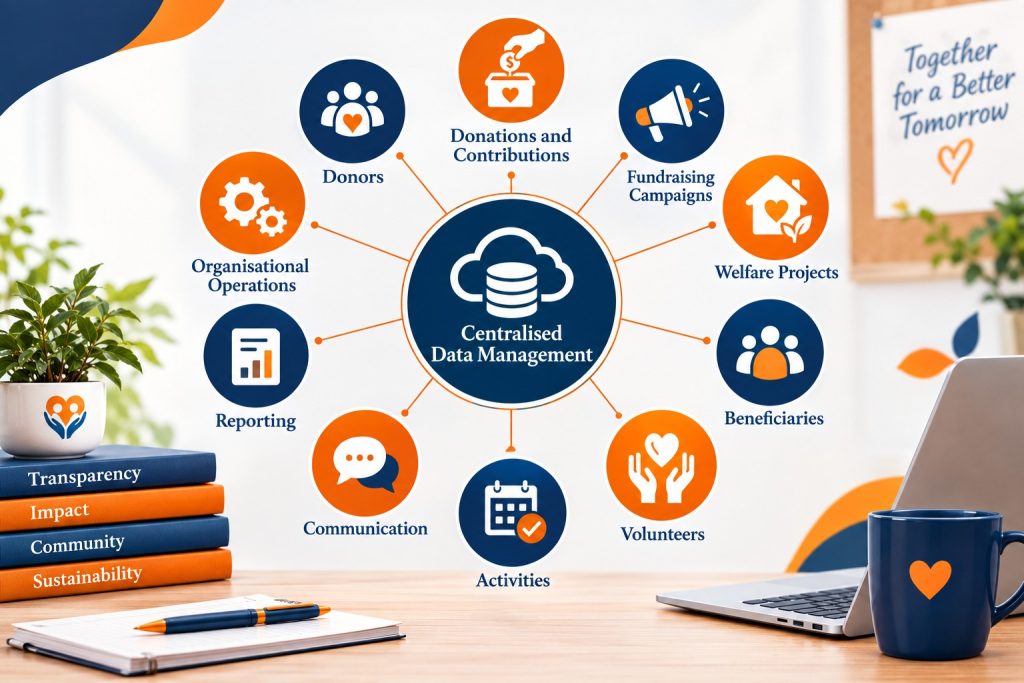
For a charitable organisation, this may involve information related to:
- Donors
- Donations and contributions
- Fundraising campaigns
- Welfare projects
- Beneficiaries
- Volunteers
- Activities
- Communication
- Reporting
- Organisational operations
The purpose is not necessarily to put every piece of information into a single screen.
Instead, centralisation means creating a more reliable structure in which authorised people can access the information they need and understand how different records relate to one another.
Why Do Charity Organisations Need Centralised Data Management?
Charity organisations need centralised data management because fragmented information can make donor management, fundraising, welfare programmes, reporting, and daily operations harder to coordinate.
Consider a growing NGO with separate spreadsheets for donor records, project activities, beneficiary information, and contributions.
A trustee asks:
“How much support has this project received, who contributed, and what has the organisation accomplished with those resources?”
Staff may need to open several files, compare records, check dates, and manually prepare an answer.
With a more centralised approach, relevant information can be organised so that the team has a clearer starting point for answering such questions.
This can save administrative effort while improving organisational visibility.
What Problems Can Disconnected Charity Data Create?
Fragmented data can create several practical problems.
1. Duplicate Records
The same donor or beneficiary may appear in multiple files under slightly different names.
This makes it harder to determine which record is current.
2. Outdated Information
A team may update one spreadsheet while another department continues using an older version.
3. Difficult Reporting
Preparing reports can become a manual exercise of collecting information from different sources.
4. Limited Organisational Visibility
Leadership may struggle to get a complete picture of fundraising, welfare projects, beneficiaries, and activities.
5. Communication Gaps
Important donor or beneficiary information may not be readily available to the team responsible for follow-up.
6. Dependency on Individuals
If important information exists mainly in one staff member’s files or personal knowledge, the organisation may become dependent on that person.
Centralised data management can help reduce these risks by creating clearer information ownership and access.
How Can Centralised Data Management Improve Charity Management?
Centralised data management can improve charity management by giving teams a more consistent source of information for coordinating activities, monitoring progress, and making operational decisions.
Here are some of the most important benefits.
Better Access to Information
Staff can spend less time searching through multiple files when information is organised in a common system.
Improved Coordination
Fundraising, programme, administrative, and leadership teams can work from more consistent information.
Easier Reporting
When relevant records are structured properly, preparing internal and external reports can become more manageable.
Better Donor Management
A centralised donor record can help teams understand contribution history and supporter relationships.
Improved Project Monitoring
Project teams can track activities, resources, beneficiaries, and progress in a more organised way.
Greater Operational Visibility
Leadership can get a broader view of what is happening across the organisation.
How Does Centralised Data Management Help Donor Management?
Lorem ipsum dolor sit amet, consectetur adipiscing elit. Ut elit tellus, luctus nec ullamcorper mattis, pulvinar dapibus leo.
Centralised donor data allows charities to organise information about supporter relationships, contribution history, fundraising activity, and relevant engagement in a more consistent way.
Instead of maintaining donor information across multiple campaign-specific spreadsheets, an organisation can work toward maintaining a structured donor record.
Depending on its processes, a charity may want to understand:
- Who has contributed?
- When did they contribute?
- Was the contribution associated with a particular project?
- Is the donor a recurring supporter?
- Has the donor supported multiple campaigns?
- What communication has taken place?
This information can help fundraising teams move from transaction-focused record keeping toward more organised donor relationship management.
How Can Centralised Data Improve Fundraising?
Centralised fundraising data can help charities compare campaigns, monitor contributions, understand supporter activity, and maintain a clearer view of fundraising operations.
For example, an NGO may conduct separate fundraising activities for:
- Education support
- Healthcare assistance
- Food distribution
- Emergency relief
- Community development
If campaign information is maintained separately, comparing performance and contribution patterns can be difficult.
A structured system can help the organisation review fundraising activity more consistently.
However, fundraising data should be interpreted carefully. The campaign that receives the largest immediate contribution is not necessarily the campaign that creates the strongest long-term supporter relationship.
How Can Centralised Data Management Support Beneficiary Management?
Centralised beneficiary information can help welfare organisations maintain more organised records of the people and communities they support and connect those records with relevant welfare programmes.
For example, an organisation working on education support may need to coordinate:
- Beneficiary records
- Programme enrolment
- Activities
- Support provided
- Follow-up
- Project status
- Relevant reporting
When this information is disconnected, staff may have difficulty understanding the complete history of a welfare activity.
A structured data environment can provide a clearer operational picture while also helping organisations apply appropriate safeguards to sensitive beneficiary information.
How Does Centralised Data Help Welfare Project Management?
Centralised project data helps charity teams bring information about welfare programmes, activities, resources, beneficiaries, and reporting into a more organised structure.
For example, a community organisation running a food-distribution initiative may need to coordinate:
- Fundraising
- Contributions
- Resource planning
- Distribution activities
- Beneficiary information
- Volunteer coordination
- Project updates
- Reporting
When these records are connected appropriately, management can better understand how a welfare project is progressing.
This is especially useful when an organisation manages several programmes simultaneously.
Can Centralised Data Improve Transparency and Accountability?
Centralised data management can support transparency and accountability by making organisational records more consistent, traceable, and easier to review.
Accountability depends on more than storing information.
An organisation should be able to understand, where appropriate:
- What resources were received
- What activities were planned
- What activities took place
- Which welfare projects used those resources
- Who was responsible for relevant activities
- What outcomes were recorded
- What information was reported
A centralised system can make this information easier to organise and review.
At the same time, charities should carefully control access to sensitive donor and beneficiary information. Transparency does not mean making confidential information publicly available.
How Does Centralised Data Help Charity Leaders Make Decisions?
Centralised information gives charity leaders a more complete basis for reviewing organisational performance and identifying areas that require attention.
Imagine a trustee wants to understand why a welfare project is progressing more slowly than expected.
Instead of reviewing separate records from different teams, leadership may be able to examine:
- Project activities
- Available resources
- Fundraising progress
- Beneficiary information
- Pending tasks
- Reporting updates
This does not automatically explain why a problem exists, but it gives leadership a stronger starting point for asking the right questions.
Good data supports judgement; it does not replace it.
What Should a Charity Centralise?
A charity should centralise the information that is important to its core operations and decision-making, while avoiding unnecessary data collection.
Depending on the organisation, this could include:
Donor Data
- Donor profiles
- Contribution history
- Recurring support
- Campaign participation
Fundraising Data
- Campaigns
- Contribution records
- Project-wise fundraising
- Fundraising progress
Beneficiary Data
- Beneficiary records
- Programme association
- Support history
- Follow-up information
Welfare Project Data
- Project details
- Activities
- Resources
- Progress
- Reporting
Organisational Data
- Team responsibilities
- Volunteer activities
- Operational tasks
- Communication records
Not every charity needs all of these categories. The system should reflect actual organisational requirements.
What Are the Benefits of Centralised Data Management for Small NGOs?
Small NGOs can benefit from centralised data management because even a relatively small organisation can experience information gaps as its donors, projects, beneficiaries, and activities increase.
A small organisation might initially manage everything through a few spreadsheets.
That may work for a while.
But problems often appear when:
- Multiple people begin editing records.
- The number of donors increases.
- More welfare programmes are introduced.
- Beneficiary records become more detailed.
- Reports need to be prepared regularly.
- Staff or volunteers change.
- Leadership needs information quickly.
Starting with a simple, organised system can make future growth easier to manage.
How Can an NGO Move From Spreadsheets to Centralised Data?
An NGO can move toward centralised data management gradually by identifying critical information, cleaning existing records, establishing consistent processes, and introducing technology according to its actual needs.
A practical process is:
Step 1: Map Existing Information
List where important data currently exists.
For example:
- Excel files
- Google Sheets
- Paper records
- Messaging applications
- Accounting records
- Individual staff files
Step 2: Identify Critical Records
Determine which information is essential for daily operations and reporting.
Step 3: Remove Duplicates
Review duplicate donor, beneficiary, project, and other records.
Step 4: Standardise Information
Use consistent formats for names, dates, project categories, contribution records, and other important fields.
Step 5: Define Responsibilities
Decide who can create, update, review, and approve different types of information.
Step 6: Choose Appropriate Technology
Select a system that matches the organisation’s size, processes, budget, technical capabilities, and future requirements.
Step 7: Train the Team
A centralised system will only work if staff and volunteers understand how to use it consistently.
What Should Charities Consider Before Choosing a Data Management System?
Charities should evaluate a data management system based on usability, security, scalability, reporting needs, workflow fit, and the organisation’s actual operational requirements.
Before choosing a solution, ask:
Is It Easy to Use?
If staff require extensive technical knowledge for everyday tasks, adoption may become difficult.
Does It Match Our Workflow?
The system should support the organisation’s actual processes rather than forcing unnecessary complexity.
Can Different Types of Information Be Connected?
Consider whether donor, fundraising, project, beneficiary, and reporting information can be organised appropriately.
Can Access Be Controlled?
Different team members may require different levels of access.
Can Information Be Retrieved Easily?
A centralised system should make finding relevant records easier, not harder.
Can the System Grow With the Organisation?
An organisation’s needs may change as programmes, donors, and teams grow.
Can Useful Reports Be Produced?
Reporting should be considered from the beginning rather than treated as an afterthought.
What Are the Common Challenges of Centralised Data Management?
Centralisation offers benefits, but it also requires planning.
Data Migration
Existing information may be spread across many files and formats.
Staff Adoption
People may initially prefer familiar spreadsheets or manual processes.
Data Quality
Moving inaccurate information into a new system does not solve the underlying problem.
Access Management
Organisations need appropriate controls for sensitive information.
Process Changes
Teams may need to change how they collect and update information.
Initial Effort
Cleaning and organising existing records can require time and coordination.
The objective should be to build a sustainable system rather than simply transfer every old record into new software.
How Can Charities Protect Centralised Data?
Charities should treat centralised data management as both an operational and a responsibility issue, particularly when records contain personal or sensitive information.
Good practices can include:
- Limit access according to responsibilities.
- Use appropriate authentication and account controls.
- Keep important information accurate and updated.
- Avoid collecting information that is not genuinely needed.
- Establish procedures for correcting records.
- Review who has access as staff and volunteer roles change.
- Maintain appropriate backups and recovery processes.
- Train staff on responsible data handling.
Specific privacy, security, and regulatory requirements can vary depending on the organisation and the information involved, so charities should obtain appropriate professional advice where necessary.
A Realistic Example: A Community Welfare Organisation
Imagine a community organisation running three programmes:
- Education support
- Healthcare assistance
- Food distribution
The organisation has donors supporting different programmes, volunteers helping with activities, and beneficiaries receiving different forms of assistance.
Initially, each programme keeps its own spreadsheet.
The fundraising team maintains another file.
The leadership team requests monthly updates from everyone.
As the organisation grows, simple questions become difficult to answer.
For example:
Which donors supported the education programme, what activities were completed, how many beneficiaries were served, and what information is available for the next report?
A centralised approach can help organise these relationships more clearly.
The broader flow becomes:
Donors → Contributions → Funds → Welfare Projects → Beneficiaries → Outcomes → Reporting → Continued Support
The value is not simply having more records.
The value comes from connecting relevant information so that the organisation can better understand how its resources and activities contribute to welfare outcomes.
Why Centralised Data Is More Than a Technology Decision
It is tempting to think of centralised data management as a software project.
In reality, it is also an organisational management decision.
Before choosing technology, charities should consider:
- How information moves through the organisation
- Who creates and updates records
- Which decisions depend on that information
- Which teams need access
- Where delays occur
- What information leadership needs
- How reporting is currently handled
Technology should follow these requirements.
A charity that digitises a poorly organised process may simply create a digital version of the same problem.
How Does Centralised Data Support Welfare Governance?
Centralised data management can become a foundation for Welfare Governance because it helps organisations organise information across donors, resources, projects, beneficiaries, activities, reporting, and outcomes.
Welfare Governance can be understood as the structured management of a welfare organisation’s activities, resources, people, projects, beneficiaries, accountability, reporting, and impact.
This is broader than fundraising.
A charity’s work can be viewed as a connected ecosystem:
Donors → Contributions → Funds → Welfare Projects → Beneficiaries → Outcomes → Reporting → Continued Support
Centralised data can help maintain continuity across this chain.
For example, donor information can sit alongside fundraising activity, while project information can be connected with beneficiaries and reporting.
This gives organisations a stronger foundation for understanding the complete welfare process rather than managing each activity as an isolated task.
What Does the Future of Charity Data Management Look Like?
The future of charity data management is likely to involve more connected digital processes, clearer reporting, and greater emphasis on using organisational information for decision-making.
But technology should remain a means rather than an objective.
A successful digital environment should help charity teams answer practical questions:
- What are we doing?
- Who are we supporting?
- What resources are available?
- Where are they being used?
- What progress has been made?
- What requires attention?
- What can we report to stakeholders?
For charities, the strongest digital approach is one that makes these questions easier to answer without creating unnecessary administrative complexity.
FAQ
What is centralised data management in a charity?
Centralised data management is the practice of organising important charity information in a structured system rather than keeping critical records scattered across disconnected files and locations.
Why should NGOs centralise their data?
NGOs can centralise data to improve information access, reduce duplication, support coordination, simplify reporting, and gain a clearer view of donors, beneficiaries, fundraising, and welfare projects.
What data should a charity centralise?
A charity may centralise donor records, contribution information, fundraising activities, beneficiary records, welfare projects, activities, volunteer information, and reporting data according to its operational needs.
Can small NGOs benefit from centralised data?
Yes. Small NGOs can benefit by establishing organised data practices early, particularly as their donor base, welfare programmes, beneficiaries, and operational activities grow.
How does centralised data improve donor management?
It can give fundraising teams a more consistent view of donor profiles, contribution history, campaign participation, and relevant engagement information.
Can centralised data improve charity transparency?
It can support transparency and accountability by making relevant records easier to organise, review, and report. Sensitive donor and beneficiary information should still be protected appropriately.
Is centralised data management the same as a CRM?
Not necessarily. A CRM generally focuses on relationship management, while centralised data management can encompass a wider range of organisational information, including projects, beneficiaries, operations, and reporting.
How does centralised data support Welfare Governance?
It can help connect information across donors, contributions, funds, welfare projects, beneficiaries, outcomes, and reporting, supporting a more structured approach to welfare management.
NidhiMax Conclusion
Centralised data management is ultimately about giving a charity a clearer understanding of its own work.
When donor information, contributions, fundraising, welfare projects, beneficiaries, activities, and reporting are organised appropriately, teams can spend less time searching for information and more time using it to manage their programmes.
This is also where Welfare Governance becomes important. Charity management is larger than donation collection. It involves managing the complete relationship between resources, welfare activities, beneficiaries, outcomes, accountability, and continued support.
NidhiMax — Welfare Governance Platform is positioned around this broader approach to digital welfare management. For charitable organisations, NGOs, trusts, community organisations, and welfare institutions, the aim is to move toward a more organised digital ecosystem that reflects the organisation’s actual welfare processes.
Every organisation has different requirements. The right technology should therefore support its workflows, people, reporting needs, and welfare activities without introducing unnecessary complexity.
Organisations interested in exploring a more structured approach to digital welfare governance can learn more through NidhiMax.com.