 Post by
Managing a charitable organisation involves far more than collecting donations. Teams may need to coordinate donors, fundraising activities, welfare projects, beneficiaries, volunteers, finances, communication, and reporting at the same time.
When this information is spread across spreadsheets, notebooks, emails, messaging applications, and separate records, it can become difficult for leaders to see what is happening across the organisation.
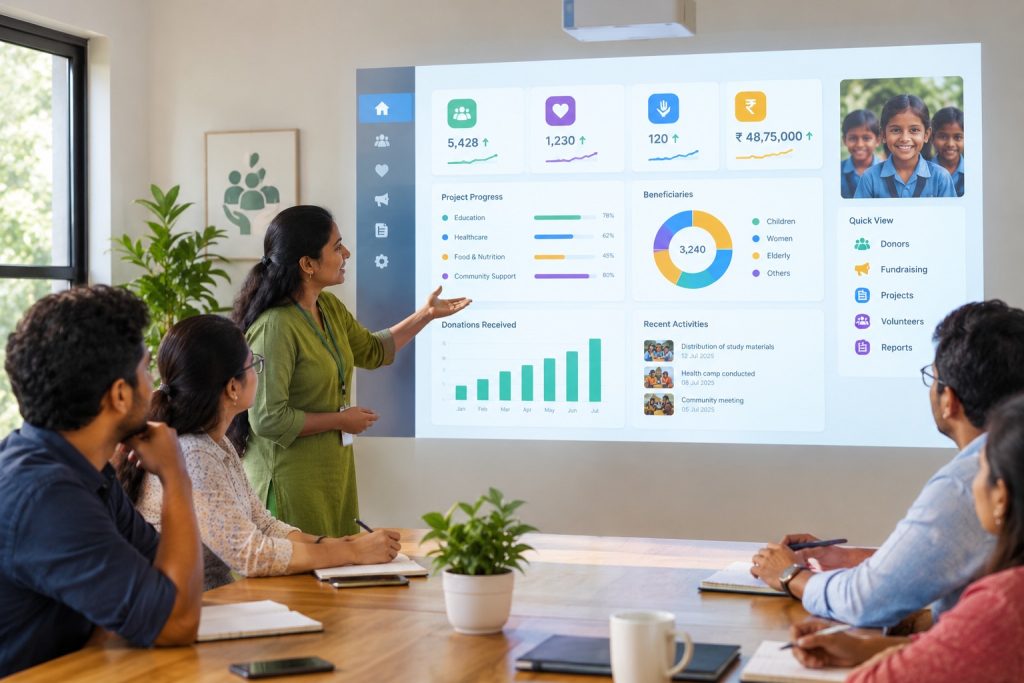
A digital dashboard can bring important information into one structured view, helping charity administrators monitor activities, identify gaps, follow progress, and make more informed decisions.
For NGOs, charitable trusts, foundations, and community organisations, the value of a dashboard is not simply that it looks modern. Its real value comes from helping people understand the organisation’s work and act on reliable information.
What Is a Digital Dashboard for Charity Management?
A digital dashboard is a central screen that presents important organisational information in an easy-to-understand format, allowing charity teams to monitor activities and make decisions more efficiently.
Instead of opening multiple files to understand the current situation, a dashboard can bring selected information together.
Depending on the organisation’s needs, this may include:
- Donation activity
- Fundraising progress
- Donor information
- Welfare projects
- Beneficiary records
- Project activities
- Fund allocation
- Communication activity
- Reporting information
- Operational tasks
The dashboard should show information that helps people answer practical questions.
For example:
How much support has been received for a particular welfare project, how many beneficiaries are being served, and what activities are still pending?
That is more useful than displaying dozens of numbers without context.
Why Do Charities Need Better Visibility Into Their Operations?
Charities need operational visibility because their work often involves multiple activities, people, resources, and stakeholders that must remain coordinated.
Consider a community organisation running several welfare programmes.
The fundraising team may know how much money was collected. The programme team may know how many beneficiaries were reached. A volunteer coordinator may have information about activities completed. Meanwhile, trustees may need a broader view of organisational progress.
If these records are maintained separately, leadership may spend considerable time collecting information before making a decision.
A dashboard can provide a shared operational view, provided the underlying information is accurate and consistently maintained.
How Can a Digital Dashboard Improve Charity Management?
A digital dashboard can improve charity management by giving teams a clearer view of important activities, reducing information gaps, supporting faster reviews, and making organisational data easier to interpret.
Here are some of the most useful ways a dashboard can support a charitable organisation.
1. Centralising Important Information
One of the biggest challenges for growing NGOs is information fragmentation.
A dashboard can bring relevant information from different operational areas into a more organised view.
For example, a charity leader might want to review:
- Current fundraising activities
- Recent donations
- Active welfare projects
- Beneficiary numbers
- Pending activities
- Recent reports
Instead of reviewing each area independently, a dashboard can provide a starting point for the review.
The purpose is not necessarily to put every piece of information on one screen. It is to make the right information easier to find.
2. Monitoring Fundraising Activities
A dashboard can help fundraising teams monitor campaign activity, contribution patterns, and progress against internal fundraising objectives.
For example, a charity could use a dashboard to review:
- Active campaigns
- Contributions received
- Number of participating donors
- Recurring versus one-time contributions
- Project-wise fundraising activity
- Campaign progress over time
This can help fundraising managers identify which activities require attention.
However, a dashboard should support fundraising decisions rather than encourage organisations to focus only on the amount of money collected.
A campaign that builds long-term supporter relationships may be valuable even when its immediate financial result is modest.
How Can a Dashboard Help With Donor Management?
A digital dashboard can give charity teams a clearer view of donor activity, helping them understand supporter relationships and organise follow-up more effectively.
A donor-management view might help staff review:
- New donors
- Recurring donors
- Previous contributors
- Donors associated with particular projects
- Recent contribution activity
- Donor engagement information
This can be particularly useful when an organisation has a growing supporter base.
For example, a fundraising manager may notice that several donors who previously supported an education programme have not interacted with the organisation recently. That observation can prompt a more thoughtful review of the relationship.
The dashboard does not replace personal communication. It simply makes relevant information easier to identify.
How Can a Digital Dashboard Improve Beneficiary Management?
A dashboard can help welfare organisations monitor beneficiary-related information and connect beneficiary activity with the projects designed to support them.
For an organisation working in education, healthcare, food distribution, or community development, leadership may need to understand:
- Which welfare projects are active
- Which beneficiaries are associated with each programme
- What activities have been completed
- What support is pending
- What follow-up may be required
A dashboard can provide a consolidated view of these areas where the organisation’s systems and data structures support it.
This is particularly useful when welfare programmes operate across different locations or involve multiple teams.
How Can Dashboards Help Charities Track Welfare Projects?
Digital dashboards can help project teams monitor the status, activities, resources, and progress of welfare initiatives from a central view.
For each project, an organisation might want to track:
Area | Example information |
Project | Education support programme |
Activities | Distribution, classes, outreach |
Beneficiaries | People receiving support |
Resources | Funds or materials allocated |
Status | Planned, active, completed |
Reporting | Updates and documentation |
Outcomes | Results being monitored |
The exact information will differ from one organisation to another.
A small community initiative may need a simple project overview, while a larger organisation may require more detailed project monitoring.
Can a Digital Dashboard Improve Transparency and Accountability?
A well-designed dashboard can support transparency and accountability by making relevant organisational information easier to review, document, and report.
Transparency is not simply about publishing large amounts of information.
It is about making important information understandable and appropriately available to the people who need it.
Internally, dashboards can help teams identify:
- What has been received
- What activities are underway
- What has been completed
- What requires attention
- Which projects need follow-up
- What information is available for reporting
For external communication, organisations should decide carefully what information is appropriate to share and ensure that confidential or sensitive information is protected.
What Should a Charity Put on Its Digital Dashboard?
A charity should place information on its dashboard based on the decisions its team needs to make, rather than trying to display every available metric.
A practical charity dashboard could include several sections.
Fundraising
- Current campaigns
- Contribution activity
- Campaign progress
- Donor participation
Donors
- New supporters
- Recurring supporters
- Recent activity
- Project interests where relevant
Welfare Projects
- Active programmes
- Project status
- Activities
- Resources
Beneficiaries
- Programme-wise beneficiary information
- Pending support
- Follow-up requirements
Reporting
- Recent reports
- Pending updates
- Project documentation
Operations
- Pending tasks
- Upcoming activities
- Team responsibilities
The dashboard should remain focused. If users cannot quickly understand what they are seeing, adding more information may make the system less useful.
How Can a Small NGO Start Using a Digital Dashboard?
A small NGO can begin with a simple dashboard focused on a few essential operational questions instead of attempting to digitise everything at once.
A practical approach is:
Step 1: Identify Decision-Making Needs
Ask leadership and staff:
- What information do we check most often?
- What information takes the most time to collect?
- Where do delays occur?
- Which activities are difficult to monitor?
Step 2: Choose Key Indicators
Select a manageable number of indicators.
For example:
- Active welfare projects
- Current fundraising activities
- Recent contributions
- Beneficiary activity
- Pending tasks
- Reporting status
Step 3: Organise the Source Data
A dashboard is only as reliable as the information behind it.
Before building one, organisations should address duplicate records, inconsistent naming, missing information, and outdated records.
Step 4: Give Appropriate Access
Not every team member needs access to every piece of information.
Access should be organised according to responsibilities and organisational requirements.
Step 5: Review the Dashboard Regularly
A dashboard becomes useful when people actually use it.
Management meetings can include a short review of important changes, pending activities, and areas requiring attention.
What Makes a Digital Dashboard Useful for a Charity?
A useful charity dashboard is simple, relevant, accurate, easy to interpret, and connected to the organisation’s real workflows.
Several principles matter.
Keep It Simple
A dashboard should reduce complexity rather than introduce it.
Focus on Decisions
Every important metric should answer a question or support an action.
Use Clear Labels
Non-technical users should be able to understand what each number or chart represents.
Keep Information Current
Outdated information can create a false sense of progress.
Maintain Data Quality
Duplicate or incorrect records can affect reports and decisions.
Protect Sensitive Information
Donor and beneficiary information should be handled responsibly, with appropriate access controls and organisational safeguards.
Make It Accessible
If staff struggle to use the system, even a technically sophisticated dashboard may provide limited value.
What Are the Common Challenges of Using Charity Dashboards?
Digital dashboards can improve visibility, but they are not automatically effective.
Poor Data Quality
If source records contain errors, the dashboard may present misleading information.
Too Many Metrics
Showing everything can make it difficult to identify what actually matters.
Lack of Staff Adoption
A dashboard is useful only when teams consistently update and use the underlying system.
Disconnected Systems
If fundraising, donor, beneficiary, and project information remain completely separate, the dashboard may provide only a partial view.
Over-Reliance on Numbers
Numbers show patterns, but they do not always explain why something happened.
For example, a reduction in donations could have many possible reasons. Staff may need to investigate the situation rather than drawing conclusions from a single metric.
A Practical Example: Community Welfare Organisation
Imagine a community organisation running an education-support programme for children.
The organisation receives donations, manages volunteers, coordinates educational activities, supports beneficiaries, and prepares internal reports.
Without a central dashboard, different teams may maintain separate records.
The fundraising team tracks contributions.
The programme team tracks beneficiaries.
Volunteers maintain activity information.
Leadership requests updates from each team.
A digital dashboard could bring selected information into a common operational view:
Donors → Contributions → Funds → Education Project → Beneficiaries → Activities → Outcomes → Reporting
A programme manager could see which activities are active.
A fundraising manager could review project-related contribution activity.
Leadership could identify pending tasks and reporting requirements.
The dashboard does not perform the welfare work itself. Its role is to make the organisation’s information easier to understand and coordinate.
How Does a Digital Dashboard Support Better Decision-Making?
A dashboard supports decision-making by turning operational information into a format that leaders and teams can review quickly and consistently.
For example, instead of asking:
“How is the project progressing?”
A management team can review several indicators and ask more specific questions:
- Are planned activities being completed?
- Are beneficiaries receiving the intended support?
- Are resources available?
- Are there pending actions?
- Is additional communication required?
- Does the project need management attention?
This changes management conversations from general updates to more structured reviews.
How Does a Dashboard Fit Into Welfare Governance?
A digital dashboard becomes even more valuable when it is part of a broader Welfare Governance approach.
Welfare Governance can be understood as the structured management of an organisation’s welfare activities, resources, people, projects, beneficiaries, accountability, reporting, and impact.
From this perspective, a dashboard is not the entire system. It is a visibility layer that can help people understand what is happening across the organisation.
The broader welfare ecosystem can be represented as:
Donors → Contributions → Funds → Welfare Projects → Beneficiaries → Outcomes → Reporting → Continued Support
Fundraising is one part of this chain.
Donor management is another.
Beneficiary management, project management, reporting, and impact tracking are equally important parts of the welfare process.
When these areas are better organised, charity leaders can make decisions with a more complete understanding of their organisation’s activities.
How Can Technology Help Charities Move Beyond Spreadsheets?
Technology can help charities move beyond disconnected spreadsheets by creating more structured ways to manage information, workflows, records, and reporting.
Spreadsheets can remain useful for many organisations, especially for simple tasks.
The challenge appears when an organisation starts maintaining multiple versions of important information across different files.
At that stage, a more structured digital environment may help with:
- Centralised records
- Information access
- Workflow coordination
- Donor management
- Fundraising monitoring
- Project tracking
- Beneficiary information
- Reporting
- Operational visibility
The right choice depends on the size, complexity, resources, and actual processes of the organisation.
Technology should simplify management, not create another layer of administrative work.
Building a Data-Informed Charity Management Culture
A dashboard alone will not improve an organisation’s management.
The organisation also needs habits that support good information practices.
Review Information Regularly
Do not wait until the end of a project to examine what happened.
Assign Responsibility
Someone should be responsible for keeping relevant records updated.
Connect Information to Action
If a dashboard identifies a problem, teams should know who is responsible for responding.
Question Unexpected Changes
A sudden change in a metric should lead to investigation rather than immediate assumptions.
Balance Data With Experience
Staff, volunteers, beneficiaries, and community partners can provide context that numbers cannot.
Improve Gradually
A useful dashboard can evolve as the organisation learns what information is genuinely valuable.
How NidhiMax Can Help
For a charitable organisation, a dashboard is most useful when it reflects the way the organisation actually manages its welfare activities.
That means looking beyond individual numbers and considering how donors, contributions, funds, welfare projects, beneficiaries, activities, outcomes, and reporting relate to one another.
NidhiMax — Welfare Governance Platform is positioned around this broader approach to organised digital welfare management.
Rather than viewing fundraising or donor management as isolated activities, a welfare governance approach considers how different operational areas fit together within the organisation’s overall welfare ecosystem.
For NGOs, charitable trusts, community organisations, and welfare institutions, this can provide a more structured way to think about areas such as fundraising management, donor management, contribution tracking, beneficiary management, welfare projects, reporting, transparency, accountability, and operational coordination, according to the organisation’s needs.
Every welfare organisation has different processes. The technology it adopts should therefore support those processes rather than forcing teams into unnecessary complexity.
Organisations interested in exploring a more organised approach to digital welfare management can learn more through NidhiMax.com.
Frequently Asked Questions
What is a digital dashboard in charity management?
A digital dashboard is a central interface that presents important charity information, such as fundraising, donor activity, welfare projects, beneficiaries, and operational progress, in an easy-to-review format.
How can a dashboard help an NGO?
A dashboard can help an NGO monitor important activities, reduce information gaps, review project progress, organise operational information, and support more informed management decisions.
What should a charity dashboard include?
A charity dashboard may include fundraising activity, donor information, welfare projects, beneficiary information, project status, reporting updates, and operational tasks, depending on the organisation’s needs.
Can small charities use digital dashboards?
Yes. Small charities can begin with a simple dashboard containing a few important indicators and expand it as their operations become more complex.
Can dashboards improve charity transparency?
A well-organised dashboard can support internal accountability and make relevant information easier to review and report. Organisations should still protect confidential donor and beneficiary information.
How does a dashboard improve donor management?
It can provide a clearer view of donor activity, contribution history, recurring support, and relevant engagement information, helping teams organise donor relationships more effectively.
What is Welfare Governance?
Welfare Governance is the structured management of a welfare organisation’s activities, resources, people, projects, beneficiaries, accountability, reporting, and impact.
Is a dashboard enough to digitally transform a charity?
No. A dashboard is one part of a digital management system. Its effectiveness depends on the quality of the underlying data, organisational processes, staff adoption, and the broader technology environment.
NidhiMax Conclusion
A digital dashboard should do more than display numbers. It should help charity teams see what is happening, understand what needs attention, and make better-informed decisions.
When dashboard visibility is connected with donor management, fundraising, welfare projects, beneficiaries, reporting, and operational coordination, it becomes part of a larger welfare-management system.
That is where Welfare Governance provides a useful framework: connecting the movement from Donors → Contributions → Funds → Welfare Projects → Beneficiaries → Outcomes → Reporting → Continued Support.
NidhiMax — Welfare Governance Platform is designed around this broader digital approach to welfare management. Charitable organisations can explore how a more organised digital ecosystem may fit their own operational requirements through NidhiMax.com.