
 Post by
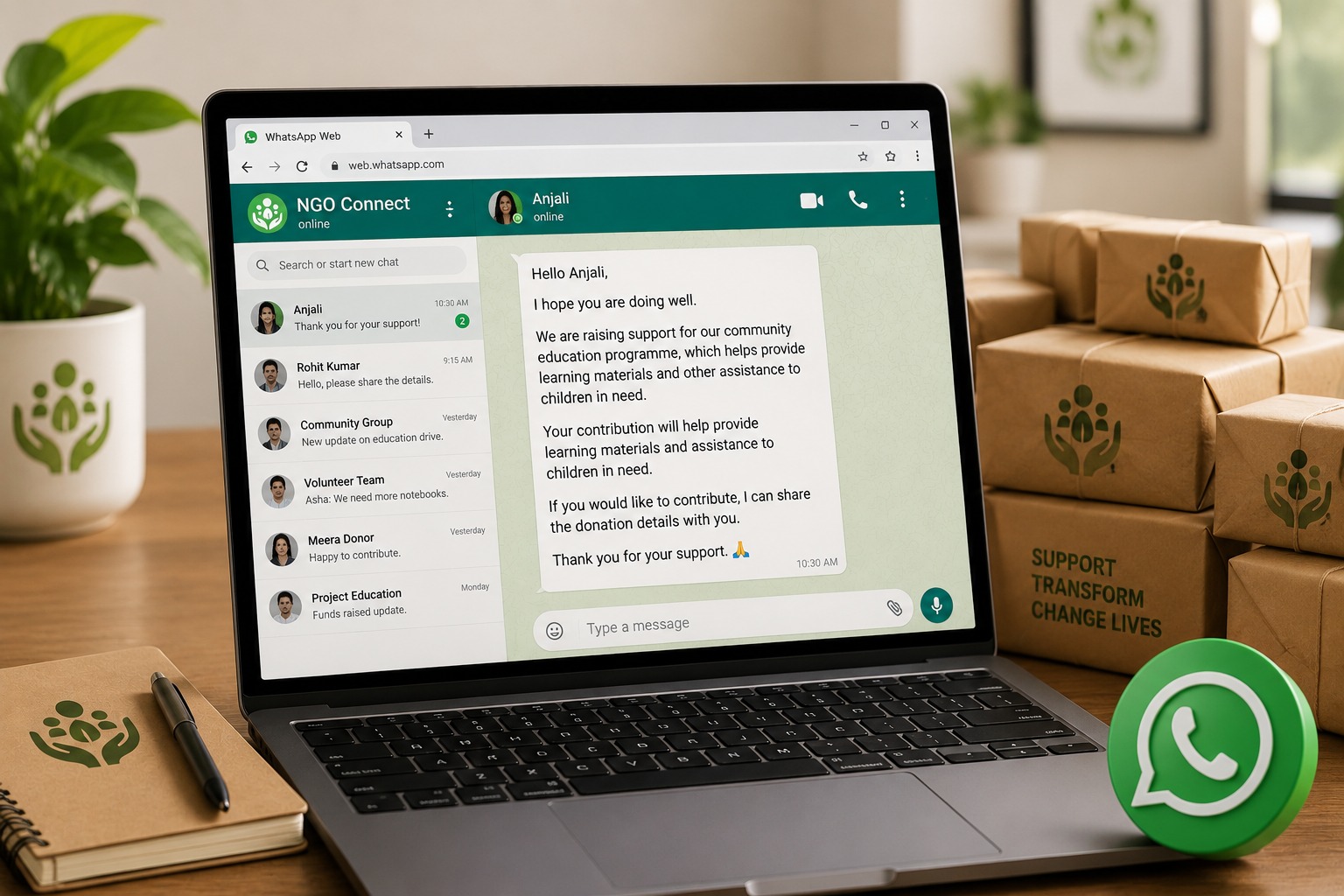
WhatsApp can be a useful communication channel for NGOs, charitable trusts, community organisations, and welfare institutions that want to share a fundraising appeal directly with supporters. But creating a donation campaign on WhatsApp involves more than writing a message and forwarding it to a long list of contacts.
A successful campaign needs a clear purpose, a specific fundraising need, the right audience, simple communication, an organised way to receive and record contributions, and appropriate follow-up. Without this structure, even a well-intentioned campaign can become difficult to manage.
For a charity, the real challenge is often what happens after the message is sent. Who responded? Who contributed? Which campaign did the contribution support? How will the funds connect with a welfare project? What updates can be shared with supporters?
This guide explains how to create a donation campaign using WhatsApp, from planning the campaign and writing the message to managing donors, contributions, communication, and the wider welfare journey.
How Do You Create a Donation Campaign on WhatsApp?
You can create a donation campaign on WhatsApp by defining a clear fundraising purpose, preparing a simple campaign message, sharing it with an appropriate audience, providing a clear contribution process, recording responses and donations, and following up with supporters.
A practical WhatsApp donation campaign can follow this process:
Define the need → Set the campaign purpose → Prepare the message → Identify supporters → Share the campaign → Receive contributions → Record donor information → Connect funds to welfare activities → Share updates → Build continued support
WhatsApp is the communication channel. The campaign itself should have a clear structure behind it.
What Should You Plan Before Starting a WhatsApp Donation Campaign?
Before sending a fundraising message, an NGO should clearly understand what it is raising funds for, who the campaign is intended to reach, and how contributions and campaign information will be managed.
Start by answering a few basic questions:
- What welfare need are we addressing?
- What is the purpose of this campaign?
- What activities are planned?
- Who is expected to benefit?
- What information can we share with supporters?
- How can people contribute?
- Who will respond to donor questions?
- How will contributions be recorded?
- How will we communicate updates?
A campaign becomes easier to manage when these questions are answered before communication begins.
For example, “We need donations” is not a complete campaign plan.
A clearer purpose might be:
Our organisation is raising support for a community education programme that will provide learning materials and related assistance to identified children.
This gives the fundraising team a clear starting point for communication.
Step 1: Define the Fundraising Need
The first step is to identify the specific welfare need that the campaign will support.
A donation campaign may be created for:
- Education support
- Healthcare assistance
- Food distribution
- Emergency relief
- Community development
- Support for elderly people
- Assistance for vulnerable families
- A specific charitable project
The purpose should be genuine and clearly connected to the organisation’s welfare activities.
Why Is a Clear Fundraising Purpose Important?
A clear purpose helps supporters understand why they are being asked to contribute. It also helps the organisation manage contributions, project activities, communication, and reporting more effectively.
Consider these two approaches:
Unclear:
Please support our organisation with a donation.
Clearer:
We are currently seeking support for an upcoming community food-distribution initiative to help provide essential supplies to families who need assistance.
The second message gives the recipient a reason for the campaign.
Step 2: Create a Clear Campaign Goal
A campaign goal should explain what the organisation is trying to achieve through the fundraising effort.
The goal does not need to be complicated. It should connect the fundraising request with a planned welfare activity.
For example:
To raise support for educational materials needed for an upcoming community education-support programme.
Or:
To collect contributions that will support planned emergency assistance activities for affected families.
When setting a campaign goal, avoid making claims or promises that cannot be reasonably supported.
The campaign should be based on information the organisation can genuinely explain and manage.
Step 3: Identify the Right Supporters
A WhatsApp donation campaign does not have to be sent to every contact available to the organisation.
The campaign may be more relevant to:
- Existing donors
- Previous supporters
- Volunteers
- Trustees
- Community members
- People who have expressed interest in the organisation’s work
- Supporters interested in a particular welfare area
For example, someone who has previously shown interest in education-related activities may find an education-support campaign more relevant than an unrelated fundraising message.
This is one reason organised donor and supporter information becomes important. When communication is based entirely on scattered personal chats, it becomes harder to understand who has previously supported which initiatives.
Step 4: Write the WhatsApp Donation Campaign Message
A WhatsApp campaign message should clearly explain the purpose of the appeal without becoming unnecessarily long.
A useful structure is:
Greeting → Organisation or initiative → Welfare need → Campaign purpose → Donation request → Contribution details or next step → Appreciation
For example:
Hello, we hope you are doing well. Our organisation is currently preparing an education-support initiative for children who need assistance with learning materials. We are reaching out to our supporters to ask if they would consider contributing to this campaign. Your support will help us carry out the planned welfare activities. If you would like to contribute or know more about the initiative, please reply to this message. Thank you for your time and support.
The message should answer the most important questions:
- Who is organising the campaign?
- What is the need?
- What will the campaign support?
- What should an interested person do next?
How Can You Make a WhatsApp Donation Campaign Message More Effective?
You can make a WhatsApp donation campaign more effective by keeping the message clear, relevant, respectful, and easy for the recipient to understand.
Put the Purpose Early in the Message
Do not make people read several paragraphs before learning why you contacted them.
Explain the campaign purpose near the beginning.
Use Simple Language
Avoid complicated fundraising language.
Instead of:
We seek to mobilise stakeholder contributions toward the implementation of our strategic social-development intervention.
Write:
We are raising support for a community development initiative.
Clear language makes the campaign easier to understand.
Explain the Welfare Activity
Tell people what their support is intended to help with.
For example:
The campaign will support the purchase and distribution of essential supplies for the planned programme.
Make the Request Respectful
A direct request is acceptable:
If you would like to support this initiative, we would be grateful for your contribution.
Avoid language that pressures people into donating.
Give a Clear Next Step
An interested supporter should know what to do.
For example:
Please reply to this message if you would like more information or would like to contribute.
Or:
You can use the contribution details below to support the campaign.
Step 5: Prepare the Donation and Response Process
A WhatsApp campaign should have a clear process for handling responses before the message is sent.
Potential responses may include:
- “I would like to donate.”
- “Can you tell me more?”
- “How will the funds be used?”
- “Can I support in another way?”
- “Please contact me later.”
- No response
The organisation should know who is responsible for responding and how relevant information will be recorded.
A simple internal process could be:
Supporter message → Response received → Information provided → Contribution made → Contribution recorded → Acknowledgement sent → Relevant follow-up
This helps prevent potential supporters from being overlooked.
Step 6: Share the Campaign Thoughtfully
Once the campaign is ready, share it with the appropriate audience.
Depending on the organisation’s communication approach, this may include:
- Individual WhatsApp messages
- Existing supporter groups where appropriate
- Volunteer networks
- Community groups
- Follow-up conversations with interested supporters
The method should match the relationship and context.
A personal supporter may respond better to a direct and relevant message. A wider community group may require a shorter campaign introduction with an option to request further information.
Avoid repeatedly forwarding the same appeal without considering whether the recipient has already seen or responded to it.
Should You Use Images or Other Content in a WhatsApp Donation Campaign?
Images, posters, short videos, or other campaign materials can provide context when they genuinely help explain the welfare initiative. However, the content should be relevant, accurate, and not misleading.
For example, a campaign poster might communicate:
- The name of the initiative
- The welfare purpose
- A short explanation of the need
- How to learn more or contribute
Visual content should support the message rather than replace essential information.
A supporter should still be able to understand the campaign’s basic purpose from the accompanying text.
Step 7: Record Donations and Supporter Responses
Once contributions begin, the organisation should have an organised way to record them.
Relevant information may include:
- Donor or supporter details
- Contribution amount
- Date
- Campaign or fundraising purpose
- Relevant payment or contribution reference
- Communication status
- Acknowledgement status
- Notes or follow-up information where needed
The exact records an organisation maintains will depend on its operational requirements.
The important point is to avoid losing campaign information across multiple personal chats, screenshots, spreadsheets, and payment records.
An organised campaign record makes it easier to answer questions such as:
- How many people responded?
- Which supporters contributed?
- Which campaign received the contribution?
- Has each contribution been acknowledged?
- Which welfare project is associated with the campaign?
Step 8: Acknowledge Every Contribution Appropriately
Acknowledging a contribution is an important part of the donor experience.
A simple message might say:
Thank you for supporting our education initiative. We sincerely appreciate your contribution and will continue to share relevant updates about the programme.
The acknowledgement should be genuine and should not automatically become another request for more money.
Supporters should feel that their contribution and engagement have been recognised.
How Can Technology Help NGOs Manage WhatsApp Fundraising?
A donation campaign should not exist separately from the actual welfare activity it supports.
Imagine a community organisation running an education-support programme for 100 children.
The organisation creates a WhatsApp campaign explaining that support is needed for planned learning materials and programme activities.
The process may look like this:
Donors receive the campaign message.
Interested supporters make contributions.
The organisation records those contributions against the relevant fundraising purpose.
The available funds support the planned education project.
The project provides assistance to identified beneficiaries.
The organisation records relevant activities and outcomes.
Appropriate updates and reporting help communicate progress.
Supporters remain informed, encouraging continued support.
The wider relationship is:
Donors → Contributions → Funds → Welfare Projects → Beneficiaries → Outcomes → Reporting → Continued Support
This helps an NGO view fundraising as part of a larger welfare ecosystem rather than as an isolated activity.
How Can NGOs Build Trust During a WhatsApp Donation Campaign?
NGOs can build trust during a WhatsApp donation campaign by being clear about the purpose of the appeal, communicating responsibly, maintaining organised records, and sharing relevant information about welfare activities.
Useful practices include:
- Clearly explaining why funds are being raised
- Giving accurate information about the initiative
- Responding appropriately to reasonable questions
- Avoiding misleading or exaggerated claims
- Recording contributions properly
- Acknowledging supporters
- Sharing relevant updates when available
- Connecting fundraising with genuine welfare activities
Trust is built over time. One message alone cannot create it.
A supporter may first encounter the organisation through a WhatsApp campaign, but their longer-term impression will depend on the overall communication and accountability of the organisation.
What Common Mistakes Should You Avoid?
A WhatsApp donation campaign can lose effectiveness when communication and administration are poorly planned.
Starting Without a Clear Purpose
Do not begin with a general request for money if the organisation cannot clearly explain the welfare need.
Sending the Same Message to Everyone Repeatedly
Repeated messages can create fatigue and cause supporters to disengage.
Making the Message Too Long
The first message should communicate the essential information clearly.
Using Pressure or Guilt
Avoid implying that someone is personally responsible for the organisation’s fundraising needs.
Failing to Prepare for Questions
Supporters may want more information. The organisation should know who will respond and what information can be shared.
Losing Track of Contributions
If records are scattered across chats and personal devices, campaign management can become difficult.
Forgetting Follow-Up
A donation campaign should include a process for acknowledgement and appropriate communication after support is received.
Focusing Only on the Money Raised
The organisation should also consider what the campaign enabled it to do and how the funds connected with welfare activities and beneficiaries.
How Can Technology Help Manage WhatsApp Donation Campaigns?
Technology can help charities organise the information and processes surrounding a WhatsApp donation campaign, including supporter communication, donor management, contribution tracking, welfare projects, reporting, and accountability.
WhatsApp may help initiate conversations, but an organisation may still need to manage information across the wider campaign lifecycle.
Before selecting a digital approach, consider:
- Where are supporter details recorded?
- How are campaign responses managed?
- How are contributions connected to campaigns?
- How are funds linked with welfare activities?
- How are beneficiaries and projects managed?
- How are updates prepared?
- How is reporting organised?
- Can the organisation understand the full journey from fundraising to outcomes?
The right technology should support the organisation’s actual processes and reduce unnecessary administrative gaps.
What Is Welfare Governance and Why Does It Matter?
Welfare Governance is the structured management of an organisation’s welfare activities, resources, people, projects, beneficiaries, accountability, reporting, and impact.
A WhatsApp donation campaign is only one part of this broader system.
For example, a fundraising team may successfully send a campaign message and receive contributions. But the organisation must still manage what follows:
- Donor information
- Contributions and funds
- Welfare project activities
- Beneficiaries
- Team coordination
- Communication
- Reporting
- Outcomes
When these areas operate in isolation, it can become difficult to maintain a complete picture of the organisation’s welfare work.
Welfare Governance encourages charities to look at how these activities connect.
That connection can be represented as:
Donors → Contributions → Funds → Welfare Projects → Beneficiaries → Outcomes → Reporting → Continued Support
A more organised approach can help welfare organisations understand not only how they raise funds, but also how those funds connect with real welfare activities and the information needed for accountability.
Best Practices Checklist for a WhatsApp Donation Campaign
Before launching your campaign, review these points:
- Define the welfare need clearly.
- Create a specific fundraising purpose.
- Identify the appropriate audience.
- Write a concise and respectful campaign message.
- Explain what the campaign will support.
- Make the next step easy for interested supporters.
- Prepare a process for responding to questions.
- Record donations and relevant supporter interactions.
- Acknowledge contributions appropriately.
- Connect funds with the intended welfare project.
- Plan relevant updates or communication.
- Review the campaign as part of the wider welfare journey.
Conclusion
Creating a donation campaign on WhatsApp begins with a clear purpose, but successful fundraising requires more than sending a well-written message.
An effective campaign should connect communication with an organised process for managing supporters, contributions, welfare activities, and follow-up. The organisation should know why it is raising funds, who it is communicating with, how contributions will be managed, and how the campaign connects with the welfare project it is intended to support.
When fundraising is viewed as part of the larger journey of:
Donors → Contributions → Funds → Welfare Projects → Beneficiaries → Outcomes → Reporting → Continued Support
charities can build a more organised and accountable approach to digital fundraising.
WhatsApp can start the conversation. Strong welfare processes help the organisation manage everything that comes after it.
Frequently Asked Questions
Can I create a donation campaign on WhatsApp?
Yes. You can create a donation campaign on WhatsApp by defining a clear fundraising purpose, preparing a campaign message, sharing it with appropriate supporters, providing a contribution process, and managing donations and follow-up in an organised way.
What should I include in a WhatsApp donation campaign?
Include a brief introduction, the welfare need, the purpose of the campaign, what support will help with, a respectful donation request, and a clear next step for interested supporters.
How do NGOs collect donations through a WhatsApp campaign?
NGOs can use WhatsApp to communicate the campaign and direct interested supporters toward their chosen contribution process. The organisation should also maintain organised records of donations and relevant donor interactions.
How long should a WhatsApp donation campaign message be?
Keep the initial message concise and focused on the essential information. Supporters should quickly understand the purpose of the campaign and what they can do next.
Can charities use WhatsApp groups for fundraising?
Charities may share relevant fundraising information in appropriate groups, but they should consider the purpose of the group and avoid excessive or irrelevant messages.
How can an NGO track donations from a WhatsApp campaign?
An NGO can maintain organised records that connect contributions with the relevant campaign, donor or supporter information, contribution details, and follow-up activity.
How should a charity follow up after a WhatsApp donation?
A charity should acknowledge the contribution and may share relevant information or updates according to its communication process and the nature of the welfare initiative.
Why should NGOs connect fundraising with welfare projects?
Connecting fundraising with welfare projects helps organisations understand how contributions support activities, beneficiaries, outcomes, reporting, and broader accountability.
NidhiMax Conclusion
Building a Better Welfare Governance System
A WhatsApp donation campaign can help an organisation reach supporters quickly, but the campaign is only one part of a much larger welfare-management process.
NidhiMax is a Welfare Governance Platform designed to help charitable organisations, NGOs, trusts, community organisations, and welfare institutions move toward a more organised digital welfare-management ecosystem.
For a welfare organisation, the bigger picture may involve:
- Fundraising management
- Donor management
- Contribution tracking
- Welfare project coordination
- Beneficiary management
- Communication
- Reporting
- Transparency and accountability
- Operational coordination
- Understanding welfare activities and outcomes
Every organisation has its own structure, priorities, and welfare processes. Technology should therefore support the way the organisation actually manages its work rather than create unnecessary complexity.
A more organised approach starts by understanding the complete journey—from the first supporter conversation and contribution to welfare projects, beneficiaries, outcomes, reporting, and continued support.