
 Post by
When a supporter makes a donation, the experience should not end with the payment. A timely acknowledgement and a clear donation receipt can help a charitable organisation maintain organised records, improve communication, and build trust with donors.
For NGOs, charitable trusts, community organisations, and welfare institutions, WhatsApp can be a convenient communication channel for sharing donation-related updates. However, sending receipts through WhatsApp should be part of a structured process. The organisation needs to make sure the correct contribution is identified, the receipt contains accurate information, the right document reaches the right donor, and a record of the transaction is maintained.
This article explains how charities can send donation receipts through WhatsApp, what information to check before sending them, common challenges to avoid, and how receipt management fits into a broader Welfare Governance process.
Can a Charity Send Donation Receipts Through WhatsApp?
Yes, a charity can use WhatsApp as a communication channel to send a donation receipt or share a receipt document with a donor, provided the organisation follows an organised process and ensures the information being shared is accurate and appropriate.
For many donors, receiving a receipt through a familiar messaging channel can be convenient. Instead of waiting for a manual response through another channel, the donor may receive an acknowledgement and receipt once the organisation has verified the contribution and completed its internal process.
However, WhatsApp should not become the only place where donation records are maintained.
A proper process should connect the receipt to the underlying contribution record so the organisation can later identify:
- Who made the contribution
- When the contribution was received
- The amount or value recorded
- The relevant transaction or reference details
- The purpose or project, where applicable
- The receipt issued for the contribution
- The communication sent to the donor
The communication channel is only one part of the process. Accurate contribution management is the foundation.
Why Should Charities Send Donation Receipts Promptly?
Charities should send donation receipts promptly because donors need clear confirmation that their contribution has been received and recorded by the organisation.
A timely receipt can help improve the donor experience by reducing uncertainty. It also allows the organisation to complete an important communication step while the contribution is still recent.
From an operational perspective, a structured receipt process can help charities:
- Acknowledge donor support
- Maintain clearer contribution records
- Reduce manual follow-up requests
- Make it easier to identify issued receipts
- Improve consistency in donor communication
- Support internal accountability
- Reduce confusion between multiple contributions
Prompt does not have to mean rushed. The organisation should first ensure that the contribution and receipt information are accurate before sending the document.
How Can an NGO Send Donation Receipts Through WhatsApp?
An NGO can send donation receipts through WhatsApp by verifying the contribution, preparing an accurate receipt, checking the donor’s contact details, sending the receipt through an authorised communication process, and recording that the receipt was issued.
A practical workflow can look like this:
Donation Received → Contribution Verified → Donor Record Checked → Receipt Prepared → Receipt Reviewed → Receipt Sent Through WhatsApp → Delivery or Communication Recorded → Donor Support Continues
Here is the process in more detail.
Verify the Donation Before Creating the Receipt
The first step is to confirm that the contribution has been correctly recorded according to the organisation’s internal procedures.
Before preparing or sending a receipt, the relevant team should check the information available for the contribution, such as:
- Donor identity or available donor details
- Contribution amount
- Date of receipt
- Transaction or payment reference, where applicable
- Relevant purpose or project information
- Any other information required by the organisation’s receipt process
This step is important because a receipt sent with incorrect information can create unnecessary administrative work and confusion.
Confirm or Update the Donor’s Details
A charity should check that it has the correct donor information before sending a receipt through WhatsApp.
For example, the organisation may need to confirm:
- Donor name
- Mobile number
- Preferred contact details
- Relevant communication preferences
- Information required for the organisation’s own receipt records
If the contribution was received through a campaign, event, fundraising drive, or welfare project, the organisation may also need to connect the contribution with the relevant activity in its records.
Keeping this information organised reduces the need to search through old messages when the donor later requests information.
Prepare an Accurate Donation Receipt
The receipt should be created based on the organisation’s verified contribution records and its applicable internal and professional requirements.
The exact information required on a receipt may depend on the organisation, the nature of the contribution, and applicable requirements. As a general operational practice, a charity should ensure that the receipt clearly reflects the contribution information it has verified.
A charity may use a consistent receipt format containing relevant details such as:
- Organisation name
- Receipt or reference number, if used by the organisation
- Date
- Donor name, where appropriate
- Contribution amount or value
- Relevant contribution details
- Authorised organisation information
- Other information required under the organisation’s applicable processes
For legal, tax, or regulatory requirements relating to donation receipts, organisations should verify current requirements with a qualified professional or the appropriate official source. Requirements can vary, and this article provides general operational guidance rather than legal or tax advice.
Convert the Receipt Into a Clear Shareable Format
Once the receipt is ready, the organisation can prepare it in a format that is easy for the donor to receive and retain.
A clear document format can help ensure the receipt remains readable and identifiable after it has been shared.
Before sending it, check:
- Is the donor’s information correct?
- Is the contribution information correct?
- Is the receipt complete according to the organisation’s process?
- Is the correct document attached?
- Is the document readable?
- Does the file name make sense internally?
A simple review before sending can prevent the common problem of sending the wrong receipt to the wrong person.
Send the Receipt With a Clear WhatsApp Message
The accompanying message should be simple, polite, and informative.
For example:
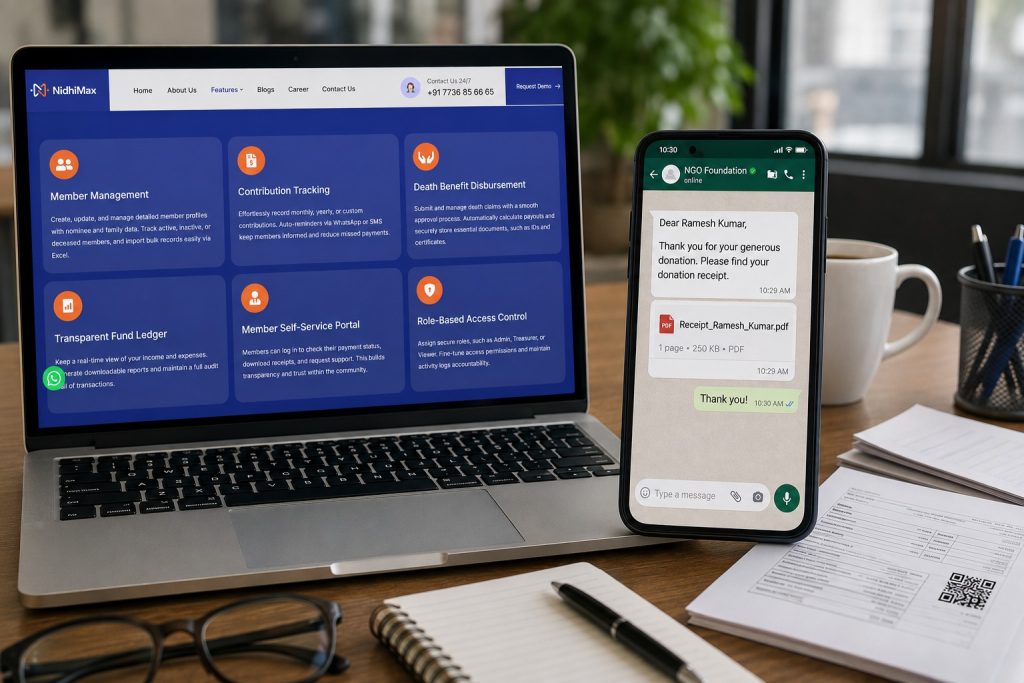
Thank you for your contribution and support. We appreciate your trust in our welfare work. Please find your donation receipt attached for your records.
If additional information is necessary, the organisation can provide it clearly without overwhelming the donor.
The purpose of the message is to acknowledge the contribution and help the donor understand what document is being shared.
Record That the Receipt Has Been Issued
After sending the receipt, the organisation should update its internal records according to its processes.
This can help answer important questions later:
- Has a receipt already been issued?
- When was it issued?
- Which contribution does it relate to?
- Which donor received it?
- Was the receipt resent or corrected?
- Is there a communication history connected to the contribution?
Without an organised process, staff and volunteers may repeatedly search through WhatsApp chats to answer these questions.
What Should a Donation Receipt Process Include?
A good donation receipt process should include more than generating a document. It should create a clear connection between the donor, contribution, receipt, and communication history.
A basic process may include the following stages:
Contribution Recording
The donation is recorded according to the organisation’s process.
Donor Identification
The contribution is connected with the available donor information.
Verification
Relevant details are checked before a receipt is issued.
Receipt Generation
The organisation prepares the receipt using the verified information.
Review
The relevant team checks that the correct document is ready.
Delivery
The receipt is sent through WhatsApp or another appropriate communication channel.
Record Update
The organisation records that the receipt has been issued or communicated.
Follow-Up
Any donor questions, corrections, or requests for another copy are handled through an organised process.
This approach becomes particularly useful when an organisation receives many contributions through different fundraising activities.
How Can WhatsApp Improve the Donor Receipt Experience?
WhatsApp can make the receipt experience more convenient by allowing charities to communicate with donors through a familiar messaging channel.
For a donor, the process can feel straightforward:
Make a Contribution → Receive Acknowledgement → Receive Receipt → Keep Document for Records → Stay Connected With the Organisation
A well-managed process can reduce unnecessary delays and repeated requests such as:
I made a donation but have not received my receipt.
or:
Could you please send my receipt again?
However, convenience should not come at the cost of organisation. The charity still needs a reliable method for tracking which receipts were created and sent.
A Realistic Example: Sending Receipts for an Education-Support Fundraiser
Imagine a community organisation running an education-support programme for children and raising funds for learning materials and related welfare activities.
The organisation receives contributions from several supporters after sharing details of the programme.
One donor sends a WhatsApp message confirming that they have made a contribution.
Instead of manually handling the process only through the chat, the organisation could follow a structured workflow:
- The contribution is checked against the organisation’s records.
- The donor’s available information is confirmed.
- The contribution is connected with the relevant fundraising activity.
- A receipt is prepared using the verified information.
- The receipt is reviewed.
- The organisation sends the document through its authorised WhatsApp communication process.
- The receipt status is recorded.
- The contribution remains connected to the wider organisational record.
Later, if the donor asks how the education-support initiative progressed, the organisation should ideally be able to connect the donor’s contribution with the broader welfare journey.
That journey may include:
Donors → Contributions → Funds → Welfare Projects → Beneficiaries → Outcomes → Reporting → Continued Support
This is why sending a receipt is not simply an isolated administrative task.
What Are the Common Challenges of Sending Donation Receipts Through WhatsApp?
Sending receipts manually through WhatsApp can become difficult when the number of donations and donor interactions increases.
Sending the Wrong Receipt
When multiple receipts are stored manually, there is a risk of attaching the wrong document.
A review process before sending can help reduce this risk.
Missing or Incorrect Donor Details
If donor information is incomplete or inconsistent, preparing the correct receipt may take longer.
Organised donor records can make the process easier.
Duplicate Receipts
Without a clear record of issued receipts, different team members may unknowingly issue or send the same receipt more than once.
Delayed Receipt Delivery
Manual processes can create backlogs, especially during fundraising campaigns, emergencies, or high-volume donation periods.
Difficulty Finding Old Receipts
A donor may contact the organisation months later and request another copy. If the receipt exists only in an old WhatsApp conversation or on an individual’s device, finding it can become difficult.
Dependence on Personal Phones
If important donor communications and documents are stored primarily on personal devices, continuity can become a challenge when staff or volunteer responsibilities change.
These issues do not necessarily mean WhatsApp should not be used. They show why the communication channel should be supported by organised charity management processes.
How Can Charities Avoid Mistakes When Sending Receipts?
Charities can reduce receipt errors by creating a simple checklist that staff or authorised volunteers follow before sending a document.
A practical pre-send check could include:
- Is this the correct donor?
- Is this the correct contribution?
- Are the contribution details accurate?
- Is the correct receipt attached?
- Has the receipt been reviewed according to the organisation’s process?
- Is the WhatsApp number correct?
- Has the organisation recorded that the receipt is being issued?
A consistent process is especially helpful when more than one person handles fundraising, donor communication, or administrative work.
Should a Charity Send Receipts Manually or Use Technology?
The right approach depends on the volume and complexity of the organisation’s operations. A small community initiative with occasional donations may manage receipts through a simple documented process, while a growing NGO may benefit from more structured digital workflows.
The important issue is not whether every step is manual or automated.
The important questions are:
- Can the organisation accurately identify each contribution?
- Can it connect the contribution with the correct donor?
- Can it generate and manage receipts consistently?
- Can authorised team members find the relevant records when needed?
- Can it avoid duplicate or incorrect communication?
- Can it maintain a clear record of the donor journey?
As operations grow, technology can help reduce repetitive administrative work and improve coordination between contribution records, donor management, communication, projects, and reporting.
How Can Technology Help Manage Donation Receipts?
Technology can help charities create a more connected process by reducing the separation between donor information, contribution records, receipt management, communication, and reporting.
Depending on an organisation’s actual needs and systems, a digital welfare-management approach can support better organisation of areas such as:
- Donor records
- Contribution tracking
- Receipt records
- Communication history
- Fundraising activities
- Welfare project information
- Operational coordination
- Reporting
- Accountability
The goal should not be to add technology for its own sake.
A useful system should reflect how the organisation actually works and help people spend less time searching for information across chats, spreadsheets, devices, and separate records.
Why Is Receipt Management Part of Transparency and Accountability?
Receipt management is connected to transparency and accountability because every contribution forms part of a larger organisational responsibility.
A donor may first interact with the charity through WhatsApp. The contribution is then received and recorded. A receipt acknowledges that transaction. But the organisation’s work continues beyond that point.
The broader journey is:
Donors → Contributions → Funds → Welfare Projects → Beneficiaries → Outcomes → Reporting → Continued Support
For example, a contribution may support an education initiative, healthcare assistance, food distribution, emergency relief, or another welfare project.
To manage this journey effectively, an organisation may need to coordinate information about:
- Donors
- Contributions
- Funds
- Welfare activities
- Beneficiaries
- Project progress
- Outcomes
- Reporting
This wider perspective is where the concept of Welfare Governance becomes relevant.
What Is Welfare Governance?
Welfare Governance is the structured management of an organisation’s welfare activities, resources, people, projects, beneficiaries, accountability, reporting, and impact.
For a charity, a donation receipt is one important point within this wider system.
The receipt connects to a contribution. The contribution connects to organisational resources and welfare activities. Those activities may support beneficiaries and produce outcomes that the organisation later monitors and reports on.
When these processes are disconnected, information can become difficult to manage.
A more organised welfare governance approach helps organisations think about the complete journey rather than treating fundraising, donor communication, project management, and reporting as entirely separate activities.
Best Practices for Sending Donation Receipts Through WhatsApp
Here are practical best practices for charities, NGOs, trusts, and community organisations.
Verify Before Sending
Check the contribution and donor information before generating or sharing the receipt.
Use a Consistent Receipt Process
Establish a standard process so authorised team members know what to do when a contribution is received.
Keep Records Outside the Chat
WhatsApp can be a useful communication channel, but important contribution and receipt records should not depend solely on chat histories.
Review Attachments Carefully
Confirm that the correct document is attached before pressing send.
Send Receipts Promptly After Verification
Avoid unnecessary delays while ensuring accuracy.
Maintain a Record of Issued Receipts
The organisation should be able to identify whether a receipt has already been issued for a recorded contribution.
Protect Donor Information
Charities should handle donor and contribution information responsibly and establish appropriate internal processes for access, communication, and record management.
Avoid Unsupported Statements
Receipt messages and donor communication should be based on accurate organisational information.
Connect Receipts With the Wider Donor Journey
Think beyond the individual document. A receipt is part of the relationship between the donor, contribution, welfare work, reporting, and continued support.
Building a More Organised Donation Receipt Process
Sending donation receipts through WhatsApp can be convenient for both charities and donors. But the most effective approach is not simply to generate a document and forward it through a chat.
A stronger process connects the receipt with the full contribution journey.
That means moving from:
Donation Received → Receipt Sent
to a more connected view:
Donor → Contribution → Verified Record → Receipt → Communication → Funds → Welfare Project → Beneficiaries → Outcomes → Reporting
When charities organise these connected processes, they can reduce administrative confusion and work toward better communication, transparency, accountability, and donor relationships.
Frequently Asked Questions
Can a charity send donation receipts through WhatsApp?
Yes. A charity can use WhatsApp as a communication channel to send a donation receipt or receipt document after verifying the contribution and following its own organised record-management process.
How do NGOs send donation receipts on WhatsApp?
An NGO can verify the contribution, prepare an accurate receipt, check the donor’s contact details, attach the correct document to a clear WhatsApp message, and record that the receipt has been issued.
What should a charity check before sending a donation receipt?
The organisation should check the donor information, contribution details, receipt accuracy, attached document, and relevant internal records before sending the receipt.
Should donation receipts be stored only in WhatsApp chats?
No. Important donation and receipt records should be maintained through an organised system or process rather than relying only on individual chat histories.
Can a donor ask for a receipt again through WhatsApp?
Yes. A donor can request another copy through WhatsApp, and the organisation can use its receipt records to locate and resend the relevant document through its established process.
How can charities avoid sending the wrong receipt?
Charities can reduce errors by verifying donor and contribution details, reviewing attachments before sending, using a consistent receipt process, and maintaining organised receipt records.
Why is a donation receipt important for donor management?
A receipt acknowledges a recorded contribution and forms part of the donor relationship. It can also help the organisation maintain clearer communication and contribution records.
How does technology help charities manage donation receipts?
Technology can help organise donor records, contribution tracking, receipt records, communication, and related reporting processes so information is less dependent on individual chats or manual searches.
How NidhiMax Can Help Build Better Welfare Governance
Sending a donation receipt through WhatsApp may appear to be a simple communication task. In practice, it connects to a much larger organisational process involving donors, contributions, records, welfare activities, reporting, and accountability.
As charitable operations grow, organisations may need a more connected way to manage this journey.
NidhiMax — Welfare Governance Platform is designed to help charitable organisations, NGOs, trusts, community organisations, and welfare institutions move toward a more organised digital welfare-management ecosystem.
Every organisation works differently. A small local community initiative may have simple donation processes, while a larger welfare organisation may need greater coordination across donors, contributions, projects, beneficiaries, communication, and reporting.
Technology should support those real processes.
For organisations exploring a more structured approach to contribution management, donor management, welfare coordination, transparency, accountability, and reporting, NidhiMax offers an opportunity to explore how these connected areas can form part of a broader Welfare Governance system.