 Post by
Running a charitable organisation is about much more than collecting donations.
A charity may begin with a simple mission: helping families in need, supporting education, providing medical assistance, feeding communities, supporting elderly people, or responding to emergencies. But as the organisation grows, managing donations, donors, beneficiaries, volunteers, projects, expenses, and communication can become increasingly difficult.
This is where technology can make a meaningful difference.
A well-designed digital system can help a charitable organisation move from manually managing welfare activities to professionally governing them.
And that is the difference between simply collecting funds and building a sustainable welfare organisation.
Why Is Fundraising Becoming More Difficult for Charities?
People are willing to support meaningful causes, but donors increasingly expect transparency, convenience, and communication.
A donor may want to know:
- Where did my contribution go?
- Who benefited from it?
- What impact did the organisation create?
- Can I receive updates about the project?
- Can I contribute again easily?
- Is there a proper system behind the organisation?
At the same time, charity administrators face their own challenges.
They may be managing donor information through spreadsheets, communicating through WhatsApp, maintaining receipts separately, tracking beneficiaries in notebooks, and preparing reports manually.
As the organisation grows, these disconnected processes can create confusion.
The solution is not simply more fundraising. The solution is better welfare governance.
How Can Technology Help a Charity Raise More Funds?
Technology can help a charitable organisation create a structured fundraising ecosystem.
Instead of treating every donation as an isolated transaction, an organisation can build a complete journey:
Supporter → Communication → Campaign → Contribution → Beneficiary → Impact → Report → Continued Support
For example, imagine a charity launching a campaign to provide educational support to 100 children.
A digital welfare system can help the organisation:
- Create the welfare project.
- Define the fundraising requirement.
- Communicate the campaign to supporters.
- Collect contributions.
- Record donor information.
- Track the funds allocated to the project.
- Record beneficiaries.
- Track project progress.
- Generate reports.
- Communicate the impact back to supporters.
This creates something much more valuable than a donation form.
It creates accountability and continuity.
Can WhatsApp Be Used for Charity Fundraising?
Yes.
For many community organisations, WhatsApp is already one of the most important communication channels.
A charity can use WhatsApp to:
- Announce fundraising campaigns
- Share project information
- Send contribution links
- Communicate with supporters
- Send reminders
- Share campaign updates
- Provide donation confirmations
- Send impact reports
- Reconnect with previous supporters
However, WhatsApp itself should not become the organisation’s entire management system.
A message may tell someone about a campaign, but the organisation still needs to know:
Who contributed?
Which campaign did they support?
How much was collected?
Which project received the funds?
Who were the beneficiaries?
What was the outcome?
That requires a structured system behind the communication layer.
How Can a Charity Build Donor Trust?
Fundraising is ultimately built on trust.
A person doesn’t simply donate because an organisation asks for money. They donate because they believe the organisation will use that contribution responsibly.
Therefore, modern charitable organisations should think beyond:
How much money did we collect?
They should also ask:
How effectively did we use the resources entrusted to us?
A strong welfare organisation should be able to connect:
Donor → Contribution → Project → Beneficiary → Outcome
This creates a traceable welfare journey.
Transparency does not necessarily mean exposing private information about beneficiaries or donors. It means having proper internal systems, documentation, reporting, and responsible communication.
What Should a Modern Charity Management System Include?
A complete system should go beyond donation collection.
Depending on the organisation’s size and mission, it may include:
- Donor Management
Maintain organised donor records, contribution history, communication records, and engagement information.
- Fundraising Management
Create campaigns, define goals, monitor contributions, and understand campaign performance.
- Beneficiary Management
Maintain structured records of individuals or communities receiving assistance.
- Welfare Project Management
Track individual projects from planning through execution and completion.
- Fund Allocation
Understand how resources are allocated across welfare initiatives.
- Communication
Maintain structured communication with donors, beneficiaries, volunteers, and other stakeholders.
- Reporting
Generate meaningful reports for internal management, trustees, donors, and other stakeholders.
- Transparency and Accountability
Create an internal system where decisions, contributions, projects, and welfare activities can be properly tracked.
- Impact Measurement
A mature organisation should eventually be able to answer:
How many people did we help?
What type of assistance was provided?
Where was it delivered?
What resources were used?
What changed because of the intervention?
Why a Charity Should Think Beyond Donation Software
A donation collection system solves only one part of the problem.
Imagine an organisation collecting ₹1 crore in contributions.
The real questions begin after the money is collected.
How is that ₹1 crore distributed?
Which projects received it?
Who approved the allocation?
Who received assistance?
What was the outcome?
How are beneficiaries followed up?
How is the organisation’s overall welfare impact measured?
This is why welfare governance is a broader concept than fundraising.
Fundraising is an activity.
Welfare governance is the system that connects the organisation’s people, funds, projects, beneficiaries, decisions, activities, and impact.
What Is a Welfare Governance Platform?
A welfare governance platform is a technology system designed to help an organisation manage and coordinate its welfare activities in a structured manner.
Instead of using separate tools for:
- donations,
- donor records,
- beneficiary records,
- projects,
- communication,
- reporting,
- and internal management,
the organisation can build a connected digital ecosystem.
This creates a single source of operational information.
The objective is simple:
Make welfare work more organised, transparent, measurable, and sustainable.
How NidhiMax Can Help Your Organisation
NidhiMax is built around this broader vision.
Rather than positioning itself only as a donation or fundraising application, NidhiMax is designed as a complete welfare governance platform for charitable organisations, NGOs, trusts, community organisations, and other welfare-focused institutions.
The idea is to bring the different parts of welfare administration into one connected ecosystem.
With NidhiMax, an organisation can work toward managing areas such as:
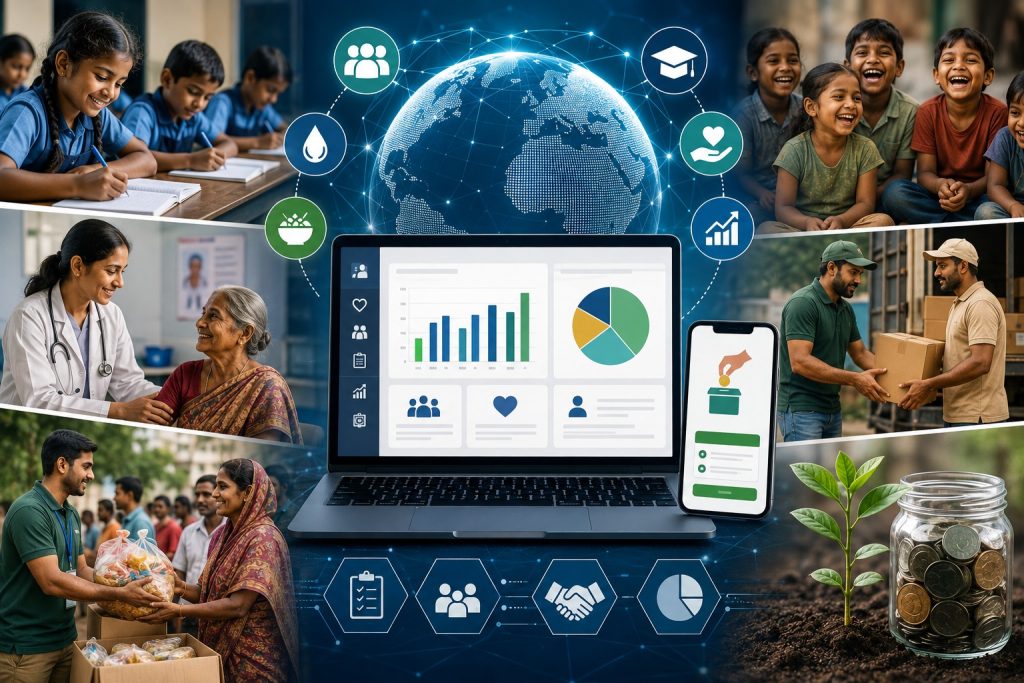
Fundraising → Donors → Contributions → Welfare Projects → Beneficiaries → Communication → Operations → Reporting → Impact
The exact requirements of every organisation are different.
A small community charity may need a simple system for managing donors and welfare projects.
A larger organisation may require multiple programs, teams, beneficiaries, locations, workflows, reporting structures, and governance processes.
Therefore, technology should adapt to the organisation’s mission—not force the organisation to change its mission to fit software.
- Your Charity May Be Unique. Your Technology Should Be Too.
- There is no single formula for welfare.
- One organisation may focus on education.
- Another may provide medical assistance.
- Another may support widows and elderly people.
- Another may respond to disasters.
- Another may manage community welfare programs.
- The technology required by each organisation can therefore be different.
- That is why NidhiMax takes a welfare-governance-first approach.
- The goal is not simply to give an organisation another dashboard.
The goal is to understand how the organisation works and help create a structured digital environment around its welfare mission.
Start With Your Mission, Then Build the System
If your organisation is currently managing donations through spreadsheets, communicating with donors through WhatsApp, maintaining beneficiary information manually, and preparing reports using multiple disconnected systems, you don’t necessarily need to change everything overnight.
Start by mapping your welfare process.
Ask:
- How do we receive contributions?
- How do we record donors?
- How do we identify beneficiaries?
- How do we approve welfare assistance?
- How do we allocate funds?
- How do we monitor projects?
- How do we communicate with stakeholders?
- How do we measure impact?
- How do we prepare reports?
- How do we maintain accountability?
Once these questions are mapped, technology can be designed around the organisation’s actual workflow.
Building the Future of Organised Welfare
Charitable organisations play an important role in society.
But good intentions alone are not enough when an organisation reaches scale.
The larger the organisation becomes, the more important systems, governance, transparency, data, accountability, and coordination become.
Technology should not replace the human side of charity.
It should strengthen it.
When administrators spend less time searching through spreadsheets and messages, they can spend more time focusing on people.
When donors receive better information, trust can grow.
When welfare projects are properly tracked, organisations can understand their impact better.
And when an organisation’s entire welfare ecosystem becomes connected, its ability to serve communities can grow with it.
Need Help Building Your Welfare Governance System?
Every charitable organisation has its own mission, structure, challenges, and way of working.
If you are looking to move beyond basic donation collection and build a complete digital welfare governance platform, the NidhiMax team can help you understand your requirements, map your welfare processes, and explore how technology can support your organisation’s long-term operations.
NidhiMax is built with a simple vision: to help organisations organise, govern, and scale their welfare activities through technology.
Your mission is to serve people.
Our role is to help you build the technology and governance foundation that can support that mission.
NidhiMax — Welfare Governance Platform.